In what season does golden osmanthus normally bloom and give off its fragrance?
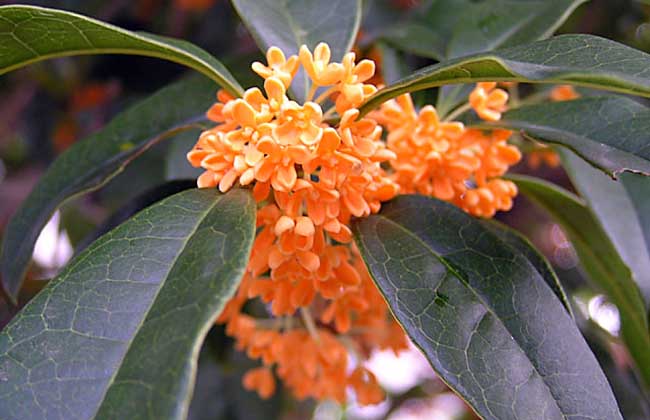
Golden osmanthus is a kind of osmanthus tree, an evergreen tree or shrub of the genus Osmanthus in the family Oleaceae. It is distributed in the northern subtropical deciduous and evergreen broad-leaved mixed forest zone of the Yangtze River basin and areas to its south. It is commonly used as a garden landscape tree species. Its flowers are a precious spice and are also used as a food flavoring. Now let us take a look at what season it is when golden osmanthus fragrance fills the air!
What season is it when golden osmanthus fragrance fills the air?
The season when golden osmanthus fragrance fills the air is autumn, around September to November on the solar calendar. "Golden osmanthus fragrance fills the air" refers to the golden osmanthus tree blooming, with its fragrance drifting ten li away; it is now used to describe something that is famous and known to everyone. At the same time, golden osmanthus blooms in September, which is autumn, so "the season when golden osmanthus fragrance fills the air" refers to autumn, and "golden osmanthus fragrance fills the air" symbolizes autumn.
How many years of cultivation does golden osmanthus need before it blooms?
The golden osmanthus variety is very special and currently cannot be obtained by sowing; it can only be grafted or propagated by cuttings, which determines when golden osmanthus blooms. Grafted golden osmanthus can generally bloom within one year, but most grafted golden osmanthus is used for potted plants and cannot be used as landscape trees. Golden osmanthus grown from cuttings can generally bloom at four years of age, and can be used both for potted plants and for landscape greening.
How to grow potted golden osmanthus
1. Watering: For potted golden osmanthus, follow the principle of not watering until the soil is dry, and watering thoroughly when you do water. However, spray the leaf surface once a day with clean water, evenly moistening all branches and leaves, until water droplets begin to drip down, so as to keep the leaves moist and wash away dust clinging to the leaves. After Qingming Festival, move the golden osmanthus outdoors and water it thoroughly once. In summer, water in the morning and evening; in winter, water around noon, so that the water temperature is close to the soil temperature and there is no sudden cold or heat. Be careful not to let water accumulate. In winter, just keep the potting soil moist.
2. Fertilizing: When golden osmanthus sprouts, apply nitrogen fertilizer 1 to 2 times to promote the growth of branches and leaves. Before flower bud differentiation and flowering, mainly apply phosphorus fertilizer. After moving the golden osmanthus outdoors in spring, begin watering with diluted fully decomposed soybean cake, sesame paste, fishy water, etc., once every half month. From the end of May until before flowering, water once a week, gradually increasing the fertilizer concentration. From July to August, apply a 0.5% potassium dihydrogen phosphate solution once every half month. After flowering, apply a light fertilizer solution once to avoid triggering autumn shoots. In winter, apply more organic fertilizer and phosphorus-potassium fertilizer. Before fertilizing, the potting soil should be slightly dry, and it is best to loosen the soil first so that the fertilizer is absorbed. Water once the next day.
3. Repotting: Potted golden osmanthus should be repotted and given new soil once every 2 to 3 years. Cut away part of the old roots and dead roots, and use a bamboo stick to remove part of the old soil. The soil mix for potted golden osmanthus is not very strict; usually garden soil, composted manure and river sand can each make up 1/3 of the mix. After planting in spring, water thoroughly, then move it to a shaded place for about 10 days so it can "settle in". During this settling-in period, do not fertilize. Only after it resumes growth and grows new leaves may you water and fertilize. As for the pot material, purple clay pottery pots or glazed pottery pots are best, and purple or ochre colors are better, as they can form a sharp contrast with the colors of the flowers and leaves and enhance the ornamental effect.
4. Pruning: For golden osmanthus shaping, it is best to create a curved-trunk style, slanting-trunk style or flowing style. Shaping generally adopts a combination of wire training and pruning. The main trunk can be trained into a curved-trunk or slanting-trunk form. It is best done in autumn. For plants that grow very tall with very bare lower branches and a poor tree shape, cut off all the branches at the top at the 2/3 or 3/4 point. For plants that are "top-heavy", cut away the overly dense upper branches and keep only the smaller lower branches. For plants with overly dense branches, thin them out. After flowering, do another round of branch training, cutting away water shoots, dead branches, diseased and pest-damaged branches, and dense, weak branches.
5. Overwintering: The room temperature should be kept at 0 to 5°C, and the relative humidity should be kept at 50 to 80%. In winter, the light in a cold room should be good, especially before the buds begin to sprout in early spring, when sufficient sunlight is even more necessary. In the spring of the following year, in North China, after Grain Rain (around Awakening of Insects in the Yellow River and Huai River basins), arrange for the potted golden osmanthus to be moved outside. After moving outside, first place them together in a wind-sheltered, sunny spot outdoors, and later spread them out in rows so they gradually adapt to the outdoor environment.
6. Diseases: Common diseases of golden osmanthus include leaf spot, sooty mold, algal leaf spot, root rot, iron deficiency, etc., and prevention and control should be carried out according to the disease situation. Leaf spot, sooty mold and algal leaf spot can be controlled by spraying 0.5 Bordeaux mixture or 5% carbendazim 500 to 1000 times solution. For root rot, attention should be paid to keeping the soil loose and breathable and avoiding water accumulation. If root rot is caused by fungi, amobam 200 to 300 times solution can be used to drench the roots.
7. Pests: Common pests of golden osmanthus include sawflies, whiteflies, mites, white peach scale, and yellow stinging caterpillars. Sawflies, whiteflies and mites can be killed by spraying 40% dimethoate 1500 to 3000 times solution. For white peach scale, in addition to manual brushing off, during the first and second instar nymph stages, 40% omethoate 1000 times solution or 40% fenitrothion 500 times solution can be sprayed to kill them.