How to Grow and Care for the Toad Plant (Stapelia)
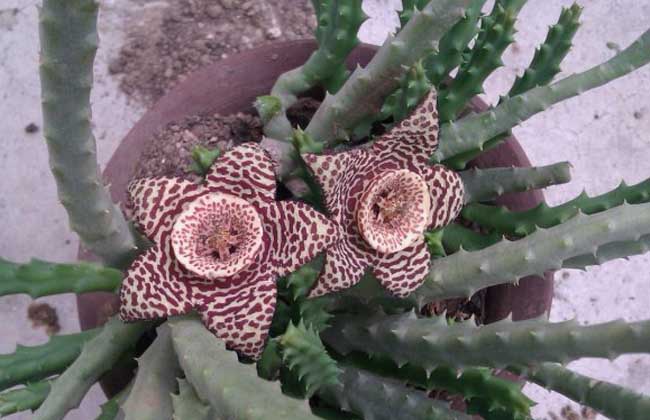
The toad plant (Stapelia) is a fairly ideal indoor ornamental flower, also known as Guozhang flower, Huiwen palm, sable flower, and so on. It is a perennial succulent herbaceous plant of the genus Stapelia in the family Apocynaceae, small and delicate, easy to propagate, highly adaptable, requiring only rough-and-ready care, with both stems and flowers being beautiful, and of extremely high ornamental value. Let us take a look below at how to grow the toad plant!
Growth Habits of the Toad Plant
The toad plant is native to tropical Africa, and is cultivated in parks (greenhouses) in North China. Its stems are bright green, growing in clusters of several plants together, about 10 cm tall, cactus-like in shape, with four ribs, the ribs slightly blunt, bearing thick, soft spines, smooth, green, and leafless. The flowers are solitary or in clusters of several, the follicles smooth, and the seeds bear white silky hairs at the tip. It likes warmth and sunshine, is especially drought-tolerant, and fears waterlogging and cold.
Propagation Methods for the Toad Plant
The toad plant is extremely easy to propagate by cuttings or division, and this can be done except during the hot, humid midsummer season. For cuttings, cut stem branches from the mother plant or separate clustered stems from the base, cut them into 5-6 cm long cuttings, place them in semi-shade, ventilated and dry for 1-2 days, and when the cut has scabbed over and the stem skin has shrunk inward, insert them into loose loamy soil, water sparingly and keep the temperature at 20-25°C; they will root in about 10-15 days, and once the roots are 3-4 cm long they can be potted up. Division is carried out in early spring, and after replanting the water supply must be appropriately restricted.
How to Grow the Toad Plant
1. Soil: The toad plant has low soil requirements; ordinary loam plus coarse sand or sandy soil is sufficient as a potting mix, and there is no need to add too much humus.
2. Temperature: During the growing season, the toad plant should be placed outdoors with plenty of light, avoiding the scorching sun. In winter it should be placed in a warm room or near a window sill with ample sunlight, and the nighttime room temperature should be kept above 5°C.
3. Fertilizing: The toad plant does not need heavy fertilizing; applying a thin liquid fertilizer once every 2 to 3 weeks is enough for it to grow well. If the potting soil is changed 2 to 3 times in summer and autumn, it will grow vigorously even without fertilizing.
4. Watering: The toad plant is not tolerant of wet conditions and should be kept from rain in summer; overwatering or water accumulating in the pot can easily cause root rot and death. Generally, water only when the weather is dry, the stems are slightly wilted, and the surface of the potting soil has turned white.
5. Toxicity: The toad plant belongs to the family Apocynaceae, and eight or nine out of ten plants in this family are toxic. If you grow it at home, there is nothing to worry about as long as you do not get the plant's sap into your mouth or onto your skin.