How to Grow and Make Purple String of Bananas (Othonna capensis) Thrive
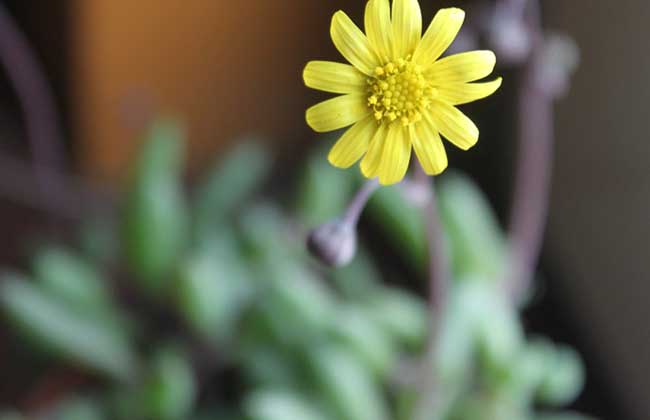
Othonna capensis, also known as 'Yellow Flowers New Moon', is a succulent in the Asteraceae family, genus Othonna, and is often mistaken for a Senecio. It is normally green, but with sufficient sunlight it turns from green to purplish-red. In autumn and winter it produces small yellow flowers in capitula with ray florets, which look very beautiful against its own purplish-red color. Let's take a look below at how to grow Othonna capensis so it fills out its pot!
The Ecological Habits of Othonna capensis
Othonna capensis has almost no dormant season, but watering should be reduced during the high temperatures of summer. If it lacks water, the leaves will wrinkle, and after watering they will plump up again the next day. In the early stage, rooting requires little water; as the stems increase, the root system becomes stronger and stronger, and once the roots are robust it will grow explosively like crazy. In the later stage it needs a lot of water, especially in spring and autumn; a large pot of Othonna capensis is basically watered every day.
Propagation Methods for Othonna capensis
Othonna capensis can be propagated by cuttings or leaf cuttings, and it grows extremely fast. Cutting propagation is very easy: just cut off a segment and insert it into the soil, water immediately, then wait for it to root. In the early stage of cutting, because the roots have not yet grown well, absorption is much poorer, so the leaves often appear wrinkled and thin. But don't worry, just observe its condition more; especially when you feel the soil inside the pot is almost dry, water generously at once. As long as you notice the leaves gradually plumping up, it means the roots are growing normally. The leaf color will also turn green in the early stage, and that's fine.
How to Grow Othonna capensis
1. Soil mix: When planting Othonna capensis, choose a deep pot as much as possible, which is good for root development. For the planting mix, choose a primarily granular substrate; you can use 4 parts akadama + parts kanuma + 2 parts peat. The choice of substrate can be flexible, but the principle is good drainage and aeration.
2. Fertilizing: Othonna capensis has almost no dormant season, but watering should be reduced during the high temperatures of summer. If it lacks water, the leaves will wrinkle, and after watering they will plump up again the next day. At the same time, a small amount of slow-release fertilizer can be applied during the growing process.
3. Light: Othonna capensis needs ample light during the growing season; with sufficient sunlight it turns from green to purplish-red. In summer, avoid scorching sun and pay attention to ventilation. During cultivation, pay attention to controlling light to avoid leggy growth caused by insufficient light.
4. Temperature: In winter, Othonna capensis needs protection from the cold. Keep the temperature above 5°C as much as possible, and preferably not below 0°C.