Crape Myrtle Bonsai: Production Methods and Care Techniques
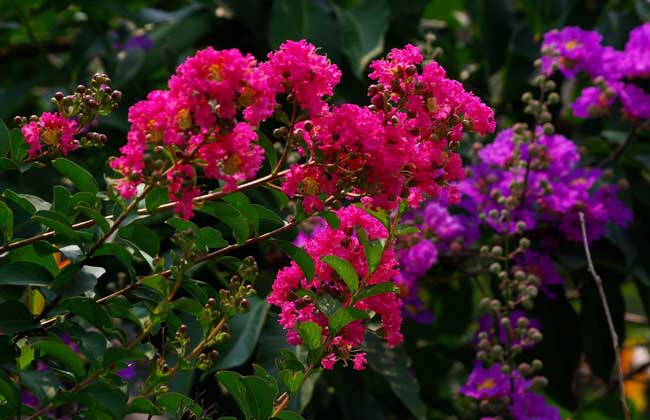
Crape myrtle (Lagerstroemia indica) is an excellent bonsai material for viewing flowers, trunks, and roots. Also known as Rujing'er Tree, Hundred-Day Red, Mantanghong, and Ticklish Tree, it is a deciduous shrub or small tree in the Lythraceae family, genus Lagerstroemia. With graceful tree posture, smooth and clean trunks, and brilliant flower colors, it has extremely high ornamental value. Let's take a look at crape myrtle bonsai production and care below!
Growth Habits of Crape Myrtle
Crape myrtle prefers warm and humid climates, likes light, is slightly shade-tolerant, likes fertilizer, and especially prefers deep, fertile sandy loam. It thrives in slightly moist locations, is also drought-tolerant, and dislikes waterlogging. It should not be planted in low-lying, wet areas with high groundwater levels. It likes warmth and can resist cold. It has strong sprouting ability and strong pollution resistance, with relatively strong resistance to sulfur dioxide, hydrogen fluoride, and chlorine gas. It is semi-shade tolerant, prefers fertile and moist soil, can also tolerate drought, and grows well in both calcareous and acidic soils.
Production of Crape Myrtle Bonsai
1. Grafting for variety change: Crape myrtle has a well-developed root system and is extremely prone to producing new roots after root cutting, making it easy to survive when potted. After obtaining a relatively ideal crape myrtle stump, you should first cut and prune according to the needs of bonsai styling. If the stump has a good root system, it can be directly potted and cultivated to grow thicker branches, which facilitates grafting survival. This is generally done before spring bud break, but in practice, different grafting methods can be used, and grafting can be done in all four seasons. Multiple supplementary grafts can be made based on grafting survival conditions.
2. Collection from the wild: The collection time for crape myrtle is generally from early October to before early spring bud break, and cold seasons and dry windy weather should be avoided as much as possible. When collecting, first select old stumps with thick, twisted, and unusual rhizomes or hollowed-out trunks resembling wrinkled, perforated, or leaky bizarre rocks. After digging up, plant them directly in pots, or plant them in moist, fertile, loose, and breathable soil for cultivation. Wait until the root system recovers and branches and leaves are lush before moving them into pots.
3. Potting: When potting a crape myrtle bonsai, arrange the stump landscape according to the shape of the crape myrtle bonsai stump and future styling needs. Then pour the prepared loose, fertile humus loam around the inside of the pot so that the root system and soil are compacted together. Water thoroughly to settle the roots, and place in a wind-protected, shaded area for care. Normally, water should be sprayed on the branches and trunk frequently to maintain moisture and prevent the trunk from drying out. After budding, move to a sunny location for normal care.
Care of Crape Myrtle Bonsai
1. Reasonable watering: In the early stage of branch and leaf growth, the amount of watering should be appropriately controlled to manage branch and leaf growth of the crape myrtle bonsai. This way, branches are thick and leaves are small, avoiding large leaves and sparse nodes that seriously affect tree shape control. After flower buds appear and during the flowering period, watering should be sufficient. In summer during high-temperature and drought seasons, the amount of watering should be increased, and water should frequently be sprayed on the canopy and leaf surfaces to increase air humidity. In winter, watering should be reduced, keeping the pot soil slightly dry.
2. Timely fertilizing: Crape myrtle bonsai should mainly receive sufficient base fertilizer in winter. During the growing season, apply cake liquid fertilizer and other phosphorus-potassium-free chemical fertilizers about once a week. Before and after flower bud appearance, a 0.2% potassium dihydrogen phosphate solution can be used for foliar spraying to promote flower bud differentiation and flower bud enlargement. After each flowering, sufficient base fertilizer should be applied. Especially for crape myrtle bonsai that have already taken shape, when flowering 2 to 3 times in the same year, it is particularly important to apply sufficient base fertilizer in combination with pruning and shaping. Otherwise, there will be branches but no flowers, or sparse flowers with dull colors, failing to achieve the best ornamental effect.
3. Repotting and soil changing: Crape myrtle bonsai should be repotted and have its soil changed every 2 to 3 years based on its growth vigor. Repotting and soil changing can be done in both winter and spring. According to the needs of the crape myrtle tree shape, replace the pot in a timely manner. Remove all or part of the old soil. After the stump is taken out of the pot, remove the surrounding soil and some decayed roots, thick roots, long roots, and overly dense roots. Plant the specimen into the pot, add cultivation soil, press firmly, and water thoroughly. The cultivation soil must be rich in organic matter, have good drainage and breathability, and sufficient fertility to ensure abundant flowers and lush leaves.
4. Shaping and pruning: For the shaping and pruning of crape myrtle bonsai, after leaf drop, according to bonsai styling needs, ordinary branches should be heavily pruned by leaving 1 to 2 buds per branch. During the growing season, pruning mainly involves removing overly dense branches, water sprouts that disrupt the tree shape, and branches sprouting from the base trunk that have no useful value. All of these should be removed or cut off in a timely manner.
5. Removing spent flowers: To make crape myrtle bonsai bloom multiple times and bloom well within a year, spent flowers should be removed promptly after each flowering to prevent fruiting and promote rapid enlargement of secondary flower buds, resulting in multiple bloom cycles. However, the flowering periods vary and are not uniform enough. In addition, if there are not many secondary flower buds after flowering, leave 1 to 2 buds per branch for heavy pruning. Generally, flower buds appear in 14 days, and in about 35 days the tree can be full of flowers. This can make the branches of the crape myrtle bonsai thicker and shorter (average branch length within 15 cm), with a very compact tree shape, abundant flowers, and brilliant colors, pleasing to the eye.
Pest and Disease Control of Crape Myrtle
1. Powdery mildew
[Symptoms] Powdery mildew mainly harms leaves, and young leaves are more easily infected than old leaves. The disease also harms branches, young shoots, flower buds, and flower buds. In the early stage of the disease, small white powdery spots appear on the leaves. After expanding, they become circular or irregular discolored patches. After flowers are infected, their surfaces are covered with a white powdery layer, and the flower spikes become deformed, losing ornamental value. Plants affected by powdery mildew become stunted, with young leaves twisted, deformed, and withered, leaves failing to expand and becoming smaller, and branches deformed. In severe cases, the entire plant may die.
[Control] ① Strengthen fertilization and pay attention to drainage to avoid excessive humidity. Reduce infection sources by combining autumn and winter pruning, removing diseased and dead branches and burning them in a centralized manner. During the growing season, promptly remove diseased buds, diseased leaves, and diseased shoots. When plants develop the disease, spray 25% triadimefon wettable powder at 3000 times dilution, or 70% thiophanate-methyl wettable powder at 1000 times dilution, or 80% zineb wettable powder at 500 times dilution. Alternating these chemicals gives better results.
2. Brown spot disease
[Symptoms] Crape myrtle brown spot disease mainly harms leaves. Leaf spots are circular or nearly circular, with some irregular, purple-brown to gray-brown, with lighter, indistinct edges, and gray-black small mold spots on both sides. After several spots appear on the leaf surface, the entire leaf quickly turns yellow and drops prematurely. High temperatures, high humidity, and frequent rainfall favor the occurrence of this disease.
[Control] Carry out autumn plowing in crape myrtle gardens or street crape myrtle plantings, turning surface fallen leaves into deeper soil to reduce the primary infection source for the following year. Prune in a timely manner to allow ventilation and light penetration. In the early stage of the disease, promptly spray 50% benomyl wettable powder at 1000 times dilution, or 75% chlorothalonil wettable powder at 800 times dilution.
3. Crape myrtle aphid
[Symptoms] Damage by the crape myrtle aphid occurs every year. The undersides of young leaves are often covered with pests. After damage, new shoots become twisted, young leaves curl and become uneven, affecting flower bud formation and shortening flower spikes, or even producing no flowers. At the same time, it can induce sooty mold and spread viral diseases.
[Control] In winter, combine pruning to remove diseased and pest-infested branches, weak branches, and overly dense branches, which can help eliminate some overwintering eggs. For household potted plants, try to keep branches and trunks clean, pay attention to removing cracked bark at branch forks, and burn them in a centralized manner to reduce overwintering aphid eggs. For chemical control, spray 10% imidacloprid wettable powder at 1500 times dilution, or 50% fenitrothion emulsifiable concentrate at 1000 times dilution, 40% omethoate emulsifiable concentrate at 1000 times dilution, and 80% dichlorvos emulsifiable concentrate at 1000 times dilution, etc. At the same time, this can also control pests such as crape myrtle felt scale.
4. Felt scale
[Symptoms] Female adults and nymphs of felt scale suck sap on bud axils, leaves, and branches, often causing weakened tree vigor and poor growth. In addition, the large amount of honeydew they secrete can induce severe sooty mold, causing leaves and small branches to turn black and lose ornamental value. It is one of the main pests harming crape myrtle.
[Control] Strengthen quarantine to prevent the introduction of pathogens, fertilize reasonably to enhance plant pest resistance, maintain ventilation and light penetration, avoid excessive plant density, and combine winter and early spring pruning to burn infested branches in a centralized manner. When pest numbers are low, manual scraping can be carried out. In winter, spray 10-15 times diluted resin soap or 40-50 times diluted machine oil emulsion 1-3 times to kill overwintering female adults. Before bud break, spray 3-5 degrees Baumé lime sulfur mixture or 3-5% diesel emulsion to kill overwintering nymphs.
5. Sawfly
[Symptoms] Sawfly larvae feed in groups, consuming leaves and chewing leaf flesh, eating all young leaves of the plant and leaving only a few main veins. This affects photosynthesis, affects the flowering period of crape myrtle, reduces its ornamental value, and may even lead to death.
[Control] In winter and spring, combine soil plowing to eliminate overwintering cocoons. Look for egg-laying shoots and leaves, and manually remove egg-bearing shoots, egg-bearing leaves, or larvae that are still clustered after hatching. During the larval damage period, spray Bt. emulsion at 500 times dilution, 2.5% deltamethrin emulsifiable concentrate at 3000 times dilution, 20% fenvalerate at 2000 times dilution, or 25% chlorbenzuron No. 3 suspension concentrate at 1500 times dilution.
6. Yellow slug moth
[Symptoms] The yellow slug moth mainly causes damage by larval feeding.
[Control] Physical control mainly involves winter pruning to remove overwintering cocoons on branches, thereby eliminating or reducing pest sources. For chemical control, it is best to apply pesticide before the larvae spread. Spray 80% dichlorvos emulsifiable concentrate at 1000 times dilution or 2.5% deltamethrin emulsifiable concentrate at 2000 times dilution.