What are the cultivation methods for the crown of thorns plant?
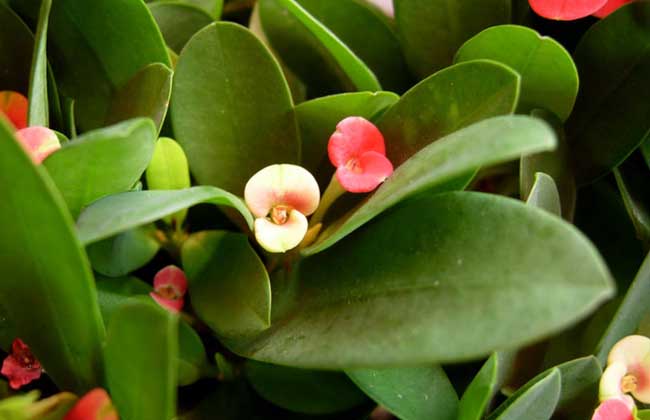
The crown of thorns plant, also known as iron begonia, crown of thorns spurge, and tiger thorn plum, is a sprawling shrub in the genus Euphorbia of the family Euphorbiaceae. It is native to Madagascar in Africa and is widely cultivated in the tropics and temperate zones of the Old World. It is grown in both northern and southern China, commonly seen in parks, botanical gardens, and courtyards, and is very popular as a potted plant. Let's take a look at the cultivation methods for the crown of thorns plant!
Growth habits of the crown of thorns plant
The crown of thorns plant can bloom all year round, with peak flowering during the summer and autumn rainy seasons. Its flower shape is unusual - the red petals you see are actually bracts, resembling a pair of big red lips, and the small yellow or orange-red flowers between the red lips are the true flowers. It prefers a warm, humid environment with plenty of sunlight, is slightly shade-tolerant, but fears high temperatures. It is relatively drought-tolerant and not cold-hardy. A loose, well-draining leaf mold soil is best. If winter temperatures are low, it may enter a short period of dormancy.
Propagation methods for the crown of thorns plant
The crown of thorns plant is mainly propagated by cuttings. Cuttings can be taken throughout the growing season, but May to June is best, giving a high survival rate and the easiest rooting. Select thick, sturdy branches about 10 cm to 15 cm long (with 3 to 4 leaf nodes), wipe away the white sap flowing from the cut, coat with plant ash, and let dry in a shaded place for 2 to 3 days. After the wound has dried, insert into plain sand and water thoroughly. Water sparingly afterward, only watering again when the potting soil is slightly dry. Roots will form after about 50 to 60 days.
Cultivation methods for the crown of thorns plant
1. Soil: For potting the crown of thorns plant, you can choose one of the following substrates: garden soil : cinder = 3:1, or garden soil : medium-coarse river sand : sawdust = 4:1:2, or one of paddy soil, pond mud, or leaf mold, or peat + perlite + ceramsite = 2 parts + 2 parts + 1 part, garden soil + cinder = 3 parts + 1 part, peat + cinder + ceramsite = 2 parts + 2 parts + 1 part, sawdust + vermiculite + medium-coarse river sand = 2 parts + 2 parts + 1 part. After potting, water thoroughly once and keep in a slightly shaded environment for one week.
2. Watering: The crown of thorns plant is a succulent and is drought-tolerant, so it should not be watered too much. If the potting soil stays too wet for a long time, it will not only cause root rot but also endanger the plant's survival. Therefore, regular watering should be done when the potting soil is slightly dry. In summer, water evaporates quickly, so watering should be appropriately increased, but water must not accumulate in the pot. Overwatering during the flowering period will cause flowers and buds to drop, and may even cause root rot.
3. Fertilizing: The crown of thorns plant should be fertilized sparingly, with a light fertilizer applied 2 to 3 times each spring. Fertilizing can be reduced in autumn. The crown of thorns plant does not like heavy fertilizer. During the growing season, applying diluted, well-rotted cake fertilizer water once every 3 to 4 weeks is sufficient. Over-fertilizing, especially with too much nitrogen, causes branches to grow excessively, producing only leaves and no flowers. Applying phosphorus and potassium fertilizer 1 to 2 times during the bud stage will result in more flowers and brighter colors.
4. Light: The crown of thorns plant likes plenty of sunlight and should be given relatively abundant light throughout all four seasons. During the flowering period, sufficient sunlight results in brightly colored bracts and a longer flowering period, while insufficient sunlight makes the flower colors dull. If kept in shaded conditions for a long time, it will not bloom or will bloom very little. The crown of thorns plant likes warmth and is not cold-hardy. In northern China, it is generally moved outdoors in early May and placed in a sunny spot, then moved back indoors in early October and placed in a spot with sunlight indoors.
5. Temperature: If the room temperature is low during the winter, the leaves of the crown of thorns plant will completely drop and it will enter a semi-dormant state. At this time, watering must be strictly controlled and the potting soil kept dry. When the temperature drops below 0°C, the plant will die from frost damage. If the indoor temperature can be kept above 15°C in winter, it will bloom continuously throughout the winter. The crown of thorns plant is very suitable as an indoor flower for autumn and winter in northern China.
6. Pruning: The crown of thorns plant blooms at the tips of new branches. To make it bloom more, proper pruning is necessary. Because if the main branches are too long, there will be fewer flowers. Therefore, after the flowering period, cut back the overly long and irregularly growing branches. Generally, 2 new branches will grow below the cut. When the new branches reach 5 to 6 cm, they can bloom. Prune once a year, and after a few years, the entire plant will be covered with bright little red flowers.
7. Pests and diseases: During the rainy season, with lots of rain, high air humidity, and an unclean potting soil surface, the crown of thorns plant is prone to root rot and stem rot. Root rot can be treated by drenching the roots with root rot remedy, and stem rot can be treated by spraying the stems with agricultural streptomycin or Rhizolex, once every half month. The main pests of the crown of thorns plant are whiteflies and scale insects. Whiteflies can be controlled by spraying with imidacloprid or acetamiprid, or by spraying with a 1500-fold dilution of 50% fenitrothion emulsifiable concentrate. Scale insects can simply be picked off by hand.