Columbine Planting Methods and Precautions
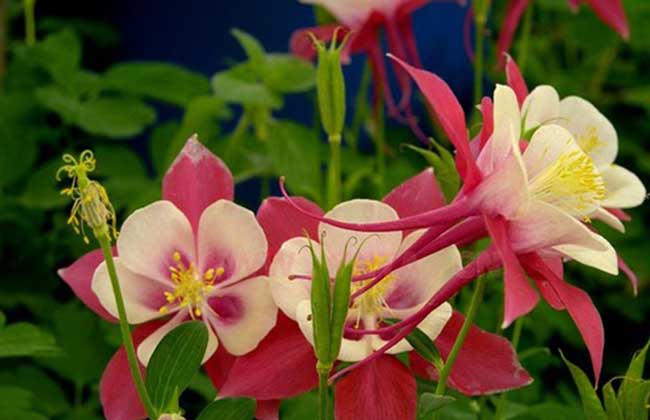
Columbine, also known as cat's claw flower, is a perennial herbaceous plant of the genus Aquilegia in the buttercup family (Ranunculaceae), native to Europe and North America. Its flowers are delicate and charming, with bright colors and strong adaptability. It is suitable for planting in patches on lawns and under dense forests, and also suitable for use as ground cover in wet places such as low-lying areas and stream sides, with high ornamental value. Let's take a look at the planting methods of columbine below!
Growth Habits of Columbine
The roots of columbine are thick, cylindrical, up to 1.5 cm in diameter, simple or with a few branches, with dark brown outer skin. The leaves are basal, glossy on the surface and downy on the underside. It blooms in June and July, usually in deep blue-purple or white. It often grows by roadsides, riversides or on moist grasslands in mountainous areas at altitudes of 200 to 2300 m. It prefers a cool climate, avoids high temperatures and scorching sun in summer, is robust and cold-hardy, and likes moist, well-drained sandy loam rich in humus.
Propagation Methods of Columbine
1. Sowing: Columbine is best sown in pots immediately after the seeds mature. To adjust the dormancy period of columbine, sow immediately after seed collection. Apply sufficient base fertilizer, rake fine and level, prepare the seedbed, water thoroughly, spread the seeds evenly on the seedbed, and cover with a soil mixture to the extent that the seeds are no longer visible. Keep the seedbed surface moist; excessive moisture will cause seed rot. Seedlings emerge in 140 days.
2. Division: Columbine division is carried out in August to September. First cut off the branches and leaves on the upper part of the plant, keeping the lower sprouts with growing points, then dig up the plant, shake off the soil, and plant by naturally separating along the main roots. If the main root is aged, it should be removed, making sure the base of the sprout carries part of the root crown, then insert it in a sand bed. After rooting, plant it separately. Divided seedlings can bloom the following year.
Columbine Planting Methods
1. Potting up: 5 to 6 weeks after columbine sprouts, it can be transplanted using plug trays with a diameter of 3 to 4 cm. After another 5 to 6 weeks, blue columbine can be transplanted into pots of 10 to 15 cm, fan columbine into pots of 7 to 11 cm, and hybrid columbine into pots of 11 to 16 cm. Two transplants are beneficial to plant quality.
2. Medium: The growing medium for columbine needs good drainage. The soil content in the medium should be about 15%, with about 15% organic matter (such as wood fiber, bark) added. Apply 1 to 1.5 kg of complete balanced fertilizer per cubic meter of medium, plus 1 to 2 kg of slow-release fertilizer, iron chelate, and micronutrients. The pH value should be 5.5 to 6.2.
3. Light: Columbine is a long-day plant. Maintain a high light level. Potted varieties need supplemental lighting in both winter and spring, which helps improve plant quality. In mid-January, it needs to grow under long-day (16 hours) and continuous supplemental lighting (30000 to 40000 lux) conditions, with the temperature maintained at 12°C.
4. Temperature: The optimum growing temperature for columbine is 14°C to 16°C. After the roots have formed, lower the temperature to 8°C to 10°C. Temperature changes can improve plant quality. In spring, seedlings begin to grow at 15°C to 18°C for 6 to 7 weeks. A temperature of 10°C to 12°C will extend the cultivation time. Avoid high temperatures and low-light conditions.
5. Fertilization: Columbine has moderate fertilizer requirements. It can be sprayed with a nitrogen-potassium balanced fertilizer at a concentration of 130 ppm to 150 ppm once a week. Avoid high ammonium and high nitrogen levels. No fertilization after mid-September. Blue columbine and fan columbine can begin spraying 100 ppm to 150 ppm of complete balanced nitrogen fertilizer in spring, while hybrid columbine can begin spraying 100 ppm to 150 ppm of nitrogen-potassium balanced nitrogen fertilizer in spring.
Pest and Disease Control of Columbine
1. Mosaic disease
[Symptoms] The whole plant is affected, with leaves showing mosaic symptoms, and the leaf surface becoming wrinkled and deformed.
[Control] Strengthen cultivation management, fertilize scientifically, apply more organic fertilizer, use more compound fertilizer, increase phosphorus and potassium fertilizer, avoid partial application of nitrogen fertilizer, so as to improve the nutritional conditions of the plant and enhance its virus resistance. Loosening the soil is beneficial to the development of the plant's root system. Remove weeds in the field in time, eliminate sources of infection, control aphids early, and eliminate the virus transmission vector.
2. Powdery mildew
[Symptoms] The disease occurs on the leaves, initially forming small powdery spots, which then enlarge. In severe cases, the entire leaf surface is covered by a powdery substance.
[Control] At the early stage of the disease, you can choose 15% triadimefon wettable powder at 1500 times dilution, or 20% triadimefon emulsifiable concentrate at 2000 times dilution, or 50% sulfur-mixed suspension at 300 times dilution, or 50% thiophanate-methyl wettable powder at 800 times dilution and 75% chlorothalonil wettable powder at 600 times dilution, etc., spraying once every 7 to 10 days, for 2 to 3 consecutive sprays. At the early stage of the disease, you can also use 2% antimycin 120 aqueous solution or BO-10 aqueous solution, applying 500 ml per mu each time, adding 100 liters of water (effective concentration 100 ppm) for spraying, once every 10 days, for 3 to 4 sprays.