How to grow Gymnocalycium mihanovichii 'Hibotan' well? A detailed guide to cultivation methods
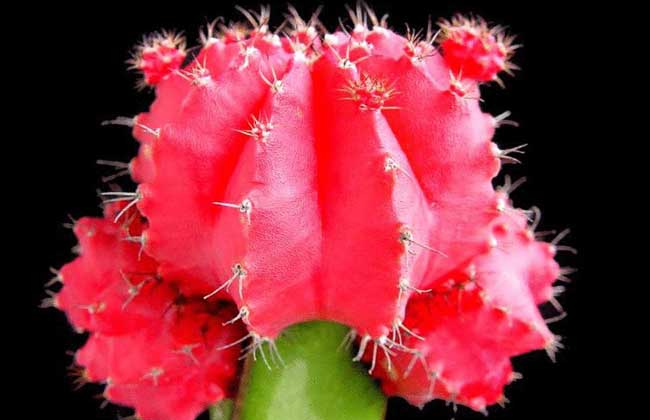
Gymnocalycium mihanovichii 'Hibotan' is one of the main cultivated varieties of cactus-type plants, also known as Red Lantern, Red Peony, and so on. It is a variegated mutant of the Gymnocalycium mihanovichii variant 'Hibotan' of the genus Gymnocalycium in the family Cactaceae, with its origin in South America. Its ball-shaped body keeps its color through all four seasons, and when placed on a balcony it has a decorative effect of "a spot of red among a sea of green" during the flowerless winter. Let us take a look below at how to grow Gymnocalycium mihanovichii 'Hibotan' well!
Growth habits of Gymnocalycium mihanovichii 'Hibotan'
Gymnocalycium mihanovichii 'Hibotan' likes a sunny and warm environment; the more sun the ball-shaped body gets, the more vivid its color, while plants grown in shady places have dull, lusterless color. However, in the hot summer it still needs appropriate shading to prevent intense sunlight from scorching the body, and ventilation should be strengthened. When the air is dry, water should also be sprayed on the plant to prevent red spider mite damage caused by high temperature, dryness and poor ventilation. During the growing period, apply a diluted, well-rotted liquid fertilizer once every 10 to 15 days, and water so that the soil is thoroughly soaked once it has dried out, avoiding long-term waterlogging of the potting soil that causes rootstock rot, and provide appropriate air humidity so that the body's color stays fresh and moist. In winter, keep it indoors in a place with ample light, stop fertilizing, control watering, and maintain a room temperature above 8°C.
Propagation methods of Gymnocalycium mihanovichii 'Hibotan'
Because the ball-shaped body itself has no chlorophyll and cannot carry out photosynthesis to manufacture nutrients, Gymnocalycium mihanovichii 'Hibotan' must be grafted and rely on the rootstock to provide nutrition in order to grow normally. Common rootstocks are Hylocereus undatus, thick flat-padded cacti and Pereskia aculeata and other robust cactus plants. Grafting can be done all year round in a greenhouse, but the success rate is highest in late spring and early summer. The flat graft is generally used, while the cleft graft is used when Pereskia aculeata is the rootstock. To propagate the crested form of Gymnocalycium mihanovichii 'Hibotan', the flat fan-shaped plant can be cut into small pieces, each with a bit of growing point, and then grafted. To propagate the 'Dragon Phoenix' form, twisted abnormal stems can be cut off for grafting; the small red ball on top cannot be used alone for grafting, and moreover it would only grow into a ball-shaped Gymnocalycium mihanovichii 'Hibotan', not into the twisted, variegated abnormal stem that resembles a swimming dragon.
How to grow Gymnocalycium mihanovichii 'Hibotan' well?
1. Soil: For the potting mix of Gymnocalycium mihanovichii 'Hibotan', it is best to use grass peat, peat and Clivia soil mixed with a small amount of perlite, with a pH that should be slightly acidic to neutral, ideally pH 6.0 to 6.5. When potting, do not place broken pot tiles at the bottom of the pot; instead, place a small amount of ceramsite.
2. Temperature: The suitable growing temperature for Gymnocalycium mihanovichii 'Hibotan' is 2 to 15°C. When the potting soil is dry, it can tolerate a high temperature of 40°C and a low temperature of 2°C.
3. Humidity: Gymnocalycium mihanovichii 'Hibotan' requires 60 to 75%. In winter, if the indoor temperature is low, it should be kept relatively dry.
4. Light: During cultivation, Gymnocalycium mihanovichii 'Hibotan' should have ample light except in the hottest summer season.
5. Water: During cultivation, Gymnocalycium mihanovichii 'Hibotan' should be watered timely except in winter, generally maintaining moderate moisture or slightly on the dry side.
6. Pests and diseases: Gymnocalycium mihanovichii 'Hibotan' often suffers from stem rot and gray mold, which can be sprayed with a 2500-fold dilution of 50% carbendazim wettable powder. When temperature and humidity are high and ventilation is poor, red spider mite damage is severe; spray with a 1000-fold dilution of 40% dimethoate emulsifiable concentrate to kill them.
Four-season care of Gymnocalycium mihanovichii 'Hibotan'
1. Spring: When the spring temperature steadily reaches 10°C, repot, once a year. After repotting and re-establishing, move it to a place with ample light for growing; with insufficient light, the lower part of the body turns green, while under direct light it becomes redder the more it is exposed. Spring is its peak growing season, so attention should be paid to water supply, but the soil must not be too wet; it is best to water after the soil has dried out. On days with more rain, reduce the frequency of watering.
2. Summer: When the summer temperature is hot, it should be placed in a spot with morning and evening light for growing, maintaining an ample water supply, but watering should alternate between dry and wet; at the same time, spray water around it several times a day and strengthen ventilation to lower the temperature. After the temperature cools at the end of summer, move it to a place with ample light for growing.
3. Autumn: In autumn, Gymnocalycium mihanovichii 'Hibotan' should be placed in a spot with ample light and no rain for growing, and it is best to water when the soil looks dry. As the weather gradually turns cooler, the amount of watering can be gradually reduced to keep the potting soil on the dry side, until dormancy. When the outdoor temperature drops to around 10°C, it should be moved promptly into a closed, light-filled balcony or room for growing.
4. Winter: Gymnocalycium mihanovichii 'Hibotan' is not cold-tolerant; in winter the indoor temperature should be kept above 8°C, and ideally maintained at around 0°C. Potted plants should be placed on a windowsill or balcony with ample light for growing, with attention paid to controlling water so that the potting soil stays on the dry side; the lower the temperature, the drier the potting soil should be.