How to Grow Calliandra? Detailed Guide to Cultivation Methods
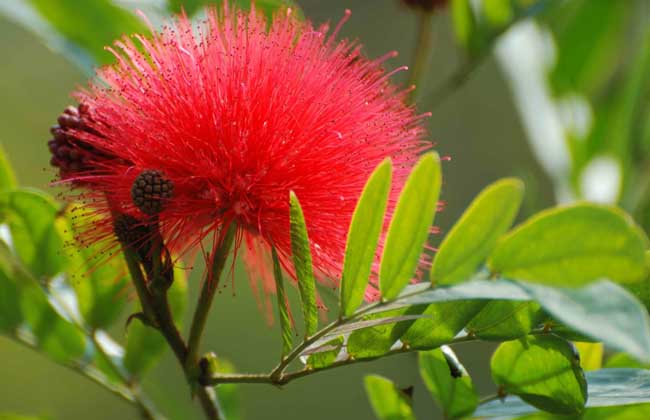
Calliandra is an excellent flowering ornamental tree species, also known as red powderpuff, American powderpuff, red pom-pom, etc. It is a deciduous shrub or small tree of the genus Calliandra in the Fabaceae family, with extremely beautiful flowers. It is native to South America and is now commonly cultivated in tropical and subtropical regions. It has been introduced and cultivated for ornamental purposes in Taiwan, China, Fujian and Guangdong in China. Let us take a look at the cultivation methods for Calliandra!
Growth Habits of Calliandra
Calliandra is a tropical flowering plant with spreading branches and brown, rough twigs. Its stipules are ovate-lanceolate, the head-shaped inflorescences are axillary, the calyx is green, the corolla is pale purplish-red, the pods are linear-oblanceolate, and the seeds are oblong. The flowering period is from August to September, and the fruiting period is from October to November. It prefers light and a warm, humid climate, is not cold-tolerant, and is suitable for growing in deep, fertile, well-drained acidic soil.
Propagation Methods for Calliandra
1. Cuttings: Calliandra is generally propagated by cuttings. In spring, strong branches 20 cm long can be cut for cuttings, and the cutting bed temperature must be maintained at 15-28°C. For cuttings, 1-2 year old branches that are not yet aged but have substantial tissue should be selected, each segment about 15-500 p-xylene, and inserted into a moist sand bed. Either shading or full-light misting can be used.
2. Sowing: Calliandra seeds are collected in October and stored dry until sowing in the following spring. Before sowing, soak the seeds in 60°C hot water, changing the water once a day. On the third day, remove them and keep them moist for germination for 1 week. They sprout 5-7 days after sowing. During the seedling period, prune side branches in time to ensure the main trunk grows straight. Transplanting is best done before the buds sprout, but when transplanting large trees, supports should be set up to prevent them from being blown over by wind.
Cultivation Methods for Calliandra
1. Potted cultivation: For home potting, garden soil mixed with some river sand should be used as the potting medium, and the plant should be placed on a south-facing balcony for growing and viewing. The optimum growth temperature is 23°C to 30°C. During overwintering, keep the temperature at 15°C to 18°C and shelter from wind, which can reduce leaf drop. Normally, water when the top 1 cm of the potting soil is dry. In winter, water when half of the potting soil is dry. Apply a compound fertilizer once a month from spring to autumn.
2. Water and fertilizer: Young Calliandra plants need more water, and attention should be paid to irrigation during the growing season. Potted plants are more prone to drought and water shortage, with leaves appearing wilted, so attention should be paid to replenishing water. For fertilization, natural organic fertilizer or compound fertilizer can be used, applied once a month. During the flowering period, apply more phosphorus and potassium fertilizer. The cultivation site needs sufficient sunlight; flowering is poor in shaded places.
3. Pruning: When the main trunk of a young Calliandra tree reaches more than 2 m in height, trunk-setting pruning can be carried out. Select 3 side branches staggered above and below as the main branches, and use them to expand the crown. In winter, cut back the 3 main branches, and cultivate several side branches on each main branch, mutually staggered in distribution, each occupying a certain space. When the crown expands too far and the lower part becomes bare, timely retract and renew the head, and prune dead branches.
4. Pests and diseases: The main disease of Calliandra is canker, which can be sprayed with 50% Tuzet wettable powder at 800 times dilution. The pests of Calliandra include longhorn beetles and psyllids. For longhorn beetles, use 1 kg of kerosene plus 50 g of 80% dichlorvos emulsifiable concentrate to kill them. For psyllids, spray with 40% dimethoate emulsifiable concentrate at 1500 times dilution.