Cypress vine: cultivation methods and precautions
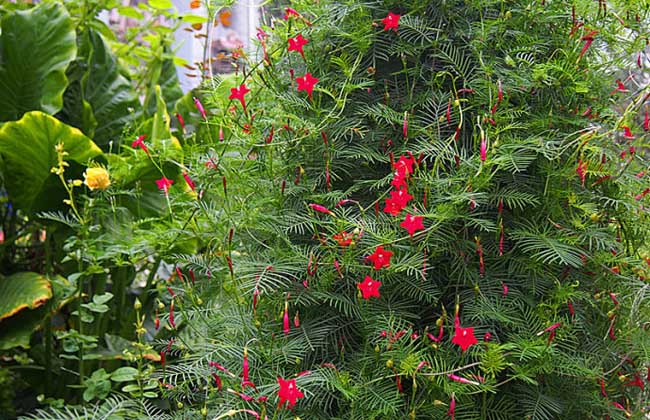
Cypress vine, also known as niaoluo, youlongcao, jinpingfeng, raolonghua, etc., is an annual twining herbaceous plant of the genus Ipomoea in the family Convolvulaceae. It is native to tropical America and is now widely distributed in temperate and tropical regions around the world. Cultivation is relatively simple, and it is a beautiful ornamental garden plant. Let us take a look at the cultivation methods for cypress vine!
Growth habits of cypress vine
Cypress vine likes light and prefers a warm, humid environment. It grows in areas at altitudes of 0 to 2500 m. It is not cold-tolerant and can self-sow (generally introduced and cultivated artificially). It requires fertile soil. It has strong stress resistance and is easy to manage. When sown artificially, seeds are sown in late March, and seedlings are transplanted when they reach 10 cm. To encourage more flowering, it should be planted in fertile soil in a sunny spot. Potted plants must be given a support to climb on, and when in bloom they are extremely delicate and beautiful.
Propagation methods for cypress vine
Cypress vine is usually propagated by sowing in seedling trays, with a sowing rate of about 100 g per sq m. After sowing, cover with about 1.5 cm of fine soil; it must not be too thin, otherwise the seedlings are likely to emerge with the seed coat still attached. Keep the soil temperature at 20-25°C. Seeds emerge 4 days after sowing. Emergence is easy, but often uneven, so seeds should be carefully selected to make the seedlings uniform. Seedlings are very afraid of drought; when drought is even slightly severe, they will wither and die, and even watering makes it difficult for them to recover. Special attention should be paid to this point during seedling raising.
Cultivation methods for cypress vine
1. Choosing a pot: choose a flower pot of appropriate size. Cover the drainage hole at the bottom of the pot with two pieces of broken tile or thin foam pieces; this should both keep the potting soil from being washed out and allow excess water to drain out in time. On top of the tile or foam, place a layer of expanded clay pellets or crushed red brick as a drainage layer, about 2-3 cm thick.
2. Potting: when potting cypress vine seedlings or repotting large plants that have been grown for several years, first place a 2-3 cm thick layer of coarse-grained substrate at the bottom of the pot as a drainage layer, sprinkle a layer of fully decomposed organic fertilizer on top as a base fertilizer, about 1-2 cm thick, then cover with a thin layer of substrate about 1-2 cm thick, and then place the plant in, so as to separate the fertilizer from the roots and avoid burning the roots.
3. Fertilizer and water: after potting cypress vine, water it thoroughly once and keep it in a shaded environment for a week. When transplanting seedlings, first dig the planting hole, sprinkle a layer of organic fertilizer at the bottom of the planting hole as a base fertilizer, about 4-6 cm thick, then cover with a layer of soil and place the seedling in, so as to separate the fertilizer from the roots and avoid burning the roots. After placing the seedling in, backfill the soil to cover the roots, firm the soil with your foot, and water thoroughly once.
4. Pruning: in winter, when cypress vine enters dormancy or semi-dormancy, cut off weak, diseased or pest-affected, dead, and overly dense branches. Branch organization can also be carried out in combination with cuttings.
5. Removing from the pot: place the flower to be repotted on the ground, first lightly pat around the pot with your palm so that the roots are disturbed and separate from the pot wall, then turn the pot upside down on your left hand, gently grip the plant between the index and middle fingers of your left hand, brace your wrist and fingertips against the rim of the pot, pat the bottom of the pot with your right hand, then use your thumb to push the root ball downward from the drainage hole so the plant comes out. After it comes out, gently pat the root ball with both palms to let excess soil fall away.
6. Repotting: cypress vine grows very quickly with proper care. When it has grown to a certain size, consider giving it a larger pot so it can continue to grow vigorously. For the growing medium and component ratio used for repotting, one of the following can be chosen: vegetable garden soil : cinder = 3:1, or garden soil : medium-coarse river sand : sawdust (mushroom residue) = 4:1:2, or one of paddy soil, pond mud, or leaf mold.