A detailed explanation of the flower language and legends of the corn poppy, helping you understand the meaning of this flower
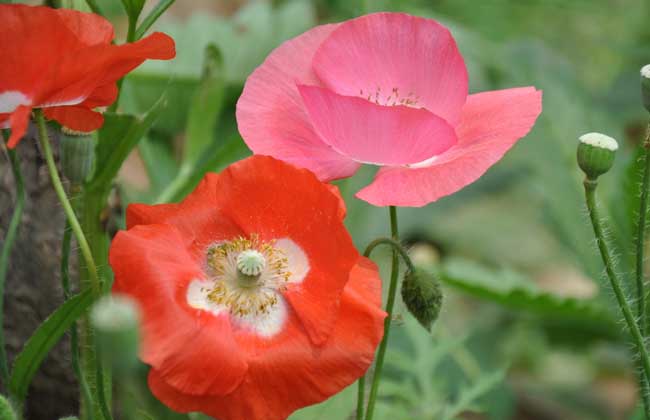
The corn poppy, also known as lichunhua, sai mudan and other names, is an annual herbaceous plant in the poppy family, Papaveraceae. Its flower colors are rich, including white, purple, red and so on. The blooms are rich and gorgeous, and in ancient times it was an object of praise for most men of letters, often an image in their poetry and carrying a certain symbolic meaning. Now let us take a look together at the flower language and legends of the corn poppy!
The flower language of the corn poppy
The corn poppy symbolizes separation in life and death, and tragic songs. The corn poppy's flowers are colorful and rich; when it blooms, its thin petals are as thin as silk, smooth and bright like satin, and its light flower crown is like red clouds and colored silk. Even without wind it seems to sway on its own, and when the wind moves it seems even more about to flutter away, quite beautiful. The red corn poppy symbolizes great luxury, charming and enchanting; the white corn poppy symbolizes comfort, arrogance and holy purity; the purple corn poppy symbolizes comfort, rest and forgetting.
The flowering period of the corn poppy
March to August. The corn poppy is propagated by sowing, usually grown as a biennial. It can be sown in spring or autumn. Generally, spring sowing is in March to April, with the flowering period in June to July; autumn sowing is in September to November, with the flowering period in May to June of the following year. The flowers are solitary at the tops of the stems and branches, covered with pale yellow spreading bristles; the flower buds are oblong-obovate, the anthers are oblong, the ovary is obovate, and the flowers are white, purple, red and so on.
The legend of the corn poppy
According to legend, in the late Qin Dynasty, when Chu and Han contended, Xiang Yu, the Hegemon-King of Western Chu, was defeated and surrounded by Han troops at Gaixia. Xiang Yu knew it was hard to break out of the siege, so he drank at night with his favored concubine Yu Ji. Suddenly hearing Chu songs rising on all sides, he could not help but sing a tragic song: "My strength plucked up the hills, my might shadowed the world; but the times were against me, and Dapple runs no more. When Dapple runs no more, what then can I do? Ah, Yu, my Yu, what will your fate be?" Yu Ji also felt that the general situation was lost, and with tears she sang "Reply to the Song of Gaixia" and danced, singing: "The Han troops have already taken the land, Chu songs rise on every side; the King's spirit is exhausted, how can I, your humble concubine, live on!" After the song ended, she drew the sword from Xiang Yu's waist, set it across her neck, and at once blood gushed out; her fragrance vanished and her jade body perished.
Later, on Yu Ji's grave grew a kind of grass, shaped like cockscomb, with opposite leaves, soft stems and long leaves, moving without wind, like a beauty dancing gracefully, charming and lovely. Folk legend says this was transformed from Yu Ji's sincere spirit, so people called this grass "Yu Ji Cao" (Yu Ji grass), and its flower "Yu Meiren" (corn poppy). The bright red on the corn poppy flowers is said to have been dyed by Yu Ji's splashed fresh blood. It seems that after Yu Ji died she was still present; she became the Yu Ji grass, blooming every year in the period from late spring to early summer. Even after turning into grass and wood, she remained steadfast, still holding that same faithfulness and waiting for the Hegemon-King, just as before, endlessly showing a smiling face and fluttering her garments for the Hegemon-King all year round.