How to grow corn poppies? Detailed growing methods
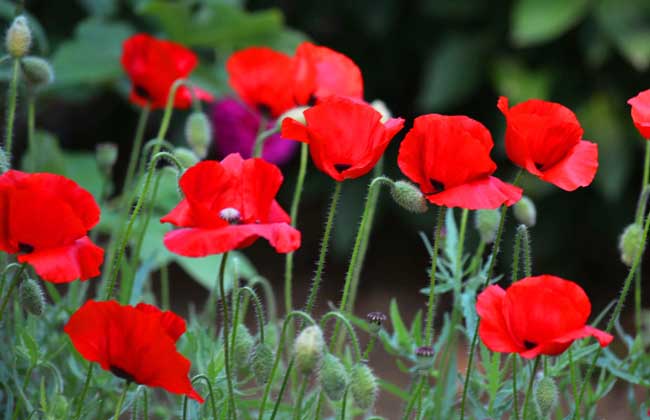
The corn poppy is also known as Lichunhua, Saimudan, Manyuanchun, Xiannühao, and other names. It is an annual herbaceous plant in the poppy genus of the Papaveraceae family. Its flowers are rich in many colors, and its flowering period is also long. It is suitable for planting in flower beds and flower borders, and can also be grown in pots or used as cut flowers. When planted in large patches in parks, the scenery is very pleasant. Now let us take a look at the growing methods for corn poppies!
Growth habits of corn poppies
The corn poppy is native to Europe and is commonly cultivated around the world. The suitable temperature for growth and development is 5-25°C. In areas with high spring and summer temperatures, the flowering period shortens, and the temperature difference between day and night is large. Low nighttime temperatures are beneficial for growth and flowering. It grows well in high-altitude mountain areas, and the flower colors are even more vivid. Its lifespan is 3-5 years. It is cold-resistant but fears summer heat. It likes a sunny environment and prefers fertile sandy loam with good drainage. It does not tolerate transplanting, avoids continuous cropping and waterlogging, and can self-sow. The flowering period is from May to August.
Propagation methods for corn poppies
Corn poppies are mainly propagated by sowing, usually cultivated as biennials. They can be sown in spring or autumn. Generally, spring sowing is from March to April, with the flowering period from June to July. Autumn sowing is from September to November, with the flowering period from May to June of the following year. If the goal is to collect seeds, it is best to use autumn sowing. The soil should be prepared finely, and the beds should be made and watered thoroughly, then seeds should be broadcast or sown in rows. Because corn poppy seeds are very small, when sowing, the soil should be leveled and finely broken up. After broadcasting, there is no need to cover with soil, or a thin layer of fine sandy soil can be applied. The covering soil thickness should be such that the seeds can no longer be seen (0.2-0.3 cm). In North China, because winters are severely cold and seedlings find it difficult to survive the winter, direct sowing is often carried out in early winter at the time of "Light Snow," so that they can sprout and grow as early as possible in spring.
Growing methods for corn poppies
1. Site selection: Corn poppies like places with sufficient light and good ventilation. They are cold-resistant but not tolerant of moisture or heat. They should not be planted in overly fertile soil, should not be planted in continuous cropping, and should not be raised or planted in low-lying, damp places with heavy water and fertilizer or poor light, otherwise they will grow poorly and are also prone to disease. They are not strict about soil requirements, but loose, fertile sandy loam is best.
2. Pot cultivation: For potted corn poppies, in January use a flowerpot with an inner diameter of 20 cm, fill it more than half full with loose old potting soil, press it level, scatter 20 to 30 seeds, cover with soil just until the seeds can no longer be seen, and after sowing, soak the pot in water so the water seeps up.
3. Thinning: Corn poppies are usually cultivated as biennials. When the seedlings have 5-6 leaves, thin them, with a general plant and row spacing of 30×30 cm. Corn poppies do not tolerate transplanting, so direct sowing in the garden is best.
4. Fertilization: Corn poppies are usually given 2-3 applications of dilute liquid fertilizer before flowering, but fertilizer must not be applied too much, otherwise pests and diseases are likely to occur. For field planting, apply thin fertilizer twice before overwintering, and apply liquid fertilizer once more before flowering. Apply the final topdressing once before flowering to promote large, vividly colored flowers and vigorous blooming.
5. Watering: During the seedling growth period, corn poppies should not be watered too much, but the soil needs to remain moist. For field planting, in general there is no need to water frequently. For pot cultivation, water once every 3-5 days depending on the weather and potting soil conditions. About 60% of the field soil's maximum water-holding capacity is better for the development of corn poppies. Water less during overwintering, and water more during spring growth.
6. Diseases: A common disease of corn poppies is seedling-stage wilt. Spray with a 1000-fold dilution of 25% thiophanate-methyl wettable powder. Usually, after the cotyledons emerge, spray weekly with a 1000-fold dilution of chlorothalonil or thiophanate-methyl, for 2-3 consecutive times.
7. Pests: A common pest of corn poppies is aphid damage. Adults and nymphs gather densely on tender shoots and suck sap from the leaves. Commonly used sprays for control are 35% luanchongjing emulsifiable concentrate at 1000-1500-fold dilution, 2.5% Tianwangxing emulsifiable concentrate at 3000-fold dilution, 50% mieyaling emulsifiable concentrate at 1000-1500-fold dilution, 10% cyhalothrin emulsifiable concentrate at 3000-fold dilution, 2.5% kungfu emulsifiable concentrate at 3000-fold dilution, 40% chlorpyrifos emulsifiable concentrate at 1500-fold dilution, 40% omethoate at 1000-fold dilution, and 2.5% rotenone emulsifiable concentrate at 1500-fold dilution.