A Detailed Guide to the Cultivation Methods and Care Techniques of the Flowering Almond
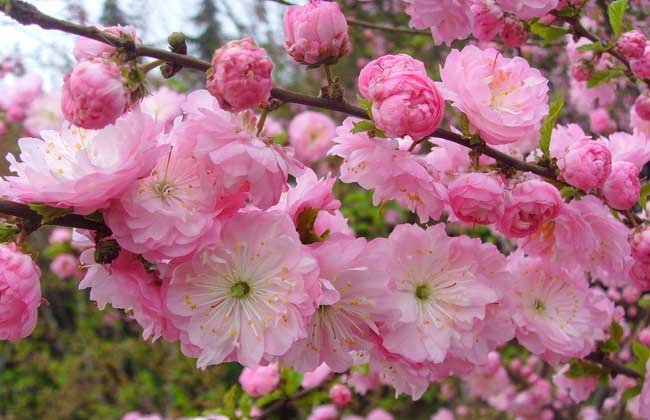
The flowering almond, also known as Yumei, Xiaotaohong, Yuye Luanzhi and so on, is named for its leaves that resemble elm leaves and its flowers that closely resemble plum blossoms. It is a shrub or small tree of the genus Prunus in the rose family, and has a cultivation history of several hundred years in China. It is planted for ornamental viewing in most parks across the country. Common cultivated types include the double-flowered flowering almond, Luanzhi and others. Let us take a look at the cultivation methods of the flowering almond below!
Growth Habits of the Flowering Almond
The flowering almond has purplish-brown branches, broadly elliptic to obovate leaves, single to double purplish-red flowers, and red nearly spherical drupes. It likes light, tolerates slight shade, and is cold hardy, able to overwinter at -35°C. It is not demanding about soil, with neutral to slightly alkaline and fertile soil being best. Its root system is well developed and its drought tolerance is strong. It is not tolerant of waterlogging. Its disease resistance is strong. It grows on slopes or beside gullies at low to medium altitudes, under arbor and shrub forests or at forest edges. In China it is produced in Heilongjiang, Jilin, Liaoning, Inner Mongolia, Hebei, Shanxi, Shaanxi, Gansu, Shandong, Jiangxi, Jiangsu, Zhejiang and other places.
Propagation Methods of the Flowering Almond
1. Grafting: The grafting methods for the flowering almond include bud grafting and scion grafting, with bud grafting generally used more often. Bud grafting is best carried out in mid to late August. The rootstock can be one-year-old flowering almond seedlings, or seedlings of wild rose species, peach, or mountain peach. For bud grafting, plump leaf buds on one-year-old branches can be selected and cut from superior varieties of flowering almond for later use. Scion grafting should be carried out in spring from February to March. The scion should be cut before the plant sprouts. In winter the scion can also be cut and stored in sandy soil for use in spring.
2. Cutting: The flowering almond is often propagated by softwood cuttings using current-year branches in late spring and early autumn, or by hardwood cuttings using last year's branches in early spring. For softwood cuttings, when the plant is growing vigorously from late spring to early autumn, select robust current-year branches as cuttings. After cutting the branches, select the sturdy parts and cut them into sections 5-15 cm long, each section carrying more than 3 leaf nodes. For hardwood cuttings, after the temperature rises in early spring, select robust branches from the previous year as cuttings, with each cutting usually retaining 3-4 nodes.
3. Division: The flowering almond can be divided in autumn and in spring after the soil thaws and before the plant sprouts. After division, the plant should have 1/3 to 1/2 of its branches pruned to reduce water evaporation, which helps the plant survive.
4. Layering: Select a robust branch, and from about 15-30 cm below the tip, peel off a ring of bark. The width of the wound after peeling should be about 1 cm, and the depth should be just enough to remove the outer bark. Cut a piece of film 10-20 cm long and 5-8 cm wide, place some moistened garden soil on it, and wrap the girdled part as if bandaging a wound. Tie the upper and lower ends of the film tightly, with the middle bulging. Roots will form in about four to six weeks.
5. Sowing: After the flowering almond seeds mature, sow them in autumn or store them in sand and sow in spring. Planting can be done from after leaf fall in autumn to before buds sprout in early spring. In cultivation management, attention should be paid to pruning and fertilizing after flowering to ensure enough flowering branches for the coming year.
Cultivation Methods of the Flowering Almond
1. Soil: The flowering almond is not demanding about soil, but it is not tolerant of waterlogging and prefers neutral to slightly alkaline, fertile, loose sandy loam.
2. Watering: The flowering almond dislikes waterlogging. When planted in spring, if the weather is dry, water 2-3 times. Normally no watering is needed, and attention should be paid to drainage during the rainy season.
3. Sunlight: The flowering almond can be given plenty of sunlight in autumn, winter and spring. When kept indoors, place it in a place with bright light as much as possible, such as a well-lit living room, bedroom, study and other places.
4. Temperature: The flowering almond likes a warm climate, but high temperatures and stuffy heat in summer are not conducive to its growth. It has strict requirements for winter temperature: when the ambient temperature is below 10°C it stops growing, and it cannot overwinter safely under frost.
5. Pests: The main pests and diseases of the flowering almond include brown spot disease, white root rot, aphids, stinging caterpillars, red spiders, leaf roller moths and so on. They generally occur in summer and autumn, and appropriate pesticides should be selected and sprayed promptly for control.
6. Pruning: During the growth of the flowering almond, attention should be paid to pruning the branches. After the flowers fade, the flowering branches should be moderately shortened, leaving 3-5 buds on each robust branch. After the onset of the dog days, prune once more, and pinch off the tips to concentrate nutrients and promote the sprouting of flower buds.
Pest and Disease Control of the Flowering Almond
1. Black spot disease: Strengthen water and fertilizer management to improve the plant's disease resistance. In late autumn, clean up fallen leaves and burn them in a centralized manner. Before buds sprout in spring, spray once with 5 degrees Baume lime sulfur mixture for prevention. If it occurs, spray with 80% zineb wettable powder at 700 times dilution, or 70% mancozeb at 500 times dilution, spraying once every 7 days, for 3 to 4 consecutive sprays to effectively control the disease.
2. Crown gall disease: During the transport and cultivation of seeds and seedlings, quarantine must be strengthened, and seeds and seedlings carrying the disease must be strictly prevented from entering the cultivation site. Before cultivation and planting, various underground pests should be controlled in time. On affected plants, use sterilized tools to remove the tumor-like growths, and then apply whitewash or Bordeaux mixture to the affected areas, and the grafting tools used must also be completely sterilized before use.
3. Leaf spot disease: In winter, in combination with pruning and tidying of branches and leaves, promptly remove the disease spots and residues left from the disease and burn them in a centralized manner. During the peak growth period of the plant, strengthen field management. During the rainy season, pay attention to timely drainage and apply an appropriate amount of fertilizer to enhance the plant's disease resistance. In the early stage of the disease, promptly spray 75% thiophanate-methyl wettable powder at 900-1400 times dilution, or 75% chlorothalonil wettable powder at 800 times dilution.
4. Aphids: If a large number of aphids are found causing damage, chemical control should be carried out promptly. Using a 1:10 ratio, prepare tobacco leaf water, soak for about 5 h, and then spray the whole plant once. Aphids can be killed with 1500 times dilution of Chan Ya, or by preparing a solution of washing powder, urea and water in a ratio of 1:3:300 and spraying the whole plant.
5. Red spiders: Red spiders reproduce quickly and can breed in environments such as weeds and plant branches and stems. They harm the entire plant, and several generations can mix on the plant and cause damage at the same time. When the damage is severe, the entire plant dies. Mix sulfur + salt + water (ratio 10:1:1:40) evenly and use it, applying "white" can both prevent mature larvae from descending the tree to overwinter in the shallow soil layer and prevent the larvae of the camphor cluster moth from climbing the tree in spring. 40% dicofol emulsifiable concentrate at 1500 times dilution kills red spiders.
6. Bagworms: Bagworms are likely to harm plants under high-temperature, dry climate conditions, mainly damaging plant leaves. When they occur in small numbers, the insects and eggs can be removed manually and burned in a centralized manner. When the pest outbreak is severe, during the larval occurrence period spray 2050 times dilution of fenvalerate, or 85% dichlorvos emulsifiable concentrate at 900 times dilution, or 80% trichlorfon crystals at 1500 times dilution.