What flower is amaranth? Introducing this ornamental plant
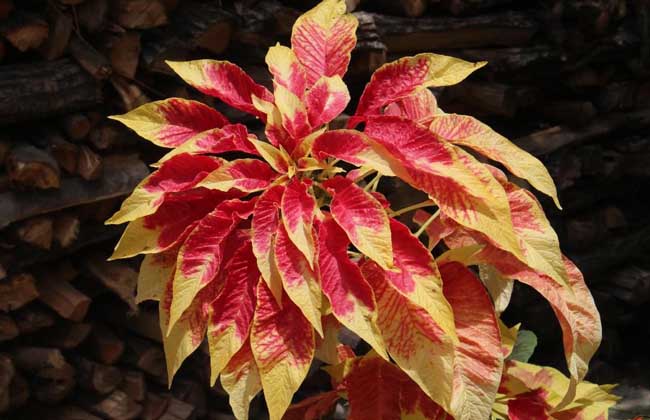
Amaranth is also known by other names such as laolai shao, tricolor amaranth, leaf cockscomb, laolai jiao, and xiangyang red. It is an annual herbaceous plant in the Amaranthaceae family, genus Amaranthus. As an excellent foliage plant, it can be used as a flowerbed backdrop, in hedgerows, or planted in clusters along roadsides, and can also be planted in large patches on lawns, forming brilliant patterns with flowers and grasses of various colors. It can also be used for potted plants and cut flowers. Its leaves change color right at the time when “wild geese fly south,” so people gave it a beautiful name——amaranth.
The amaranth stem is erect, 15-45 cm tall, single or branched, covered with glandular hairs. The lower leaves are opposite, and the upper leaves are alternate, broadly ovate, oblong, and lanceolate, with soft hairs on the leaf surface and no petiole. The paniculate cyme is terminal, with short soft hairs, and the pedicel is very short. The calyx is tubular, and the calyx lobes are lanceolate-subulate. The corolla is salverform, in colors such as pale red, deep red, purple, white, and pale yellow. The stamens and style are much shorter than the corolla. The capsule is elliptical, with a persistent calyx below. The seeds are oblong and brown.
Amaranth is native to tropical Asia and is widely cultivated in China, distributed in mainland China as well as India, Japan, Central Asia, and other places. It is drought-tolerant but not cold-tolerant, and prefers a moist, sunny, and well-ventilated environment, and prefers fertile, well-drained soil. It also prefers a moist, sunny, and well-ventilated environment, and is averse to waterlogging and damp heat. It is not strict about soil requirements and is suitable for well-drained fertile soil. It has a certain tolerance to alkalinity and can self-sow and reproduce.
Amaranth is propagated by sowing in May in spring, usually by direct sowing in an open-field seedbed. Shade is required when sowing. Because its seeds fall naturally to the ground after maturing, seed collection must be carried out in time. Pay attention to management after sowing, keep the soil moist, and maintain the temperature at 15-20°C; seedlings can emerge in about 7 days. In tropical low-latitude regions, it is often sown in winter and emerges in May-June of the following year. The tip leaves can change color, and the ornamental period is also relatively long.
The propagation quantity of amaranth by cuttings is relatively small, so it is rarely used, but it is often used to maintain the excellent characteristics of the mother plant, or when there are too few sown seedlings to meet the need and the sowing season has passed, it can also be propagated by cuttings. Cuttings are taken during its growing season. Cut the middle and upper branches as cuttings, cut them into 10-15 cm lengths, with a flat cut surface, and the lower cut about 2 mm from the leaf base. They can be inserted into fine sand, vermiculite, or perlite. If the cuttings are soaked in 0.1% ABD rooting agent for 1-2 days, rooting can be advanced by 2-3 days.
According to legend, by the Yan River, there was a young man named Yanzi and a girl named Hongxiang. The young man was handsome and the girl was beautiful, and they were a good pair, one farming and the other weaving, and they had arranged their marriage. One day, the local bully colluded with the government officials to send Yanzi far away to do hard labor and forced Hongxiang to marry the bully's son. Hongxiang was very angry and dashed her head against a tree and died. Later, a flower grew on her grave. When Yanzi heard the news that Hongxiang had died, he died of grief, and his body turned into a goose. When the goose flew to the side of Hongxiang's grave, the leaves of the flower turned bright red, so this plant was called “amaranth.”