How to Grow Tradescantia pallida? Detailed Guide to Cultivation Methods and Tips
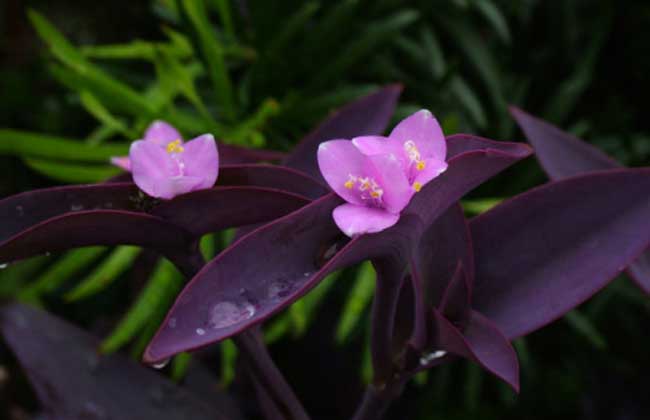
Tradescantia pallida, also known as purple heart, purple queen, and purple secretia, is a perennial herbaceous plant in the genus Tradescantia of the family Commelinaceae. It is native to Mexico and other places, and is now widely cultivated artificially. The entire plant is purplish-red all year round, with branches either trailing or hanging, featuring distinctive characteristics and high ornamental value. Let's take a look at the cultivation methods for Tradescantia pallida!
Growth Habits of Tradescantia pallida
After elongating, Tradescantia pallida becomes semi-trailing and creeps along the ground as a ground cover. It blooms in spring and summer. Under conditions of sufficient sunlight, both stems and leaves turn deep purple and the flower quantity is larger. It prefers warmth and humidity, is not cold-tolerant, and should be protected from direct sun exposure. It likes partial shade and has strong adaptability to drought. It is suitable for fertile, moist loam soil. When potted, white, blue, or other flower pots are preferable. In winter, the potting soil only needs to be slightly moist. In March of the following year, carry out one pruning on weak and messy plants to promote new branch growth.
Propagation Methods for Tradescantia pallida
The main propagation methods for Tradescantia pallida are cuttings and division. Cuttings are taken in spring when repotting, combined with renewal pruning. Cut 7-10 cm long shoot tips, let them dry slightly, then insert for rooting. Under conditions of partial shade, moisture, and a temperature of 15-251°C, roots will form in 1-2 weeks with a high survival rate. Alternatively, insert the cuttings directly into pots with a diameter of 15-20 cm, several plants per pot, or cut branches and place them in water, where roots will emerge and they will survive within a few days. Division should be carried out in April combined with repotting. Overcrowded plants can be divided into several clumps and then planted separately.
Cultivation Methods for Tradescantia pallida
1. Temperature: Tradescantia pallida prefers a warm climate. The optimal growth temperature is 18-30°C. It is averse to cold and frost. The overwintering temperature needs to be maintained above 10°C. When the winter temperature drops below 4°C, it enters a dormant state. If the ambient temperature approaches 0°C, it will die from frostbite. In winter, it can be wrapped in plastic film outdoors for overwintering, but the film should be uncovered every two days at noon when the temperature is higher to let it breathe.
2. Light: Tradescantia pallida loves light. Only under conditions of sufficient sunlight can it maintain bright leaf color and short, sturdy internodes. However, it is not tolerant of strong light exposure. When directly exposed to the scorching sun, the leaves become dull, short, withered, yellow, and curled, and the plant also becomes stunted. Only with sufficient light can its color be vivid. With prolonged excessive shade, the color becomes dull, the internodes elongate, the branches and tendrils become limp, and it lacks vitality.
3. Watering: Because the branches and leaves of Tradescantia pallida are somewhat succulent and it has a certain degree of drought resistance, it will not die even if not watered for several days. However, only when the potting soil is moist can the plant grow well. During the growing period, watering should follow the principle of "do not water if not dry, water thoroughly when watering," keeping the potting soil moist but not dry. In winter, watering needs to be moderated, keeping the potting soil in a relatively dry state.
4. Humidity: Tradescantia pallida likes a moist climate environment, but has strong adaptability to drought. It requires the relative air humidity of the growing environment to be 60-75%. During the growing season, water should be sprayed frequently on the branches, leaves, and surrounding environment to increase relative air humidity. When relative air humidity is high, the plant grows luxuriantly, delicate, and lovely.
5. Fertilizing: During the growing season, apply a fertilizer combining nitrogen, phosphorus, and potassium once every 1-2 weeks to Tradescantia pallida. It is most afraid of indiscriminate fertilizing, concentrated fertilizer, and one-sided application of nitrogen, phosphorus, or potassium fertilizer. Applying nitrogen fertilizer alone, although the branches and leaves grow thick and large, they are not brightly colored. In September, stop applying nitrogen fertilizer and apply only phosphorus and potassium fertilizer to facilitate safe overwintering. Stop fertilizing in winter.
6. Pruning: During the young plant stage, Tradescantia pallida should be pinched back to promote branching and make the plant shape full. For plants that have been planted for a long time, the leaves at the base will wither and deteriorate the plant shape. In spring, combined with repotting, heavy pruning and cutting back should be carried out on the plant to allow the bare base to sprout and renew. For old plants with excessively weak growth, cutting propagation for renewal should be considered.
7. Repotting: During cultivation, Tradescantia pallida is usually repotted once every 1-2 years. It prefers loose, fertile, and well-drained sandy loam soil. The substrate can be prepared from materials such as leaf mold, peat soil, garden soil, rice husk ash, or plain sand. After repotting Tradescantia pallida, water it thoroughly once and place it in a shaded environment for care.