How to propagate the succulent bear's paw (Cotyledon tomentosa)? Detailed method introduction
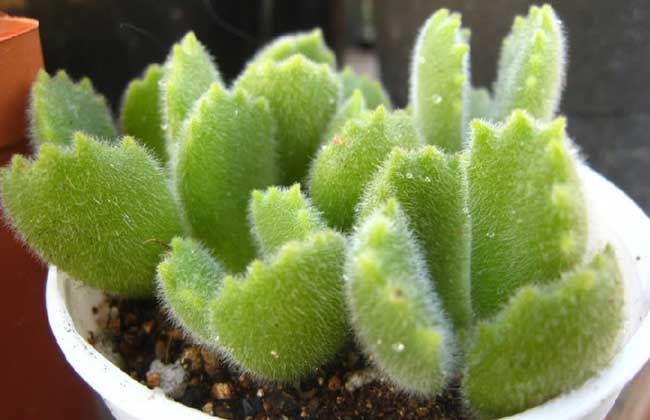
Bear's paw (Cotyledon tomentosa) is a succulent of the genus Cotyledon in the family Crassulaceae, native to Namibia in Africa. Its leaves are covered with fine fuzz and resemble a bear's claws. The propagation method usually used is stem cutting, which is the method with the highest survival rate and the most convenient one. Of course, leaf cuttings are also used, but they are more difficult. Let's take a look below at how to propagate bear's paw!
Stem cutting propagation of bear's paw
Stem cutting is the most commonly used propagation method for bear's paw. The best time for cutting is in spring and autumn, when the temperature is more suitable and it is also the vigorous growth period of bear's paw, which can improve the survival rate of the cuttings. For the cuttings, choose branches with plump and healthy leaves, cut them off and place them in a cool place to air-dry. After drying, insert them into a soil mix of vermiculite, perlite and peat, and place them in a cool place, then wait for them to grow roots.
Leaf cutting propagation of bear's paw
Leaf cutting of bear's paw is very difficult to keep alive, and generally it will not succeed. Especially when the leaves are not in very healthy condition, it is even harder, and the survival rate is extremely low. It is easy for leaf cuttings to grow roots, but that does not mean they can succeed; growing new shoots is quite difficult.
How to grow bear's paw
1. Temperature: After moving bear's paw into a new pot, you should always pay attention to keeping its growing environment dry and ensure sufficient sunlight. However, note that the growing temperature for bear's paw should not exceed 35°C, because at this time the plant's growth will enter a paused state.
2. Light: During the growing period, bear's paw needs full sunlight. With sufficient sunlight, the leaves will become thick and plump. If it is too shady, the stems and leaves will become slender and weak. In the high temperatures of midsummer, provide appropriate shading, but if it is too shaded, the stems and leaves will be weak and the fuzz will lack luster. It is not cold-tolerant, so in winter move it indoors for care and place it by a window with plenty of sunlight.
3. Watering: Bear's paw prefers dry soil. If the surrounding environment is relatively humid, the frequency of watering should be reduced to prevent excessive moisture at the roots from causing root rot. When watering bear's paw, note that you should water a little less each time; watering twice a month is enough. Try to control the watering time to around seven o'clock in the evening.
4. Repotting: As bear's paw grows, a small pot can no longer meet its growth needs. Generally, it should be repotted once every one to two years, and it is best to do so in spring during the growing period. Before repotting, prepare new soil in the new pot. The new soil should have medium fertility and good drainage. You can mix coarse sandy soil, vermiculite, garden soil and leaf mold evenly. Since bear's paw is drought-tolerant and not tolerant of waterlogging, only a small amount of water is needed at the beginning of repotting.
5. Pests and diseases: Wilt disease and leaf spot disease are two common conditions of bear's paw. Wilt disease can cause the leaves of bear's paw to turn yellow and wither, and in severe cases it can lead to death. Leaf spot disease causes various irregular spots on the leaves of bear's paw, which affects its ornamental value. To prevent and control these two diseases, 50 grams of captan can be diluted 800 times and sprayed on the surface of the plant. The pests of bear's paw include scale insects and whiteflies. You can use 40% omethoate emulsifiable concentrate diluted 1000 times and spray it on the surface of the plant.