How to grow a Bear's Paw plant well? A detailed guide to the correct cultivation methods
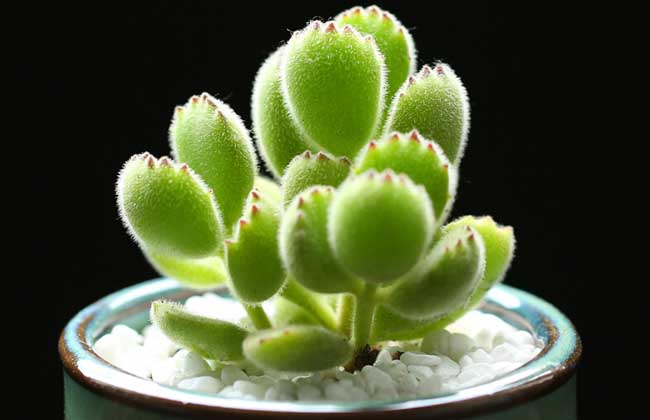
The Bear's Paw (Cotyledon tomentosa) is an angiosperm succulent in the family Crassulaceae, genus Cotyledon. Its leaves are covered in fine hairs, like a bear's paws. It is native to Namibia in Africa. The usual market price is 14 to 20 yuan for 4 leaves, and 30 to 50 yuan for 30 leaves. It easily dies in high summer temperatures, and keeping it at 5°C in winter is enough for it to overwinter safely. Now let's take a look at how to grow a Bear's Paw plant well!
The growth habits of the Bear's Paw plant
The Bear's Paw plant quite likes sunlight, but it goes dormant when summer temperatures are too high. It prefers a warm, dry environment with plenty of sunlight and good ventilation, and it dislikes cold and excessive moisture. For summer dormancy, when the summer temperature exceeds 35°C, watering should be reduced to prevent root rot caused by overly moist potting soil. At the same time, it should be shaded appropriately to prevent the intense sun from scorching the sun-facing leaves and leaving scars that affect its overall ornamental value.
Propagation methods for the Bear's Paw plant
The Bear's Paw plant is mainly propagated by cuttings. During the growing season, choose cuttings with short stem nodes and thick, plump leaves, 5 cm to 7 cm long, with the top stem node being the best. After the cut end dries slightly, insert it into a sand bed. About 20 to 25 days after insertion it roots, and after 30 days it can be potted. The branch can also be inserted directly into garden soil. Unlike other Crassulaceae plants, although leaf cuttings of the Bear's Paw plant root easily, they rarely produce shoots, so leaf cuttings are generally not used for propagation.
How to grow a Bear's Paw plant well?
1. Temperature: After moving the Bear's Paw plant into a new pot, you should always pay attention to keeping its growing environment dry and ensure it gets plenty of sunlight. But note that the growing temperature for the Bear's Paw plant should not exceed 35°C, because at this point the plant's growth will pause.
2. Light: The Bear's Paw plant needs full sunlight during the growing season. With sufficient sunlight, the leaves become thick and plump; if it is too shady, the stems and leaves become slender and weak. In the high heat of midsummer, shade it appropriately, but if it is too shaded, the stems and leaves become weak and the fine hairs lack luster. It is not cold-tolerant; when moved indoors for winter care, it should be placed in front of a window with plenty of sunlight.
3. Watering: The Bear's Paw plant prefers dry soil. If the surrounding environment is fairly humid, then the frequency of watering should be reduced to prevent the roots from becoming overly moist and causing root rot. When watering the Bear's Paw plant, note that you should water a little less each time; watering twice a month is enough, and the watering time should be kept to around seven o'clock in the evening.
4. Repotting: As the Bear's Paw plant grows, a small pot can no longer meet its growth needs, so it generally needs repotting once every one to two years, and it is best done in spring during the growing season. Before repotting, prepare new soil in the new pot. The new soil should have medium fertility and good drainage. Coarse sand, vermiculite, garden soil, leaf mold and the like can be mixed evenly. Since the Bear's Paw plant is drought-tolerant and not tolerant of waterlogging, only a small amount of water is needed at the beginning of repotting.
5. Pests and diseases: Wilt disease and leaf spot disease are two conditions that commonly affect the Bear's Paw plant. Wilt disease can make the leaves turn yellow and wither, and in severe cases it can be fatal. Leaf spot disease causes various irregular spots to appear on the leaves, which affects the ornamental value of the Bear's Paw plant. To prevent and control these two diseases, 50 grams of captan can be diluted 800 times and sprayed on the surface of the plant. The insect pests of the Bear's Paw plant include mealybugs and whiteflies, and 40 percent omethoate emulsifiable concentrate can be diluted 1000 times and sprayed on the surface of the plant.