A Detailed Guide to Growing the Succulent Sedum morganianum 'Burrito'
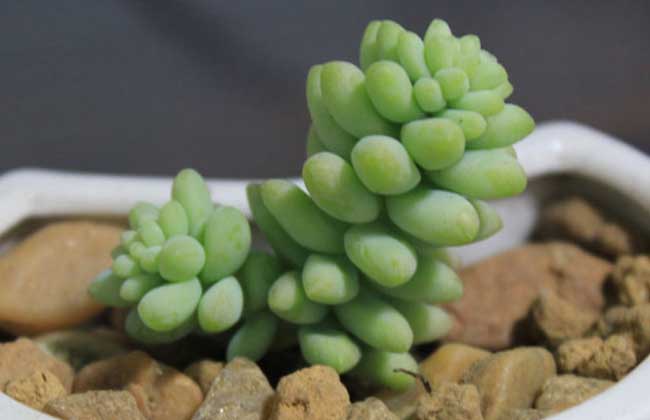
Sedum morganianum 'Burrito', also known as the burro's tail cultivar and Sedum vicozum, among other names, is a succulent in the Crassulaceae family, genus Sedum, native to Mexico. Some scholars consider it a variety of Sedum morganianum (donkey tail), but because the leaf characteristics of Sedum morganianum 'Burrito' differ greatly from those of donkey tail, most people consider them distinct species. The plant grows in a trailing manner and can also be grown in hanging containers. Under strong light the leaves grow densely, making it even more attractive. Let's take a look below at how to grow Sedum morganianum 'Burrito'!
Growth Habits of Sedum morganianum 'Burrito'
The Sedum morganianum 'Burrito' plant grows in a trailing manner and can also be grown in hanging containers. Under strong light the leaves grow densely, making it even more attractive; if placed in a spot with insufficient light for too long, it will become leggy. Generally speaking, apart from the intense midday light of midsummer, whether it gets partial sun or full sun, as long as there is sunlight, Sedum morganianum 'Burrito' will grow vigorously. Sedum morganianum 'Burrito' is a drought-tolerant plant that prefers well-drained soil.
Propagation Methods for Sedum morganianum 'Burrito'
The main propagation methods for Sedum morganianum 'Burrito' are leaf cuttings and stem cuttings. Fallen pieces of Sedum morganianum 'Burrito' can be propagated again; the cultivation method is quite simple. Scatter them evenly in a pot as if they were seeds, then do not water at first. Wait until the leaves have rooted before watering. Then hang it on a balcony in a spot with ample sunlight and no rain exposure, and water only when the medium is dry. Fertilize once per season, and do not apply too much fertilizer. Be careful when planting it and do not touch it often, because its leaves fall off extremely easily. When watering, also pour the water onto the soil and try not to get it on the leaves, because the leaves have a thin coating of white powder that easily rubs off from watering or touching.
How to Grow Sedum morganianum 'Burrito'
1. Soil: Sedum morganianum 'Burrito' is a drought-tolerant plant that prefers well-drained soil; poor drainage can easily cause root rot. For the growing medium, you can mix coarse sand and potting soil at 1:1, or mix potting soil, vermiculite and coarse sand at 2:1:1, or simply use cactus-specific soil.
2. Temperature: Sedum morganianum 'Burrito' likes environments with a large day-night temperature difference. The optimal growing temperature is between 10 and 32°C. When the temperature drops below 4°C or rises above 33°C, it enters dormancy and stops growing. If the temperature drops to near 0°C, it will suffer frost damage or freeze to death. Therefore, in summer pay attention to air circulation, and during the midday period it is advisable to add shade material to avoid high temperatures. In winter, when the low temperature falls below 5°C, it can be moved indoors to a sunny spot to avoid the cold.
3. Watering: A relative humidity of 40-60% makes Sedum morganianum 'Burrito' feel comfortable. Normally you can wait until the soil begins to dry before watering a little, and about once a month you should water thoroughly, judged by water starting to drip from the drainage hole at the bottom of the pot. When watering, avoid the leaves, so that the leaves do not rot from standing water for too long, and note that water must not accumulate at the bottom of the pot. During the dormant period and on days when winter temperatures are low, reduce watering; conversely, in summer slightly increase the frequency of watering.
4. Fertilizing: Sedum morganianum 'Burrito' only needs a light application of liquid potassium fertilizer and phosphorus fertilizer once a month to grow beautifully. Applying liquid fertilizer also counts as one watering. Sedum morganianum 'Burrito' should not be given nitrogen fertilizer, because nitrogen fertilizer will cause them to absorb too much water, making the stems and leaves fragile from storing too much water.