How to grow and care for belladonna lilies
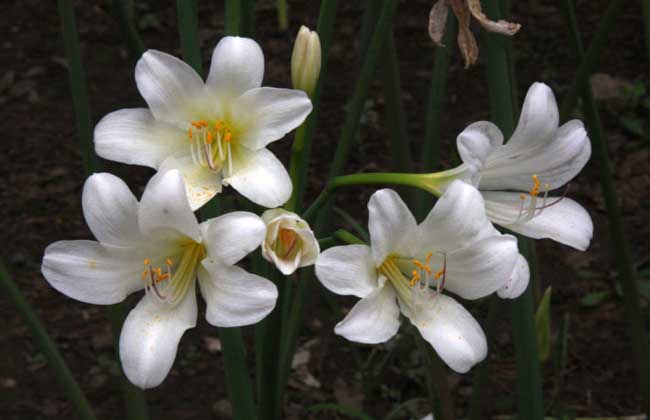
The belladonna lily, also known as magic lily, naked lady and so on, is a perennial herbaceous ornamental plant in the amaryllis family (Amaryllidaceae), genus Amaryllis. Its flowers are poised and neatly arranged, delicately colored and quietly fragrant. It is suitable for mass planting along the edges of woodland meadows, as accents in rock gardens, or in perennial mixed borders. Its pale red-purple funnel-shaped blooms are fresh and elegant, and it works well as a cut flower. Let us take a look below at how to grow belladonna lilies.
Morphological characteristics
The belladonna lily is a perennial herbaceous plant with linear, dark green leaves that have a powdery green band down the middle. It bears a single flower at the tip of the stem, and its tunicate bulb is spherical. The flower scape stands more than 60 cm tall, with a terminal umbel bearing 4 to 8 flowers. The flowers are pink, with a lilac or water-red flush, and are slightly fragrant. There are varieties with deeper flower colors.
Growth habits
The belladonna lily originates from the lower reaches of the Yangtze River in China, and is distributed in Jiangsu, Zhejiang and Anhui. It is cold-hardy and prefers shady, humid environments, but also tolerates full sun and drought. It adapts well to different soils, with fertile, loose sandy loam being best. The above-ground parts have two dormancy periods, in summer and winter.
Propagation methods
The belladonna lily is commonly propagated by dividing the bulbs, done after flowering in autumn or in early spring when the leaves have just withered. Do not damage the roots when dividing, as this can affect flowering that year. Generally, bulbs are divided once every 4 to 5 years. It can also be propagated by seed: after the seeds mature in autumn, store them in sand in a pot, and transplant the seedlings after the young roots sprout the following spring, but seedlings must be grown for 3 to 4 years before they flower.
Growing methods
For field planting of the belladonna lily, the soil should be deep-plowed and plenty of base fertilizer applied. Plant at a depth of 8 to 10 cm, and water thoroughly once after planting. From May to June the underground parts gradually wither and enter dormancy, so watering should be reduced. During the flowering period from August to September, keep the soil moist and apply fertilizer once. In mid-September the plants wither and enter winter dormancy, with the bulbs overwintering in the open ground. The belladonna lily is sometimes affected by anthracnose, which can be controlled by spraying a 500-fold dilution of 50% carbendazim wettable powder once every 15 days.