How should Graptopetalum amethystinum be cultivated so it grows well?
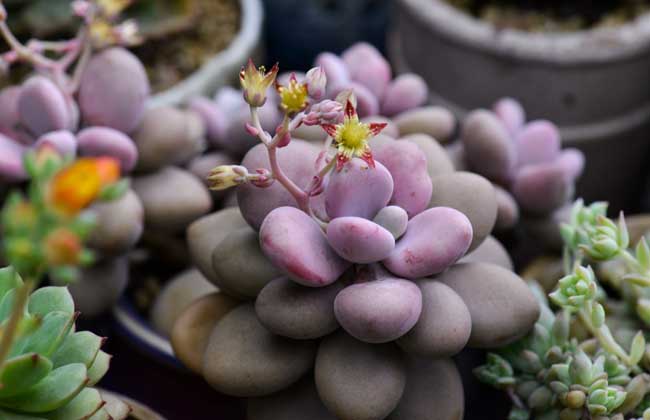
Graptopetalum amethystinum is a succulent plant with bright, dreamy colors and a cute, attractive shape, also known as peach egg, drunken beauty, and so on. The question of which genus Graptopetalum amethystinum belongs to was already internationally settled in 1931 as Graptopetalum, and its star-shaped flowers also have very typical Graptopetalum characteristics. Now let us look at how to cultivate Graptopetalum amethystinum well!
Growth habits of Graptopetalum amethystinum
Graptopetalum amethystinum likes a warm, dry environment with plenty of light. It is highly drought-tolerant and likes loose soil with good drainage and air permeability. It has no obvious dormant period and can accept relatively strong sunlight. Under sufficient light, its color becomes more vivid and striking, and the plant shape becomes more beautiful and compact. With insufficient light, the leaves appear light green, flat, and sparse. It is suitable for outdoor cultivation. It grows well under warm winter and cool summer climate conditions, and it is not tolerant of hot, humid summer weather. Apart from a brief dormancy during high summer temperatures, it basically grows the rest of the time. When sunlight is sufficient, it presents an intoxicating pink color, and its egg-shaped leaves look like ripe peaches.
Propagation methods for Graptopetalum amethystinum
Graptopetalum amethystinum can be propagated by stem cuttings, leaf cuttings, and sowing, but leaf cuttings are generally used. Leaf cuttings are best done in spring and autumn. Place healthy, complete, plump leaves on the surface of slightly moist, loose soil, and do not expose them to strong sun. After a few days or weeks, they will naturally sprout roots and small leaves. When the roots reach 2 to 3 cm, a thin layer of fine sand can be placed over the roots, and they can grow into independent small plants. Sowing is recommended for enthusiasts with rich succulent-growing experience; beginners should try it cautiously.
How to cultivate Graptopetalum amethystinum well?
1. Soil: For the cultivation soil of Graptopetalum amethystinum, use peat : perlite : coal cinder at about 1:1:1. To separate the plant from contact with the soil surface and also for better air permeability, you can spread clean granular river sand or pumice on top (river sand size 3 to 5 mm). It is also recommended to use granular soil for cultivation, such as volcanic rock, maifan stone, and so on.
2. Watering: Watering for Graptopetalum amethystinum requires watering thoroughly after the soil has dried out, and not watering if it is not dry. Leaf drop occurs because when there is too much moisture, or when too much water is given during seasonal changes, the leaves fall off easily with a light touch. Use less water, or give water gradually, and leaf drop can be avoided as much as possible. As long as the dropped leaves are plump, they can all be used for leaf cuttings and are very easy to keep alive.
3. Pruning: After beheading, Graptopetalum amethystinum tends to grow side branches. If not beheaded and left to grow continuously, the old stem of the plant will grow very long before it begins to branch. For a more beautiful look, once it has grown to a certain extent it should be beheaded to stimulate side buds; only then will the plant look beautiful when it forms a cluster.
4. Summer: When cultivating Graptopetalum amethystinum in summer, pay attention to ventilation and shading. Water 3 to 4 times each month, giving a small amount of water slowly around the edge of the pot to get through midsummer, just enough to keep the plant's root system from drying out and withering due to excessive dryness.
5. Winter: For Graptopetalum amethystinum in winter, when the temperature is below 3 degrees, gradually reduce water. Below 0 degrees, keep the potting soil dry, and try to keep it no lower than minus 3 degrees; this way it can safely overwinter. Use as little water as possible, and in early spring water gradually, otherwise root rot may occur.