Bromeliad (Billbergia) growing methods and precautions
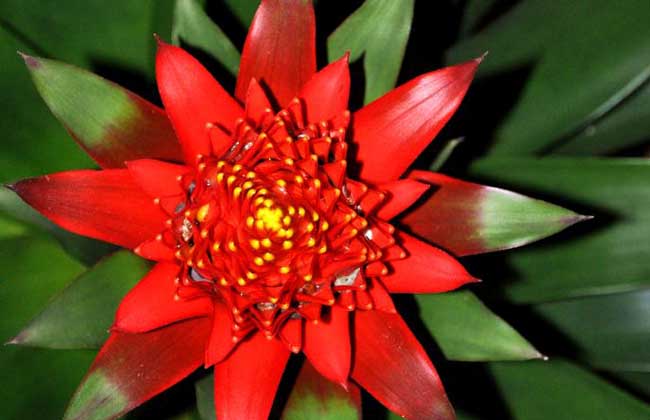
Billbergia is a perennial evergreen herbaceous succulent plant of the genus Billbergia in the Bromeliaceae family, also known as flame bromeliad, red algae bromeliad, water tank bromeliad, red pen bromeliad, etc. It is a good indoor foliage plant, native to tropical regions of the Americas, growing epiphytically on trees or in humus in tropical forests. It is widely cultivated in greenhouses in China, especially in the southern regions. Let's take a look at the growing methods for Billbergia below!
Growth habits of Billbergia
Billbergia prefers warm, humid, semi-shaded environments, is not cold-tolerant, slightly drought-tolerant, requires relatively high air humidity, and avoids direct strong light. The suitable growth temperature is 20-28°C. It has low requirements for soil quality and is suitable for growing in well-drained acidic sandy soil. A slightly acidic sandy loam rich in humus with good drainage and aeration is best, and calcareous soil should be avoided. The optimal growth temperature is 25°C, and the wintering temperature must not be lower than 10°C.
Propagation methods for Billbergia
1. Seed sowing: Most bromeliads used for ornamental purposes on the market are hybrids, and it is very difficult to obtain seeds under natural conditions. Even when seeds are obtained through artificial pollination and other methods, the traits of the offspring will segregate and cannot maintain the excellent traits of the mother plant. Therefore, seed propagation is only used for germplasm preservation of native species and breeding of new varieties.
2. Division: Billbergia division propagation is usually carried out in spring. The mother plant can produce offsets at the base or between the leaves before and after flowering, and the mother plant cannot continue to grow and dies. The offsets can be used for division propagation and cutting propagation. Offsets with roots can be directly potted.
3. Cuttings: Billbergia cutting propagation is usually carried out in spring, as the survival rate of division during high-temperature periods is relatively low. For cuttings, when the offsets are 8-10 cm, cut them off and insert them into a substrate of half leaf mold and half coarse sand. Keep the room temperature at 25-28°C. Roots will form in about 30-40 days, and they can be potted for cultivation in 50-60 days. The mother plant from which the offsets were removed can produce another 2-3 batches of offsets after being cultivated.
4. Tissue culture: The division and cutting propagation of Billbergia grow slowly, the number of seedlings obtained is small, and their sizes are uneven. Large-scale propagation of commercial cultivars mostly uses tissue culture methods, generally using the stem tip tissue of offsets as material. After routine disinfection, they are inoculated on MS medium supplemented with 4 mg/L 6-benzylaminopurine and 0.1 mg/L indoleacetic acid. Adventitious buds can form in 30-40 days.
Growing methods for Billbergia
1. Soil: Billbergia has low requirements for soil quality. A slightly acidic sandy loam rich in humus with good drainage and aeration is best, but calcareous soil should be avoided.
2. Sunlight: Billbergia mainly grows under sparse shade in shrub thickets or on the northwest side of hillsides, where it can receive partial intermittent direct sunlight each day. Therefore, if it is placed in direct sunlight for maintenance in summer, it will grow very slowly or enter a semi-dormant state, and the leaves will also be scorched and gradually turn yellow and fall off, so attention should be paid to shading 50% of the sunlight. In other seasons, since the temperature is not very high, Billbergia can be appropriately given direct sunlight to facilitate photosynthesis and the formation of flower buds and flowering.
3. Temperature: Billbergia is native to tropical or subtropical regions and prefers high-temperature and high-humidity environments. Therefore, the most suitable growth temperature for Billbergia is 18-30°C. When the summer temperature reaches above 35°C, it can still endure it, but growth will be temporarily hindered. However, in winter, when the temperature is below 3-6°C, it cannot overwinter safely.
4. Water: During the peak growth period, Billbergia requires more water, but the potting soil should not be too wet. Normally, in addition to watering to keep the soil moist, the central cup of the Billbergia plant can also be filled with water. In winter, water less, and do not add much water to the central cup either; just keep it moist. Normally, water should be sprayed around the plant frequently to maintain relatively high environmental humidity, and a soft cloth should be used regularly to wipe the leaf surfaces to keep them shiny and clean.
5. Fertilization: Billbergia has high requirements for fertilizer and water, but it is most afraid of random fertilization, concentrated fertilizer, and one-sided application of nitrogen, phosphorus, and potassium fertilizers. It is required to follow the fertilization (watering) principle of "light fertilizer applied frequently, small amounts with more applications, and complete nutrition."
Pest and disease control for Billbergia
1. Heart rot and root rot: To prevent and control heart rot or root rot, in addition to paying attention to the problems of substrate, watering, and water quality, after planting and during high-temperature and high-humidity seasons, 75% oxadixyl mancozeb 400x solution or 40% fosetyl-aluminum 400x solution can be used to irrigate the leaf cup once a month for 3 consecutive times. For seedlings, 40% fosetyl-aluminum 800x solution can be used to soak the seedlings for 10 minutes, then take them out and dry them in the shade before potting.
2. Leaf tip yellowing and withering: Irrigation water that is too alkaline or contains high calcium and sodium, air humidity that is too low, excessive fertilization or liquid fertilizer concentration that is too high, and poor substrate drainage can all cause bromeliad leaf tips to turn yellow and wither. In winter, it is best to maintain the temperature above 5°C, otherwise cold damage may occur. The diseased parts dry up and become scorched, and severe cold damage can lead to plant death.
3. Scale insects: When the eggs have just hatched and the scale covering has not yet thickened, spraying pesticides gives the best control effect. Common organophosphorus pesticides such as dichlorvos, malathion, and fenitrothion can be used for control. Once the scale insects have settled, only systemic pesticides can be used for control. Common pesticides include dimethoate, omethoate, and acephate. For a small number of scale insects, they can also be removed manually with fingernails.
4. Red spider mites: Red spider mites live by piercing and abrading the leaf epidermis and then sucking the sap, causing damage to plant growth. In addition to common organophosphorus pesticides such as phosmet, dimethoate, omethoate, and dichlorvos, acaricides specifically used to kill red spider mites are also available, such as dicofol, propargite, fenbutatin oxide, and bromopropylate.
5. Bagworms: When bagworms damage bromeliad leaves, they usually eat the mesophyll, leaving only a transparent lower epidermis. The lower epidermis dries up and falls off, turning into holes, gaps, or breaks. There are many pesticides for controlling bagworms, such as trichlorfon, dichlorvos, dimethoate, omethoate, malathion, and fenitrothion.
6. Caterpillars: The larvae of tussock moths and related species are often called caterpillars. They can damage leaves and flowers, eating them into notches or biting them off. Common organophosphorus or pyrethroid insecticides can all be used to spray and kill caterpillars.
7. Snails: To control snails, quicklime powder can be scattered on the ground, or they can be caught manually. Alternatively, leaves, weeds, vegetable leaves, etc. can first be used to make lure piles. Before dawn, the snails hide under the lure piles, and then they can be caught in a concentrated manner.
8. Tobacco cutworms: The larvae mainly damage bromeliad flowers, feeding on petals, stamens, and pistils. They usually hide in dark places such as the potting soil and the bottom of pots during the day, and come out to feed at dusk, but on cloudy and rainy days they may also feed outside during the day. Pesticides used to control caterpillars can all be used to control tobacco cutworm larvae.