How to grow Lithops well? A detailed guide to care methods
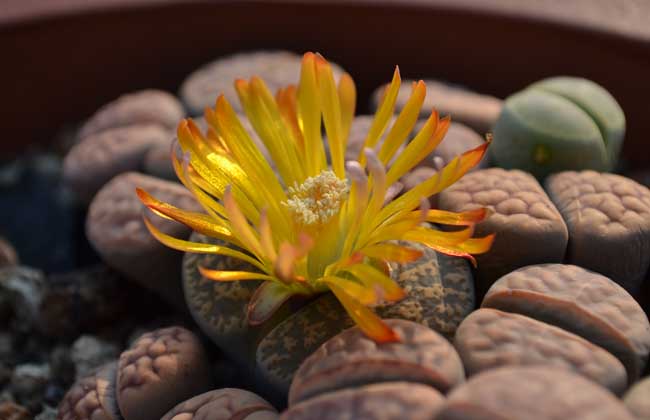
Lithops is also known as stone flower, stone grass, butt flower, etc. It is a small perennial succulent plant of the genus Lithops in the family Aizoaceae, native to southern and southwestern Africa, commonly found in rock crevices and gravel, shaped like colorful stones, rich in color, small and exquisite, and enjoys the reputation of "living stones." Now let us take a look at how to grow Lithops well!
Growth habits of Lithops
Lithops prefers a climate that is warm in winter and cool in summer, and likes a warm, dry environment with plenty of sunlight. It fears low temperatures and avoids strong light. It likes abundant sunlight. The suitable growth temperature is 10-30°C. It is best grown in loose, breathable, neutral sandy loam. Remember to reduce watering appropriately in winter and summer to help with molting. Common varieties include Fulaiyu, Huawenyu, Rilunyu, Zhuxianyu, Mrs. Li, Huangyu, and others.
Propagation methods of Lithops
1. Sowing: Lithops is sown in spring from April to May. Because the seeds are tiny, indoor pot sowing is generally used. After sowing, there is no need to cover with soil, otherwise it will not germinate. When the potting soil is dry, water by the soak-pot method, and never water directly, so as not to wash away the seeds. The sowing temperature is 15-25°C. It germinates about half a month after sowing. Seedlings need 2-3 years to bloom.
2. Division: Every spring, Lithops grows new fleshy leaves from the gap in the middle, causing the old leaves to swell and split open, and the old leaves then shrink and die. The new leaves grow quickly, and by summer they shrink and split open again, and 2-3 small new plants grow from the gap. Simply plant the young plants separately.
How to grow Lithops well?
1. Soil: Lithops does not have very strict requirements for environmental conditions, and cultivation and management are relatively easy. The potting soil can be prepared by mixing 4 parts leaf mold, 3 parts calcareous material (shell powder, eggshell powder, old lime wall scraps, etc.), and 3 parts river sand.
2. Watering: Lithops needs more water during the growing period, but it must not be too wet, as algae easily grow and affect the normal growth of the spherical leaves.
3. Sunlight: In summer, keep Lithops in a semi-shaded place for care, or shade it by 50%, and the leaf color will become more beautiful. In spring and autumn, since the temperature is not very high, give it direct sunlight to help it carry out photosynthesis and accumulate nutrients. In winter, keep it indoors in a place with bright light.
4. Temperature: The most suitable growth temperature for Lithops is 15-25°C. It fears high temperatures and stuffiness, and enters dormancy when the summer heat exceeds 33°C. It avoids cold and frost, and the overwintering temperature needs to be kept above 10°C. It also enters dormancy when the winter temperature drops below 7°C. If the ambient temperature approaches 4°C, it will die from frostbite.
5. Fertilizing: Lithops needs fertilizing once every half month, but the fertilizer solution must never contaminate the spherical leaves. Stop fertilizing after flowering in autumn.
6. Pests and diseases: Lithops mainly suffers from leaf spot disease and leaf rot disease, which can be sprayed with 65% zineb wettable powder at 600 times dilution. Pests include ants and root-knot nematodes. Use the soil-changing method to reduce nematode damage. To prevent ants, use the double-pot water-barrier method for care so that ants cannot climb onto the tender, juicy spherical leaves.
Notes on growing Lithops
1. When repotting Lithops, remove the plant from the soil, shake off part of the soil, do not damage the fine roots, and prune away dry old roots.
2. When Lithops is molting, it is generally not recommended to peel off the skin, because some people lack experience and may harm the seedling, so operate carefully.
3. The watering time for Lithops is generally in the evening. Do not water when the temperature is relatively high, so as to avoid sudden temperature drops harming the plant.
4. The soil for growing Lithops must be breathable, and at the same time a ventilated state must be maintained. Also, in midsummer, do not move Lithops around at will, so as to avoid causing changes in the environment.