Detailed Explanation of Key Planting Techniques for Viburnum odoratissimum
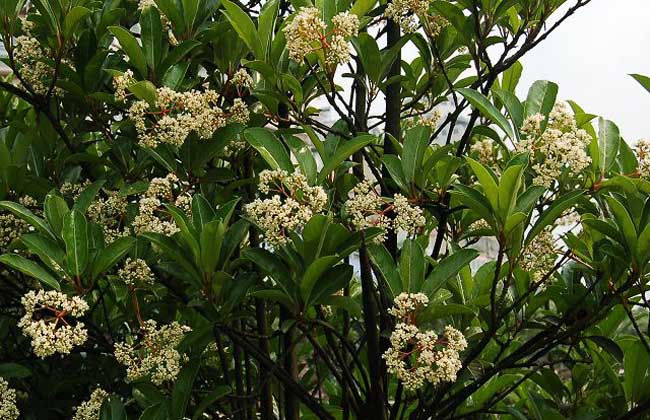
Viburnum odoratissimum, also known as French viburnum, early rice tree, etc., is an evergreen shrub or small tree of the genus Viburnum in the Caprifoliaceae family. It is native to China and is also distributed in India, Myanmar, Thailand and Vietnam. It has strong fire resistance and can serve as a forest fire barrier. Its wood is fine and soft and can be used for hoe handles and the like. In formal gardens it is often pruned and trained into green walls, green gates and green corridors. Let us take a look at the planting techniques for Viburnum odoratissimum below!
Growth Habits of Viburnum odoratissimum
Viburnum odoratissimum grows in shaded spots beside streams in dense mountain valley forests, in sunny spots in open forests, or in thickets on flat ground. It likes warmth, is slightly cold-tolerant, likes light and is slightly shade-tolerant. It grows rapidly and vigorously in moist, fertile neutral soil, and can also adapt to acidic or slightly alkaline soil. Its root system is well developed and its sprouting ability is strong; it is tolerant of pruning and highly resistant to toxic gases.
Seedling Raising Techniques for Viburnum odoratissimum
1. Propagation methods: Viburnum odoratissimum is mainly propagated by cuttings or sowing. Cuttings can be taken throughout the year, but spring and autumn are best, rooting quickly with a high survival rate. The main method is to select robust, upright stem nodes, and from May to June cut mature branches 15-20 cm long, insert them into a seedbed or sand bed, and they will root 20-30 d after insertion, then be transplanted into the nursery in autumn. For sowing, seeds are collected in August, sown in autumn or stored in sand over winter and sown in spring the following year, and 30-40 days after sowing they will germinate and grow into seedlings.
2. Nursery site selection: The nursery site should be chosen in a section sheltered from wind and facing the sun, with convenient transportation and easy drainage and irrigation, and with complete supporting facilities for ditches, roads, canals and electricity. The site should have flat terrain, deep, fertile soil, good drainage, sufficient sunlight, and slightly acidic to slightly alkaline (pH 6.5-7.5) sandy loam or loam, with the groundwater level below 1.5 m.
3. Land preparation and plowing: Before raising seedlings, the nursery land must be carefully prepared, deeply plowed and finely harrowed, with weeds and tree roots cleared, to improve the soil, increase fertility, maintain soil moisture, and create an environment for seedling growth. Winter fallow land should be plowed and harrowed three times, to a depth of 25-30 cm; spring-plowed land should be plowed and harrowed twice, with a plowing depth of 20 cm as appropriate.
4. Soil improvement: For barren soil, increase the application of organic fertilizer year by year; for acidic soil, apply lime, plant ash and bone meal as appropriate; for alkaline soil, increase the application of acidic fertilizers; for clayey soil, mix in sandy loam; for sandy soil, add burnt soil. Before making beds, apply 15000-30000 kg/ha of decomposed organic fertilizer, or 1500-2250 kg/ha of decomposed cake fertilizer, and 375-750 kg/ha of phosphate fertilizer or compound fertilizer, incorporating them into the plow layer along with plowing.
5. Soil treatment: Before raising seedlings, the soil should be disinfected and treated for pest control. For sterilization, ferrous sulfate at 300-450 kg/ha can be applied 20 days before insertion, or zineb at 22.5-30 kg/ha can be mixed with an appropriate amount of fine soil to make toxic soil and spread into the soil. For pest control, 50% phoxim emulsifiable concentrate at 20 kg/ha can be mixed with fine soil to make toxic soil and spread into the soil.
6. Bed making and weed control: The seedbed specifications depend on management requirements and nursery conditions. Generally the seedbed is 100-120 cm wide, 20-30 cm high, with a walkway 45-50 cm wide; the seedbed length depends on circumstances, generally 10-20 m. Beds are best oriented east-west, with a level surface and the center higher than the two sides, to avoid local water accumulation. After the beds are made, spray 1125-1350 mg/ha of pendimethalin on the soil surface to kill weed seeds. The soil should be kept moist before and after spraying to ensure efficacy. If it rains after application, pay attention to drainage to avoid herbicide damage.
Planting Techniques for Viburnum odoratissimum
1. Transplanting and pruning: From March to April each year, transplant the dug-up small seedlings with native soil; large seedlings must be transplanted with a soil ball, and must be transplanted as soon as they are lifted. After transplanting, water thoroughly and generously. In dry years, water frequently to ensure survival; after survival, topdress 1-2 times to promote seedling growth. In addition, annual shaping and pruning should be carried out well, and pruning can be done according to the requirements for green walls, hedges, green gates and green corridors. For potted Viburnum odoratissimum, the grown seedlings can be transplanted into pots or vats, and then daily management such as watering, topdressing, pruning and shaping can be carried out.
2. Timely irrigation: Viburnum odoratissimum grows vigorously and absorbs a large amount of water, so it is best cultivated in fertile, moist soil. After initial planting, water thoroughly to set the roots, and afterward water or irrigate appropriately according to soil or weather conditions. Irrigation should be flexibly controlled according to local climate, site conditions, soil moisture and seedling growth, and can be done by watering, spraying or ditch irrigation, preferably in the morning and evening. In the early growth stage of seedlings, from April to May, water little but often; in the fast-growing period from June to August, water thoroughly each time; in the late growth stage, control irrigation and generally do not irrigate except in exceptional drought.
3. Weeding and loosening soil: Weeding should follow the principles of removing early, removing small, removing completely, and not injuring the seedlings, keeping the nursery land free of weeds. Manual weeding is done after rain or irrigation has dried. Actively promote chemical weeding; for walkways, Roundup or glyphosate can be used, but spraying on the seedlings must be prevented. For grassy weeds, because the weeds are tender in the early stage, haloxyfop or quizalofop-p-ethyl can be used. When using herbicides for the first time, test first before use to avoid herbicide damage. Loosen the soil along with weeding, 4-6 times each year, from shallow to deep: shallower near the seedling roots and between plants, deeper between rows.
4. Fertilizing and shaping: During the plum rain season, deeply apply about 750 kg/ha of compound fertilizer and about 300 kg/ha of urea. Thereafter, from May to August each year, urea can be applied several times; with sufficient water and fertilizer supply, growth is vigorous. Viburnum odoratissimum has strong sprouting ability, can naturally form a barrel-shaped crown, and its lower branches are not easy to die off, so it generally does not need pruning. If used as a hedge, prune 2-3 times before spring budding and during the growing season.
5. Disease control: For root rot and black rot of Viburnum odoratissimum, spray or drench with 1000-fold dilution of 10% antibacterial agent 401 acetic acid solution. For stem rot, leaf spot and angular leaf spot, spray with 600-fold dilution of 75% chlorothalonil wettable powder.
6. Pest control: The main pests of Viburnum odoratissimum, and the more serious ones, are mainly scale insects and nettle moths, such as the globose scale, cottony cushion scale, Kuwana scale, and flattened nettle moth.
① Manual control: In winter or early spring, combine with pruning, cut off and burn infested branches to reduce the overwintering pest population. For scale insects on individual branches or leaves, gently brush them off with a soft brush, or dip a writing brush or similar in kerosene to kill them. For nettle moths, take advantage of the adults' phototaxis and set up black light traps to kill the adults.
② Chemical control: For scale insects, during the hatching period of the young nymphs (February to April each year), contact insecticides can be sprayed, such as 3000-5000-fold dilution of 2.5% deltamethrin (Decis), 80% dichlorvos emulsifiable concentrate, 3000-fold dilution of 50% fenitrothion emulsifiable concentrate, etc.; spray once more after 7-8 days for a very good control effect. During the period when the insects are fixed, parasitic, secreting wax and causing damage (February to April each year), use systemic agents by scraping the bark and painting the trunk, or by root application or drenching; the commonly used agent is 5-10-fold dilution of 50% phoxim emulsifiable concentrate. Nettle moth larvae have weak resistance to insecticides and can be sprayed with 1500-2000-fold dilution of 90% trichlorfon, 80% dichlorvos emulsifiable concentrate, or 50% phoxim emulsifiable concentrate, or sprayed with 5000-fold dilution of fenpropathrin-type pesticides. Red spider mites can be controlled by spraying 1000-fold dilution of 20% tetradifon wettable powder, and aphids, leafhoppers and scale insects can be controlled by spraying 1000-fold dilution of 5% fenitrothion emulsifiable concentrate.