How to grow Desert Rose? Detailed guide to cultivation methods
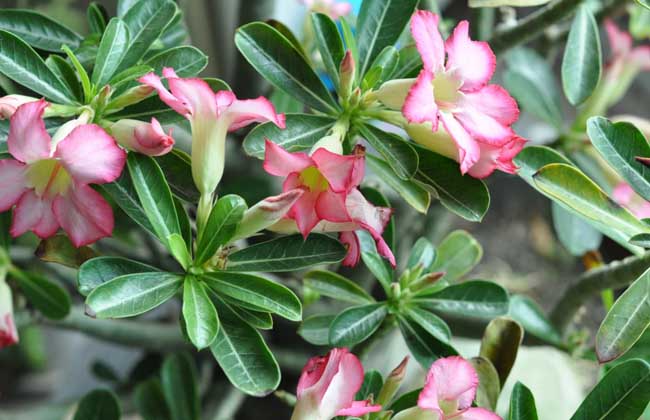
Desert Rose, also known as Tianbao Flower, is a succulent plant in the genus Adenium of the Apocynaceae family. Although it has "rose" in its name, it is not actually a rose growing in desert regions, nor is it closely related to or similar to roses. It is named Desert Rose because its place of origin is close to deserts and its flowers are red like roses. Let's take a look at the cultivation methods for Desert Rose below!
Growth habits of Desert Rose
Desert Rose prefers a climate with high temperatures, drought, and plenty of sunlight. It likes calcium-rich, loose, breathable, well-drained sandy loam. It is not tolerant of shade, dislikes waterlogging, and is averse to concentrated fertilizer and raw manure. It fears cold, and its optimum growth temperature is 25-30°C. In summer, it can be placed outdoors in a sunny spot without shading, and watered thoroughly to keep the soil moist, but not waterlogged. In winter, watering should be restricted, and the overwintering temperature should be maintained above 10°C so that it sheds its leaves and goes dormant. During cultivation, apply organic fertilizer 2 to 3 times a year as appropriate.
Propagation methods for Desert Rose
1. Cuttings: For Desert Rose cuttings, summer is best. Select 1-2 year old branches, with terminal branches being the best. Cut them into 10 cm lengths. After the cut surface dries, insert them into a sand bed. They will root about 3-4 weeks after insertion.
1. Grafting: For Desert Rose grafting, use oleander as the rootstock. In summer, use the cleft grafting method. After surviving, the plant grows robustly and flowers easily.
3. Layering: For Desert Rose layering, air layering is often used in summer. Cut two-thirds into a vigorous branch, first fill with moss, then wrap with plastic film. It roots in about 25 days, and after 45 days it can be cut off and potted.
4. Sowing: Sow Desert Rose in summer; the germination temperature is 21°C.
Cultivation methods for Desert Rose
1. Soil: Desert Rose grows near deserts, so it likes well-drained sandy soil. When the plant is growing luxuriantly, some river sand or small gravel can be added to its substrate to aid drainage. Seedling-stage Desert Roses should be repotted every year.
2. Sunlight: Desert Rose benefits from good sunlight for flowering. Even during the dormant period, sunlight cannot be reduced.
3. Temperature: Desert Rose is suited to growing in a high-temperature, well-ventilated environment. It has poor cold tolerance. It is generally easier to keep alive in the south. In winter, it should be moved indoors and kept dry.
4. Fertilizing: The growing season of Desert Rose is during the spring and summer rainy seasons each year. During this period, Desert Rose grows very quickly. Slow-release fertilizers are best, such as decomposed compost.
5. Pruning: If Desert Rose is not pruned regularly, it easily loses its ornamental value. The best time to prune is after its flowering period. More branches mean more flowers. To get more flowers, you need to find ways to keep more branches.
6. Overwintering: In autumn and winter, Desert Rose enters its dormant period, growing very slowly or even stopping completely, so no fertilizing is needed in autumn and winter.
7. Repotting: Seedling-stage Desert Roses should be repotted every year. The repotting method is very simple. First, before repotting, stop watering. Then, after the potting soil is completely dry, turn the plant out, remove the old potting soil and prune the roots, then replant.
Precautions for growing Desert Rose
1. During the growing period, Desert Rose should be kept dry rather than wet. In the high-temperature summer period, water generally once every 3 days, and there must be no water accumulation in the pot.
2. In the vigorous spring growing season, apply nitrogen fertilizer 2-3 times. Before flowering, apply a compound fertilizer containing calcium and phosphorus 2 times.
3. Soft rot is the main disease harming Desert Rose. It mainly appears near the soil surface, initially white or pale yellow, and finally turning dark brown or even rotting. This is mainly caused by poor ventilation and water accumulation in the pot, so do not water too much at ordinary times. About once every month, spray agricultural streptomycin 1000x solution or 150-200x Bordeaux mixture for chemical control.