A Detailed Guide to the Cultivation Methods of the Graptopetalum 'Qiuli' Succulent
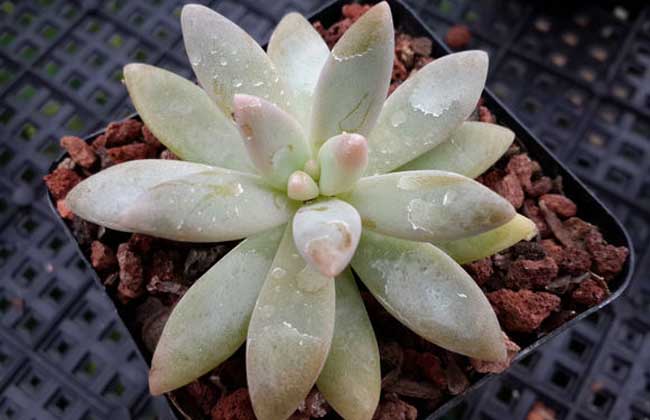
Graptopetalum 'Qiuli' is a succulent in the Crassulaceae family, genus Graptopetalum, possibly a hybrid of Graptopetalum paraguayense and Sedum 'Little Beauty'. Although its name resembles that of Graptopetalum 'Jiqiuli', the two are actually unrelated. It is often confused with Graptopetalum 'Jiqiuli' or mistakenly classified under the genus Graptopetalum (it is in fact an intergeneric hybrid), and is sometimes wrongly considered a hybrid of Graptopetalum paraguayense and Graptosedum 'Little Beauty'. Let's take a look together at how to grow Graptopetalum 'Qiuli'!
Growing Habits of Graptopetalum 'Qiuli'
Graptopetalum 'Qiuli' prefers a sunny, well-ventilated environment and needs full sun. Aside from needing controlled watering during the high summer heat, it can be watered normally during the growing season; generally, watering after the potting soil has dried out is more appropriate. Its disease resistance is relatively weak and it is prone to viral infections, so be sure to sterilize the substrate. It is especially unsuited to long periods in a damp, waterlogged state, which can easily lead to root rot. It can be grown in commercially available succulent-specific potting mix, which is generally already sterilized. It readily forms clusters; in environments with large temperature swings and ample sunlight, the plant grows compact, with plump leaves that display a wondrous blend and wash of pink, purple, red, orange, yellow and other colors.
Propagation Methods for Graptopetalum 'Qiuli'
Graptopetalum 'Qiuli' is a variety that is very easy to propagate. Propagation can be done by cutting the top to encourage side shoots, by leaf cuttings, and various other methods, with a very high success rate. In spring and autumn (also possible in winter in areas north of the Yangtze River), twist off healthy, mature, intact leaves for cuttings. Place the leaves at a slight angle or flat on vermiculite, peat, or coir, keep them slightly moist, and they will soon root at the base and grow new shoots. Once the new shoots have grown a bit larger, plant them separately to become new plants. In addition, young plants sprouting beside the old plant can be used for cuttings; before planting, let the cut surface dry, then bury the lower stem shallowly in sandy soil, with the other precautions the same as for leaf cuttings. The cutting medium should be a loose, sandy soil so the plant's roots can grow well.
How to Grow Graptopetalum 'Qiuli'
1. Light: The more ample the light and the greater the day-night temperature difference, the more vivid and lustrous the leaf color. When temperatures allow, it is best to place it outdoors for care to ensure ample light. With insufficient light or excessive soil moisture, it will grow leggy: the whole plant turns dull and green, the leaves become sparse with elongated internodes, and it grows rapidly upward, seriously harming its ornamental value and possibly even dying because the plant's photosynthesis is impaired.
2. Water: Because the plant has a high internal water content, Graptopetalum 'Qiuli' easily rots in overly damp environments. Never overwater. To avoid water accumulating at the roots, it is best to choose a pot with drainage holes at the bottom; beginners can use a breathable terracotta pot (though this may affect how plump the leaves are). Glass containers absorb heat and have poor breathability, so use them with caution. Usually water about once every 10 days, just until the soil is thoroughly soaked; adjust the watering frequency as appropriate according to climate differences in different regions and seasons.
3. Soil: It is best to grow it in a neutral, sandy soil with good drainage and breathability, to facilitate the removal of excess water and the growth of the plant's roots. You can mix 1 part pine needle soil, 1 part vermiculite, 1 part leaf mold, and 1 part sandy soil, or add coal cinder and sifted granules such as akadama, kanuma, and volcanic rock. Repot once every 1 to 2 years in spring, and you can trim off dead old roots. The soil's nitrogen content should not be too high.
4. Temperature: Generally, below 5 °C it stops growing or suffers mild frost damage, and at 0 °C or below the water in the leaves freezes and the cells die. When temperatures are too high (above 35 °C) or too low (below 5 °C) in winter and summer, the plant stops growing; at this time, temporarily reduce or stop watering, and resume the watering frequency once temperatures are suitable again. In high summer heat, pay attention to ventilation and prevent prolonged direct sun exposure to avoid sunburn.
5. Pruning: Regularly remove dried, withered old leaves in time to prevent them from piling up and breeding bacteria. When the plant grows leggy or too tall, you can trim the top stems and leaves to shape it and control its height, maintaining a graceful plant form. The cut top portion can be dried at the wound and then inserted into slightly moist sandy potting soil to root and become a new plant. The lower stem and leaves can sprout more side shoots.