How to grow and care for Cotoneaster horizontalis
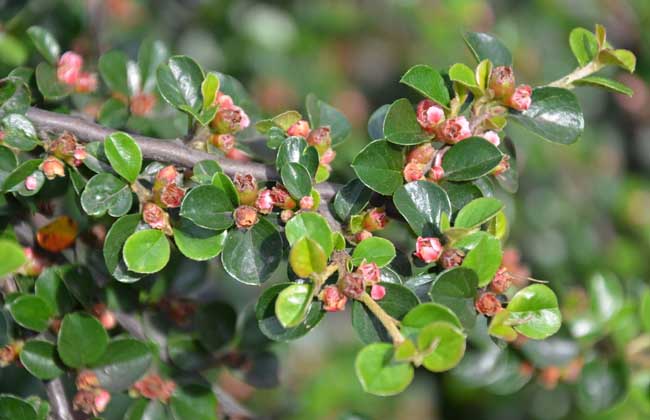
Cotoneaster horizontalis, also known as creeping cotoneaster, little-leaf cotoneaster, and dwarf red cotoneaster, is a semi-evergreen creeping shrub of the genus Cotoneaster in the rose family. As an excellent material for rock gardens, courtyards, green spaces, wall edges, and corners, it can be used as ground cover and for making bonsai; its fruiting branches can also be used in flower arrangements, and it can serve as a foundation planting or be made into bonsai. Let's take a look at how to grow Cotoneaster horizontalis!
Growth habits of Cotoneaster horizontalis
Cotoneaster horizontalis prefers a warm, humid, semi-shaded environment. It tolerates dry and barren soil, does not tolerate damp heat, has a certain degree of cold hardiness, and fears waterlogging. It is distributed in Shaanxi, Gansu, Hubei, Hunan, Sichuan, Guizhou, and Yunnan in China, growing in shrub thickets or on rocky slopes at an altitude of 2000-3500 m. It is also distributed in Nepal.
Propagation methods for Cotoneaster horizontalis
1. Sowing: Cotoneaster horizontalis is commonly propagated by cuttings and seeds. Seeds can be sown in autumn, or stored in damp sand and sown in spring. Fresh seeds can be sown immediately after collection, while dry-stored seeds should be sown in early spring in January-February. Transplanting is best done in early spring, and large seedlings need to be moved with a soil ball.
2. Cuttings: Cotoneaster horizontalis can be propagated by cuttings in spring or during the plum rain season. Spring cuttings require warmth and moisture retention, using mountain soil or peat soil as the substrate. Cuttings taken during the plum rain season especially need a substrate with good aeration. Softwood cuttings in summer have a high survival rate.
How to grow Cotoneaster horizontalis
1. Transplanting: Keep the temperature in the Cotoneaster horizontalis seedling shed at around 28°C and the humidity above 90%. Spray water once each at 8:00-9:00 and 16:00-17:00 every day, but do not make the soil too wet; keeping the leaf surface moist is sufficient. To prevent bacterial infection, spray a 0.2% carbendazim solution once on the 7th day after cutting for full disinfection. Start hardening the seedlings after 40 days, and transplant after 5-6 days of hardening.
2. Humidity: Cotoneaster horizontalis likes a humid or semi-dry climate environment. The relative air humidity of the growing environment should be 50-70%. When the relative air humidity is too low, the lower leaves turn yellow and fall off, and the upper leaves lose their luster.
3. Temperature: Cotoneaster horizontalis is native to subtropical regions, so it has strict requirements for winter temperature. Growth stops when the ambient temperature is below 8°C.
4. Light: Cotoneaster horizontalis has a strong ability to adapt to light. When kept indoors, place it in a spot with bright light as much as possible. After keeping it indoors for a period (about one month), move it outdoors to a shaded spot (with cold protection in winter) for a period (about one month), and alternate between the two.
5. Fertilizer and water: During routine care of potted Cotoneaster horizontalis plants, appropriate fertilizer and water management is also needed. During the winter dormant period, the main task is to control fertilizer and water, with an interval of about 3-7 days. The interval is shorter on sunny days or during high temperatures, and longer or no watering on cloudy and rainy days or during low temperatures.
6. Pruning: In winter, when Cotoneaster horizontalis enters dormancy or semi-dormancy, cut off weak, diseased, pest-damaged, dead, and overly dense branches. Branch organization can also be combined with taking cuttings.
7. Repotting: As long as Cotoneaster horizontalis is cared for properly, it will grow very quickly. When it grows to a certain size, consider giving it a larger pot so it can continue to grow vigorously. For the potting soil and component ratios used for repotting, one of the following can be chosen: vegetable garden soil : cinder = 3:1, or garden soil : medium-coarse river sand : sawdust (mushroom residue) = 4:1:2, or one of paddy soil, pond mud, or leaf mold.