What are the cultivation methods for Echeveria peacockii?
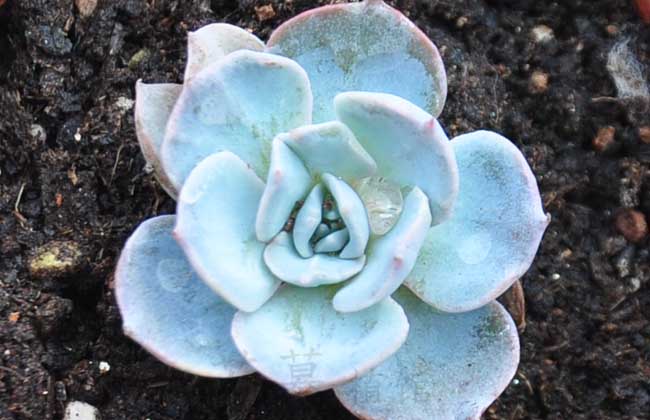
Echeveria peacockii, also known as blue echeveria, is a succulent plant of the genus Echeveria in the Crassulaceae family. The plant is not large and has a short stem that gradually elongates over time to form an old stem. The leaves are densely arranged in a rosette pattern. The plant diameter does not grow very large, and the leaves are relatively thin. It can be planted in small to medium pots for decorating studies, living rooms, bedrooms and offices. Let us take a look below at how to cultivate Echeveria peacockii!
Growth habits of Echeveria peacockii
Echeveria peacockii prefers a warm, dry, sunny and well-ventilated environment, and moderate shade is also acceptable (it cannot tolerate strong light). The optimal growth temperature is 20-30°C. The lower the temperature, the more vivid the flesh color. It is not tolerant of frost, has no obvious dormant period, is drought-tolerant, not cold-tolerant, slightly tolerant of semi-shade, and dislikes waterlogging. In summer when temperatures are high, the plant has a brief dormant period, during which growth slows or stops completely. Spring, autumn and early summer are the main growing seasons for the plant.
Propagation techniques for Echeveria peacockii
1. Sowing: The seeds of Echeveria peacockii are extremely small, so seed propagation cannot be done by dibbling; only broadcast sowing can be used. The specific method is to take a sheet of white paper and fold it in half, place the seeds in the crease of the folded paper, and then gently tap the white paper while sowing so that the seeds are evenly distributed into the area.
2. Cuttings: Echeveria peacockii can be propagated by both leaf cuttings and stem cuttings, with relatively high survival rates. The two methods are fairly similar in operation, but most people use leaf cuttings as the main method, as it is both simple and convenient and easy to survive. Simply remove a well-grown offset and insert it directly into a sand bed.
How do you cultivate Echeveria peacockii?
1. Soil: Echeveria peacockii is a medium-to-large plant. Depending on its growth condition, it can be repotted once every 1-3 years. The pot diameter can be 1-2 cun larger than the plant diameter, which promotes plant growth. For the soil mix, generally use one part each of peat, vermiculite and perlite, and add an appropriate amount of bone meal. Alternatively, mix 3 parts leaf mold, 3 parts river sand, 1 part garden soil and 1 part furnace slag.
2. Watering: During the growing season, water Echeveria peacockii thoroughly after the soil has dried out. When the air is dry, sprinkle water around the plant, but water should not accumulate on the leaf surface, especially in the center of the leaf rosette, otherwise it will cause heart rot. Reduce watering during high-temperature periods. During the growing season, water thoroughly after the soil dries out and keep it appropriately dry. When the winter temperature is below 5°C, control watering.
3. Fertilizing: Do not fertilize Echeveria peacockii during the high-temperature summer dormant period. During the growing season, fertilize appropriately, generally about once every 20 days, but do not let the fertilizer liquid touch the leaf surface when fertilizing. Fertilizing is generally done on a clear morning or evening. Water thoroughly once on the evening of the same day or the morning of the next day to dilute any residual fertilizer liquid in the soil.
4. Light: Echeveria peacockii needs sufficient sunlight for the leaf color to be vivid and for the plant shape to be more compact and attractive. Too little sunlight results in pale leaf color, loosely arranged leaves, stretching, and thinner leaves. In summer, shade is needed and watering should be controlled. In winter, place it indoors in a sunny spot for cultivation.
5. Temperature: In winter, place Echeveria peacockii indoors in a spot with ample sunlight. If the minimum nighttime temperature is around 10°C and there is a certain temperature difference between day and night, you can water appropriately and fertilize as needed to keep the plant growing. If such a high temperature cannot be maintained, control watering, keep the potting soil dry, and stop fertilizing to let the plant go dormant; it can also tolerate low temperatures of 5°C.
6. Pests and diseases: Common problems of Echeveria peacockii include rust disease, leaf spot disease and root-knot nematode damage. They can be controlled by spraying with 75% chlorothalonil wettable powder at 800 times dilution, and root-knot nematodes can be controlled with 3% carbofuran granules. Among insect pests, there is damage from the black vine weevil, which can be killed by spraying with 25% carbaryl wettable powder at 500 times dilution.