Detailed Explanation of the Key Points of Firecracker Vine Planting Techniques
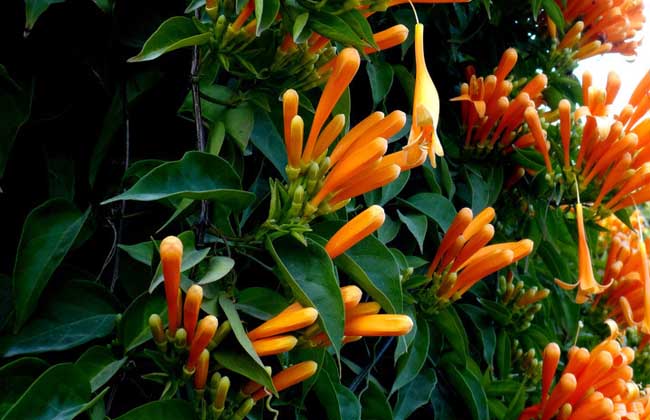
Firecracker vine, also known as firecracker flower, yellow eel vine, etc., is a climbing plant of the genus Pyrostegia in the family Bignoniaceae. It is native to Brazil in South America and has been widely cultivated in tropical Asia as an ornamental pergola plant for gardens. It is mostly planted around garden buildings and climbs on trellises. In early summer, its red-orange flowers hang in dense clusters, resembling firecrackers, hence the name firecracker vine. Now let us take a look at firecracker vine planting techniques!
Growth Habits of Firecracker Vine
Firecracker vine prefers sunny environments and fertile, moist, acidic soil. It grows rapidly and, in South China, can remain evergreen and overwinter outdoors. Because tendrils mostly grow at the stem nodes of the upper branches and vines, the whole plant can attach itself to other objects for growth. It is cultivated in Guangdong (Guangzhou), Hainan, Guangxi, Fujian, Taiwan, China, Yunnan (Kunming, Xishuangbanna) and other places in China.
Propagation Techniques for Firecracker Vine
1. Layering: Layering mainly uses vines that have fallen to the ground. Wound the bark at the leaf axils and cover with soil. It can be done in spring, autumn and summer, and summer is the most suitable. After 20 to 30 days, it can take root. After one and a half months, cut it off to form a new plant, and it can bloom in the same year. It is mostly grown in pots. Alternatively, layer directly in a container without moving it to a nursery bed for seedling cultivation.
2. Cuttings: For cuttings, in mid-to-late March, select 1-year-old robust branches as cuttings, insert them into a wet sand bed, and mist to maintain moisture. When the air humidity stabilizes at around 20°C, roots develop about 25 days after insertion, and the survival rate can reach 70%. After about 1.5 months, they can be moved to a nursery for cultivation. 1-year-old seedlings can be planted out, bloom the following year, and form a landscape in the third year. Old stems can also be used for cuttings inserted into fertile sandy loam, kept in semi-shade, and they begin to take root after about 50 to 60 days, allowing them to sprout branches and leaves freely that year.
Firecracker Vine Planting Techniques
1. Soil: Firecracker vine is not strict about soil requirements, but when cultivated in fertile soil rich in organic matter, well-drained and with a deep soil layer, it grows more vigorously. For the growing medium, mainly select leaf mold, garden soil, mountain soil, etc., and apply an appropriate amount of decomposed compost, soybean cake, bone meal and other organic fertilizers as base fertilizer.
2. Watering: Watering should follow the principle of watering when dry and stopping when wet, and stagnant water in the pot must be avoided. In summer, when temperatures are high, watering should be sufficient, and water should also be sprinkled on the ground near the flower pot to increase air humidity. In autumn, flower bud differentiation begins, and watering should be appropriately reduced at this time to control vegetative growth and promote flower bud differentiation.
3. Temperature: Firecracker vine is not cold-tolerant, and in northern regions it must be moved indoors to overwinter in winter. During overwintering, place it indoors in a spot with ample sunlight, control watering, stop fertilizing, and keep the room temperature above 10°C.
4. Fertilizing: Fertilizing firecracker vine should mainly focus on phosphorus fertilizer. During the growing season, generally apply a dilute liquid fertilizer combining nitrogen and phosphorus about once every 2 weeks. During the bud stage, apply a liquid fertilizer mainly based on nitrogen once to promote flowering and plant growth.
5. Pests and Diseases: Common diseases of firecracker vine include leaf spot and powdery mildew, which can be sprayed with 50% carbendazim wettable powder at 1500 times dilution. Pests include whiteflies and scale insects, which can be killed by spraying with 40% omethoate emulsifiable concentrate at 1200 times dilution.
6. Pinching: When firecracker vine seedlings grow to about 70 cm tall, a trellis should be set up, and their branches should be guided onto the trellis. Pinching is also needed to promote the sprouting of side branches, which helps produce more flowers.
Precautions for Planting Firecracker Vine
1. Firecracker vine grows quickly, blooms abundantly, and has a long flowering period, so fertilizer and water must be sufficient. During the growing period, apply a top dressing once a month. The top dressing should preferably be decomposed dilute soybean cake water or compound chemical fertilizer to promote luxuriant branches and leaves and flowers all over the branches.
2. When planting firecracker vine, keep the soil moist. The frequency of watering should depend on the moisture condition of the soil. In hot summer, in addition to watering, spray water on the branches and leaves 2 to 3 times a day and sprinkle water on the surrounding ground to increase air humidity.
3. Firecracker vine has tendrils and can climb upward with the help of other objects. When growing at home, in order to improve the ornamental effect, a large and deep flower pot can be chosen for planting. When the seedlings grow to a certain height, set up a flower frame in the pot, guide and tie the stems and vines onto the flower frame, and pay attention to even distribution. Place it on a balcony with ample sunlight for care.
4. Firecracker vine can be planted in a large pot, with a flower frame set up on the balcony to let it climb upward. When the branches grow to a certain height on the supporting object, they need to be topped to promote the sprouting of new branches, so as to produce more flowers. Branches that have already bloomed will not bloom again the following year, while newly grown branches need to form buds. Therefore, some old branches and weak branches should be pruned in time to avoid consuming nutrients and affecting flowering the next year.
5. In winter, transplant firecracker vine with soil to the center of a lawn or an open area in front of the door, and support it with bamboo to prevent lodging. It relies on tendrils for attachment and growth. During the growing period, never turn the vines or break the tendrils, otherwise it will affect the absorption of water and nutrients, resulting in poor flowering or even no flowering.