What to do when the leaves of the mini pineapple cactus (Mitrophyllum) wrinkle? Causes and solutions
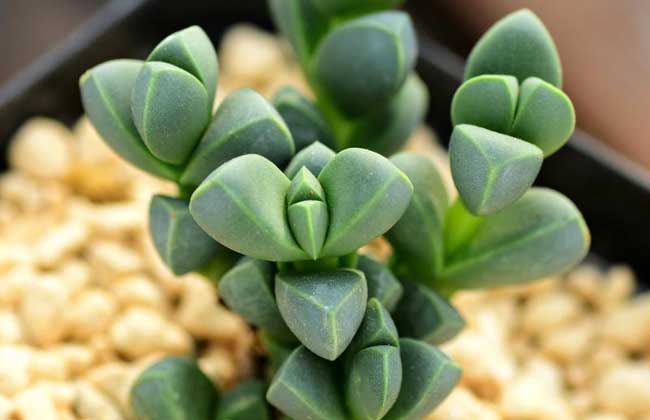
Mitrophyllum is a succulent plant of the genus Mitrophyllum in the family Aizoaceae. Its leaf shape and leaf color are quite beautiful, with high ornamental value. Many people, when growing Mitrophyllum, feel that although they have been watering and fertilizing it well all along, some problems still appear. Generally, these problems can be summarized as the leaf surface becoming wrinkled and cracks appearing on the leaves. Below let us take a look at what to do if Mitrophyllum gets wrinkled!
What should I do if my Mitrophyllum gets wrinkled?
1. Too little watering: because Mitrophyllum lacks water, the water supply to the leaves is insufficient, which causes the leaves to lack water, resulting in wrinkling, or the appearance of cracks or openings. At this time, the amount of water should be increased.
2. Too much watering: because Mitrophyllum is watered too much, the roots rot, which affects the water supply to the leaves. If the above problems occur, it is recommended to cut off the rotten roots, then do not water. After the soil dries, water a little less, and wait for the roots to grow back.
3. Direct strong light: in summer, if direct light rather than diffused light is used, the leaves under direct light will also lack water, because transpiration is too strong, causing cracks or wrinkling. It is recommended to place it in a semi-shaded place in summer for diffused light.
How to grow Mitrophyllum well?
1. Soil: for growing Mitrophyllum, loose and airy sandy soil is best. Of course, it does not necessarily have to be sandy soil; the soil mix can be the same as for other succulents.
2. Environment: Mitrophyllum should be kept in a sunny environment. If it is newly planted, it can be acclimated in a cool and ventilated place.
3. Watering: Mitrophyllum does not need the soil to remain moist for a long time; the soil should be kept on the dry side, so when watering, you must control your hands. It is drought-tolerant and not easy to die from drought, but it is prone to root rot from water accumulation.
4. Pests and diseases: when potted Mitrophyllum is kept in excessively high humidity, root-knot nematode disease often occurs, and 3% carbofuran granules can be used for control. Pests include scale insects, which can be sprayed and killed with 55% fenitrothion emulsifiable concentrate at 1500 times dilution.
Notes on growing Mitrophyllum
1. If Mitrophyllum is potted, the soil in the pot needs to drain and be ventilated. It must not accumulate water. The soil should not be too acidic; neutral is fine. The soil should not have too much humus; ordinary soil is enough. The size of the pot depends on the length and size of its roots.
2. Mitrophyllum neither likes moisture nor dryness. It is generally recommended not to water until the soil is dry. In summer, a certain humidity should be maintained, and more water can be sprinkled on the leaves.
3. For the growth of Mitrophyllum, it is generally recommended to use diffused light. In summer, because the temperature is too high, it is recommended to place it in a cool place to grow, keeping the soil from drying out. In spring and autumn, growth is vigorous, so appropriate light can be given.
4. During the growing period of Mitrophyllum, it is generally recommended to fertilize in spring and autumn, using dilute fertilizer, once every half a month or 1 month.
5. The recommended growing temperature for Mitrophyllum is around 20°C. If it is below 15°C, it will not grow, but if it is below 5°C, then it will stop growing and even develop wrinkles. In summer, place it in a ventilated and cool place as much as possible.