How to Grow and Care for the Succulent Blue Bean
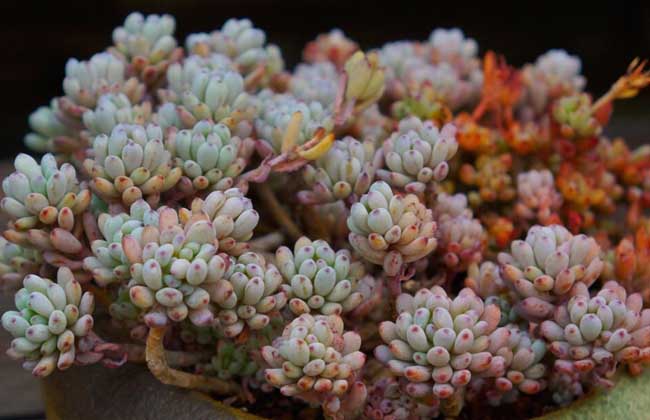
Blue Bean is a rare perennial herbaceous variety in the genus Graptopetalum of the Crassulaceae family, and one of the few fragrant succulents. It is native to northeastern Mexico. The plant's leaves are light blue and oblong; under strong light and large day-night temperature differences, or during low winter temperatures, the leaf color turns a very beautiful blue-white. Let's take a look at how to grow Blue Bean below!
Blue Bean's Growth Habits
Blue Bean prefers a warm, dry environment with plenty of sunlight. It is drought-tolerant and averse to waterlogging. If kept in a shaded spot for a long time, the plant becomes loose in shape with sparse leaves and is difficult to flower. Do not water too much normally, to avoid root rot caused by overly wet soil. Ensure good ventilation during high summer temperatures.
Blue Bean's Propagation Methods
Blue Bean can be propagated by division when repotting, or during the growing season by laying plump, healthy fleshy leaves flat on sandy soil for leaf cuttings. After planting, keep the soil slightly moist; many new shoots will grow from the wound at the base. Once these shoots are somewhat larger, remove them and plant them separately to become new plants.
How to Grow Blue Bean
1. Soil: Blue Bean prefers humus-rich sandy loam and can also adapt to poor soil. Use loose, fertile, well-aerated sandy soil for the pot; mix 3 parts leaf mold, 3 parts river sand, 1 part garden soil, and 1 part cinder, and add a small amount of calcium materials such as bone meal.
2. Watering: For Blue Bean, follow the principle of "don't water until dry, and water thoroughly when you do," avoiding water accumulation in the pot, otherwise root rot will occur. When the air is dry, sprinkle water around the plant, but do not let water accumulate on the leaf surface, especially in the center of the leaf rosette, otherwise it will cause heart rot; in particular, avoid prolonged rain.
3. Sunlight: Blue Bean tolerates high temperatures and strong sun, but overly strong light easily ages the leaves and affects the ornamental effect. Therefore, in hot weather, place it on a balcony or windowsill that gets sunlight in the morning and evening. Under strong light and large day-night temperature differences, or during low winter temperatures, Blue Bean's leaf color turns a very beautiful blue-white.
4. Temperature: In winter, place Blue Bean indoors in a sunny spot. If the nighttime minimum temperature is around 10°C and there is a certain day-night temperature difference, you can water appropriately and fertilize as needed to keep the plant growing. If such a high temperature cannot be maintained, control watering, keep the pot soil dry, stop fertilizing, and let the plant go dormant; it can also tolerate low temperatures of 5°C.
5. Fertilizing: During the growing season, apply a diluted decomposed liquid fertilizer or a low-nitrogen, high-phosphorus-potassium compound fertilizer about once every 20 days, though fertilizing is optional. When fertilizing, do not splash the fertilizer solution onto the leaves. Fertilizing is generally done on a clear morning or evening; water thoroughly once that evening or the next morning to dilute any residual fertilizer solution in the soil.
6. Pests and Diseases: Blue Bean is often affected by rust disease, leaf spot disease, and root-knot nematodes. It can be controlled by spraying 75% chlorothalonil wettable powder at 800 times dilution, and root-knot nematodes can be controlled with 3% carbofuran granules. Among insect pests, the black weevil causes damage; spray 25% carbaryl wettable powder at 500 times dilution to kill them.