What fungicide works well to control orchid leaf blight?
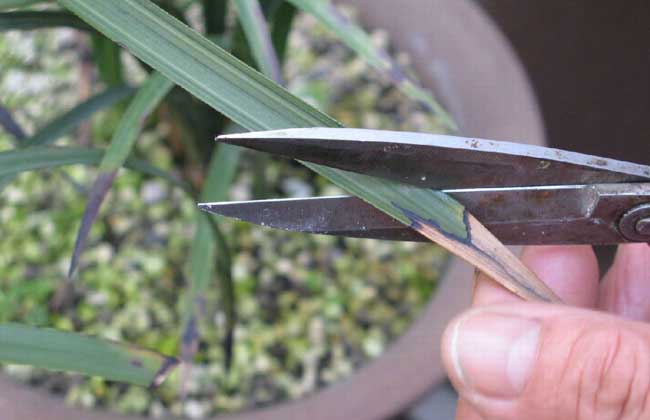
Orchid leaf blight is a relatively serious disease that harms orchids. It usually spreads quickly to the branches and leaves of the orchid, and the disease progresses very fast. In just a few days, the entire diseased seedling turns yellow and dies. It is somewhat similar to soft rot, except that after a plant dies from leaf blight there is no off odor, whereas when a plant with soft rot is pulled up and smelled, it has a foul odor. Let us take a look below at what fungicide should be used for orchid leaf blight!
Symptoms of orchid leaf blight
In orchid leaf blight, diseased seedlings on one side of either new growths or old growths begin to turn yellow (in the case of metabolism, at most the leaves turn yellow one patch at a time, whereas with this disease almost the entire plant turns yellow at the same time. With metabolism, only old leaves turn yellow, while leaf blight occurs regardless of whether the growth is old or new). In just a few days, the entire diseased seedling turns yellow and dies. In severe cases, plants become diseased one after another until the entire pot of orchids all dies.
Occurrence pattern of orchid leaf blight
Orchid leaf blight is a disease caused by fungi, and the pathogen is Colletotrichum gloeosporioides of Phalaenopsis. The pathogen overwinters or oversummers on diseased leaves. When conditions are suitable, the pathogen spreads and spreads through wind and rain and through water droplets splashing during watering. It mainly invades through wounds, but can also directly invade through the epidermis of young leaves. From April to July is the period when old leaves become diseased, and from late May to June it enters the peak period of disease occurrence. From July to November is the period when new leaves become diseased, and new leaves are affected more severely than old leaves. In the Guangdong area, disease begins in mid-December each year, damage is severe in March of the following year, and after May the disease tends to stabilize. Disease is likely to occur under conditions of suitable temperature, high relative humidity, or moist leaf surfaces, and disease is severe where soil is compacted, potted flowers are placed too densely, and ventilation and light penetration are poor.
What fungicide should be used for orchid leaf blight?
1. Strengthen management: The greenhouse should be ventilated and allow light through, flower pots should not be placed too densely, and new soil should be replaced when potting. Remove diseased leaves and their residues in a timely manner to eliminate sources of infection and prevent the disease from spreading.
2. Chemical control: Before disease onset, 0.5-1% Bordeaux mixture, or 65% zineb wettable powder at 600-800 times dilution, can be sprayed once every 7-10 days, giving a relatively good protective effect. During disease occurrence, 50% carbendazim at 800 times dilution or 75% thiophanate-methyl at 1000 times dilution can be sprayed, and both can control the spread of the disease.