Detailed Explanation of the Planting Methods and Key Points for French Marigold
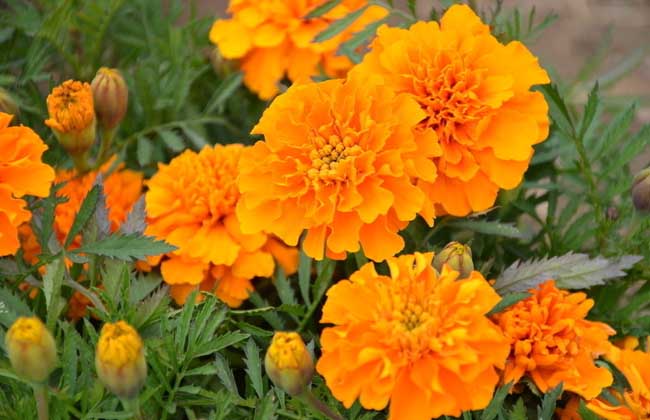
French Marigold, also known as dwarf marigold, red-yellow herb, western marigold, stinking chrysanthemum flower, satin flower, etc., is an annual herbaceous plant of the genus Tagetes in the Asteraceae family. It is native to Mexico and is commonly cultivated in gardens across China. It has become naturalized in central and northwestern Yunnan, central and southwestern Sichuan, and western Guizhou. Let us take a look at the planting methods for French Marigold!
Growth Habits of French Marigold
French Marigold grows on hillside grasslands and in forests at altitudes of 750-1600 m, or is cultivated in gardens. It loves sunlight, but can also bloom when planted in semi-shade. It is not demanding about soil, tolerates transplanting, grows rapidly, and is very easy to cultivate and manage. Seeds that fall to the ground can grow on their own under suitable temperature and humidity conditions, making it a flower with very strong adaptability.
Propagation Methods for French Marigold
1. Seed propagation: French Marigold seed propagation is carried out from November to March. Seeds sown in winter and spring bloom from March to May. Sowing can be done directly in the courtyard or in pots. For pot cultivation, about 1 month after sowing, the seedlings can be dug out and planted into pots.
2. Cutting propagation: For French Marigold cutting propagation, from June to August, cut tender branches about 10 cm long and insert them directly into the courtyard, with shading and covering; they grow rapidly, and can also be inserted directly into flower pots. Cuttings taken in summer and autumn bloom from August to December. Whether inserted in the ground or in a cutting bed (pot), the cuttings can survive.
Planting Methods for French Marigold
1. Transplanting into pots: For French Marigold raised in plug trays, transplanting into pots should be done when it grows to 2-3 pairs of true leaves. In the Zhejiang area, most people are accustomed to using 12 cm diameter nutrition pots, planting into the final pot in one step without another repotting. If sowing is done by broadcasting in open seedling trays, then sow thinly, and at 2-3 pairs of true leaves, directly transplant the seedlings into pots.
2. Light regulation: French Marigold is a sun-loving plant, and both growth and flowering require ample sunlight. Sufficient light also helps prevent the plants from becoming leggy. However, in our province from July to September, direct sunlight should be avoided, and shading and cooling are needed around noon.
3. Temperature control: After French Marigold is potted, the temperature can be reduced from 22°C to 18°C. After a few weeks, it can be lowered to 15°C. Before and after flowering, it can go as low as 12-14°C. This temperature is ideal for forming a good plant shape, but in actual production it may be difficult to achieve these conditions. Therefore, generally speaking, as long as it is above 5°C it will not suffer frost damage, and it can grow well between 10-30°C.
4. Water management: The key to water management for French Marigold is to use a well-drained medium. Although keeping the medium moist is important, proper drying before each watering is necessary. Of course, the medium must not be allowed to become too dry and cause the plants to wilt.
5. Fertilization method: For French Marigold cultivated entirely in artificial medium, fertilization should use 20-10-20 and 14-0-14 fertilizers, applied alternately once every 7-10 days at a concentration of 200-250 ppm. When the temperature is relatively low in winter, reduce the use of 20-10-20 fertilizer. If the medium is ordinary soil, a compound fertilizer can be mixed in an appropriate amount as a base fertilizer before potting the medium. If fertility is insufficient, then apply a water-soluble fertilizer as a top dressing.
6. Pest and disease control: Common diseases of French Marigold include brown spot and powdery mildew, which are fungal diseases. A good site should be chosen for cultivation, and attention should be paid to drainage and irrigation, removing diseased plants and leaves, burning residual branches, and promptly spraying fungicides such as rust powder.