How to grow Echeveria pulvinata well? A detailed guide to its cultivation methods
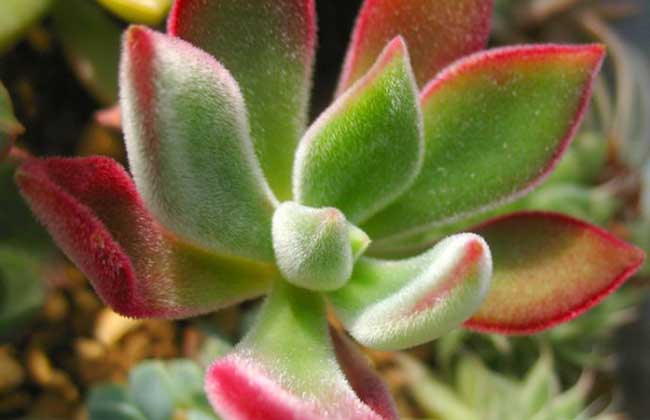
Echeveria pulvinata, also known as Golden Bear's Paw, Chenille Plant, Cat's Ears and so on, is a succulent plant of the genus Echeveria in the family Crassulaceae. Its thick, fleshy leaves are covered with fine, short white hairs. In an environment with abundant sunlight and a large temperature difference, the leaf edges will be edged with a ring of brilliant red, and in winter or early spring it will bloom with strings of small orange-red flowers, very beautiful. Let's take a look below at how to grow Echeveria pulvinata well!
The cultivation value of Echeveria pulvinata
Echeveria pulvinata is a relatively commonly cultivated succulent plant. Its thick, fleshy leaves are covered with fine, short white hairs, and the red at the tips of the leaf margins is bright and eye-catching, complementing the strings of small orange-red flowers that bloom in winter and early spring, exceptionally beautiful. Potted plants decorating balconies, desks and tea tables are vivid and interesting.
The growth habits of Echeveria pulvinata
Echeveria pulvinata has a robust constitution, is drought-tolerant and avoids waterlogging. It likes light and also tolerates partial shade. It is suited to a cool, dry and sunny environment, and avoids dampness and muggy heat. During the growing season, do not water too much; if the potting soil is too wet, the stems and leaves will grow leggy, the distance between leaves will lengthen, the plant will not be compact, and its ornamental value will be reduced. It can grow normally in partial shade, but the red at the leaf margins and leaf tips will fade and even disappear. Its resistance to ultraviolet rays is very strong.
The propagation methods of Echeveria pulvinata
Echeveria pulvinata can be propagated by cuttings during the growing season; both stem cuttings and leaf cuttings can survive. For stem cuttings, generally cut off a top shoot with leaves, about 10 cm long, and insert it into sandy soil; it will root in 10-15 days. For leaf cuttings, cut off a leaf, let the cut dry, then insert it or lay it flat on a sand bed, keep it slightly moist, and it will root in about 20 days. Leaf cuttings are relatively difficult, so side shoots are often cut off for cuttings.
How to grow Echeveria pulvinata well?
1. Environment: Echeveria pulvinata likes a dry, warm and sunny environment and requires well-drained sandy loam. It avoids water accumulation and fears low temperatures. In winter, the room temperature is best kept at around 10°C.
2. Fertilizing: During the growing season of Echeveria pulvinata, fertilize once a month to keep the leaves green and verdant. Each application must not be too concentrated; concentrated fertilizer damages the roots. However, excessive fertilizing causes the internodes to lengthen and affects the plant's form. If the branches grow leggy or age, they can be cut short and fertilized to renew and rejuvenate them. Apply a dilute fertilizer low in nitrogen and high in phosphorus and potassium once every 15-20 days. When fertilizing, be careful not to splash the fertilizer water onto the leaves, so as not to form unsightly spots that are difficult to remove.
3. Watering: During the growing season of Echeveria pulvinata, do not water too much. If the potting soil is too wet, the stems and leaves are prone to leggy growth, and the leaves and roots are prone to rot, losing ornamental value. Especially under low-temperature conditions in winter, excessive water can easily cause the roots to rot and die.
4. Repotting: Repot Echeveria pulvinata every year in early spring, adding a mixed soil of loose, fertile leaf mold, potting soil and coarse sand.
5. Summer: In summer, Echeveria pulvinata will have a brief dormancy under high temperatures, and the lower leaves will dry up and drop. Reduce watering, and balcony cultivation must never be drenched by sudden rain showers.
6. Winter: In winter, place Echeveria pulvinata indoors in a sunny spot, keep the temperature at 6-8°C, and restrict watering to prevent root rot caused by low temperature and dampness.