Weigela care: growing methods and maintenance tips
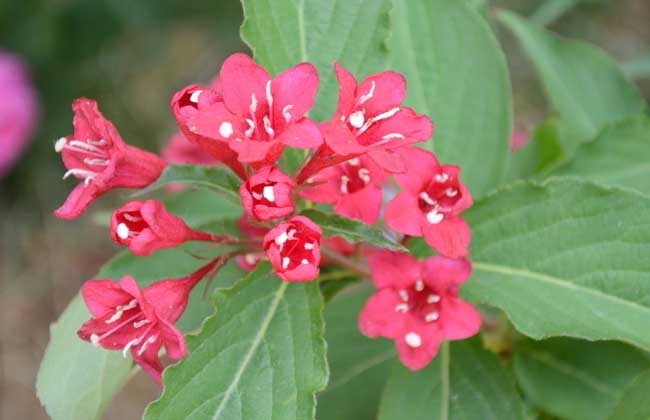
Weigela is also known as five-color crabapple, mountain sesame, and sea fairy flower, among other names. It is a deciduous shrub of the genus Weigela in the honeysuckle family, with dense branches and leaves and brilliant flower colors, and its flowering period can last more than two months. It is suitable for group planting at courtyard wall corners and lakesides, and can also be used as a flower hedge or in group plantings at the edges of groves, or dotted on rockeries and slopes. Now let us take a look at how to grow weigela!
Growth habits of weigela
Weigela is distributed in Heilongjiang, Jilin, Liaoning, Inner Mongolia, Shanxi, Shaanxi, Henan, northern Shandong, northern Jiangsu and other places in China, growing under mixed forests or in mountain-top shrub thickets at altitudes of 100-1450 m. It likes light, tolerates shade and cold, and is not strict about soil, capable of tolerating poor soil, but grows best in deep, moist soil rich in humus, and fears waterlogging. It has strong sprouting ability and grows rapidly.
Propagation methods of weigela
1. Sowing: Weigela seeds can be harvested from September to October, sown directly, or soaked in cold water for 2-3 hours one week before sowing. Sowing should be done in windless weather with no heavy rain in the near future, and the bed surface should be leveled and finely worked. The sowing method can be broadcast sowing or drilling on the bed surface, with a sowing rate of 2 g/sq m. After sowing, the soil cover must not exceed 0.3 cm in thickness. Keep the bed surface moist within 30 days after sowing, and seedlings emerge in about 20 days.
2. Cuttings: Variant types of weigela should be propagated by cuttings, as seed propagation makes it difficult to maintain the traits of the variant. The ground temperature should be 25-28°C, the air temperature should be 20-25°C, the air humidity in the shed should be 80%-90%, and the light transmittance should be about 30%. Roots can form in 50-60 days, with a survival rate of about 80%.
3. Layering: Weigela can be propagated by layering during the growing season by pressing its stems into the soil. Usually after flowering, select lower branches for layering; lower branches tend to be prostrate, and roots form and survive easily at the nodes.
4. Division: Division propagation of weigela is usually carried out in early spring and autumn and winter, generally around spring bud break in combination with transplanting. Dig out the whole plant, divide it into several clumps, and replant them separately.
How to grow weigela
1. Fertilizing: When growing weigela in pots, mix 3 parts garden soil with 1 part rice-hull ash, and add a small amount of barnyard manure and the like as base fertilizer. When planting, apply rotted compost as base fertilizer, then every 2 to 3 years during the winter or early spring dormant period, dig a trench around the roots and apply fertilizer once. During the growing season, fertilize 1-2 times a month.
2. Watering: Pay attention to watering during the growing season of weigela. After spring bud break, gradually increase the amount of watering and keep the soil moist regularly. High temperatures and drought in summer can easily cause leaves to turn yellow and shrivel and branches to wither, so keep sufficient moisture and spray water to cool the plant or move it to a semi-shaded, moist place for care. Water thoroughly 1 to 2 times a month to meet its growth needs.
3. Pruning: Weigela has a relatively long growing period, and before winter the small branches at the top often do not grow fully and are very likely to dry up when overwintering. Therefore, before spring bud break each year, the dead branches at the top of the plant as well as other old, weak, diseased and pest-damaged branches should be cut off, and long branches should be shortened. If seeds are not to be kept, the spent flower branches should be cut off promptly after flowering to avoid consuming too many nutrients and affecting growth. For branches that have grown for 3 years, cut them off from the base to promote robust growth of new branches.
4. Pests and diseases: Weigela has few pests and diseases, with occasional damage from aphids and red spider mites, which can be killed by spraying dimethoate.