How to Grow Oleander? A Complete Guide to Cultivation Methods
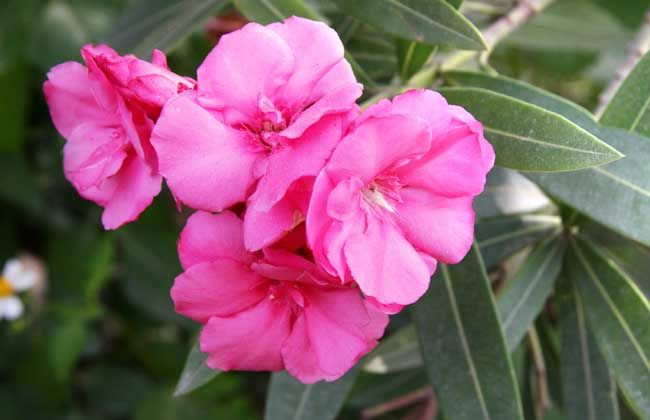
Oleander is an evergreen, upright large shrub of the genus Nerium in the dogbane family (Apocynaceae). Its flowers are large, showy and long-blooming, and it is often grown as an ornamental plant. It is cultivated in all provinces and regions of China, especially in the south, and is commonly planted in parks, scenic areas, along roadsides or beside rivers and lakes. Where it is grown north of the Yangtze River, it must overwinter in a greenhouse. Let's take a look at how to grow oleander!
Oleander's Growth Habits
Oleander prefers a warm, humid climate and is not very cold-hardy. South of the Yangtze River basin in China it can be planted in the open ground, but in Nanjing the branches and leaves sometimes freeze and wither, and young seedlings may even freeze to death. In the north it can only be grown in pots for ornamental purposes and overwintered indoors. The white-flowered varieties are slightly more cold-hardy than the red-flowered ones. Oleander is not tolerant of waterlogging and should be planted in a high, dry spot with good drainage. It likes light and is fond of fertilizer, and can also adapt to a fairly shady environment, but when planted in shade it produces fewer and paler flowers. It has strong suckering ability, and the tree recovers easily after damage.
The Cultivation Value of Oleander
1. Ornamental: Oleander is a well-known ornamental flower. Its leaves resemble those of willow or bamboo, and its red flowers blaze brilliantly, surpassing even peach blossoms. The corolla ranges from pink to deep red or white, with a distinctive fragrance. The flowers are clustered at the tips of the branches, gathering together like an open umbrella, funnel-shaped, with overlapping petals, in three colors: red, yellow and white.
2. Environmental protection: Oleander has the ability to resist smoke, dust and toxic substances, purify the air and protect the environment. Its leaves are toxic to humans and have a strong resistance to harmful gases such as sulfur dioxide, carbon dioxide, hydrogen fluoride and chlorine. Even when covered all over with dust, it can still grow vigorously, and people call it the “guardian of the environment”.
3. Medicinal: Oleander root bark has the effects of strengthening the heart and killing insects; the leaves have the effects of strengthening the heart, promoting diuresis, resolving phlegm and killing insects; the whole plant has the effects of strengthening the heart, promoting diuresis, inducing sweating, resolving phlegm, dissipating blood stasis, relieving pain, detoxifying and promoting rash eruption. It is used for asthma, epilepsy, heart failure, killing flies and eliminating mosquito larvae.
Propagation Methods for Oleander
1. Sowing: Oleander fruit can be sown as soon as it is collected after ripening. After sowing, it is kept in a greenhouse and only emerges after 3 months. When sown in the open ground in autumn, seedlings emerge successively the following Qingming.
2. Layering: Oleander layering is carried out during the rainy season. A branch near the ground is cut and wounded, then pressed into the soil. After about 2 months it roots and can be separated from the parent plant.
3. Water rooting: Oleander can be rooted in water during the growing season. Cut a 30-40 cm long branch, split the lower end about 4-6 cm with a small knife, and insert it into a glass container filled with water. In spring and autumn, when the temperature is suitable, roots grow in 2-3 weeks. In summer, change the water frequently to prevent it from spoiling and causing root rot.
4. Cuttings: Oleander cuttings must be of good quality, vigorous growth and free of pests and diseases, and should be cut, shortened and planted immediately. To improve the survival rate of cuttings, at the time of planting, tie dozens of cuttings neatly into bundles and soak them in 100 ppm ABT rooting powder No. 1 for 2 to 8 hours, or in 30 to 100 ppm rooting powder No. 6 for 1 to 8 hours.
Cultivation Methods for Oleander
1. Watering: Although oleander likes water, it fears waterlogging. On continuous rainy days, the accumulated water in the pot should be poured out promptly to prevent root rot. Too much watering makes the leaves turn yellow and drop one after another, affecting flowering the following year. In spring and autumn, water according to the principle of "dry-wet cycle," keeping the potting soil moist. Summer is the period of vigorous growth and flowering for oleander, so it needs more water; water once in the morning and once in the evening each day, and be sure to spray and wash the branches and leaves frequently to keep the foliage fresh and green. Move it indoors in mid-October; after moving indoors, watering should be controlled, and never overwater, otherwise it is prone to root rot and leaf drop, affecting growth the following year.
2. Light: Oleander likes sunlight, so during the growing period it should be kept in a spot with plenty of sunlight, otherwise it will produce fewer and paler flowers.
3. Temperature: Oleander should be planted in a sheltered, sunny spot. In winter, move it indoors to protect it from freezing; a room temperature not lower than 0°C is sufficient. If the temperature is too high, nutrients are consumed, which is unfavorable for growth and flowering the following year. Where outdoor temperatures are high in winter, soil can be mounded up around the plant to protect it from the cold.
4. Fertilizing: Oleander likes fertilizer. From the time it is moved outdoors until the flowers fade (First Frost), apply a dilute liquid fertilizer about once every 20 days. After the Beginning of Autumn, oleander grows rapidly; at this time, apply fertilizer solution about once every 15 days until just before it is moved indoors.
5. Pruning: Oleander is generally pruned four times: first after Grain Rain in spring, second during July and August, third during October, and fourth in winter. If you want it to bloom indoors, move it to a sunny spot indoors at around 15°C. Prune immediately after flowering, otherwise the flowers will be few and small, or it may not bloom at all. Pruning keeps the branches evenly distributed, making the flowers large and vivid and the tree shape beautiful.
6. Diseases: Brown spot is an important disease of oleander. In the early stage of the disease, spray 50% benomyl wettable powder at 1000 times dilution, or 25% carbendazim wettable powder at 600 times dilution, or 36% thiophanate-methyl suspension concentrate at 500 times dilution. For the control of black spot, management should be strengthened to increase tree vigor, and when necessary spray 75% chlorothalonil at 700 times dilution.
Note: The entire oleander plant is highly toxic, and accidental ingestion by humans or livestock is dangerous, so it should be avoided planting it near wells and drinking water ponds. The fragrance of oleander flowers can make people drowsy and reduce mental acuity. The milky white sap secreted by the stems, leaves, bark, flowers and fruit all contains a highly toxic substance called oleandrin. Excessive contact can easily trigger cancers of the respiratory and digestive systems, but brief contact in small amounts will not cause much of a problem.