How to grow Graptopetalum paraguayense 'Kisetsu' so it grows multiple heads? Detailed care guide
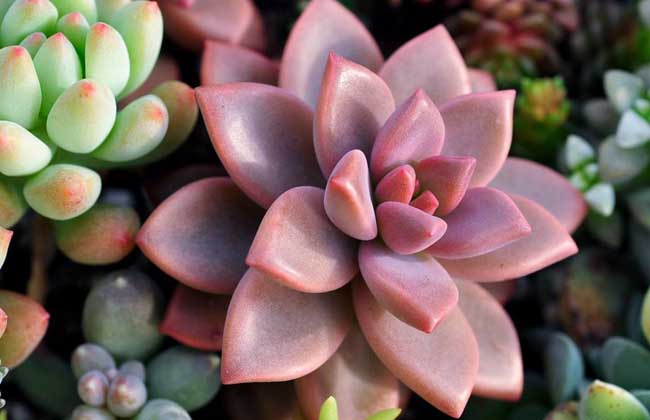
Graptopetalum paraguayense 'Kisetsu' is also known as pink lotus, jewel flower, first frost, variegated petal, and so on. It is a perennial succulent of the genus Graptopetalum in the Crassulaceae family. Its plant form is extremely similar to Graptopetalum paraguayense, with leaves arranged in an elongated rosette and covered in white powder. It is normally green, and when sunlight is sufficient the leaf color turns vermilion with brown, the leaves are melon-seed shaped with relatively pointed tips, and it bears small yellow star-shaped flowers. Now let us take a look together at how to grow Graptopetalum paraguayense 'Kisetsu' to get multiple heads!
Growth habits of Graptopetalum paraguayense 'Kisetsu'
Graptopetalum paraguayense 'Kisetsu' has fairly beautiful leaf shape and leaf color, has a certain ornamental value, and can also be planted indoors to absorb substances such as formaldehyde, with the effect of purifying the air. Graptopetalum paraguayense 'Kisetsu' is native to Mexico, and can now be cultivated in many places in our country. It likes a sunny, warm and dry environment and is drought tolerant. Spring and autumn are the main growing seasons for plants of the genus Echeveria.
Propagation methods of Graptopetalum paraguayense 'Kisetsu'
The propagation speed of Graptopetalum paraguayense 'Kisetsu' is super fast, especially leaf cuttings, with a success rate of almost 100%, making it the top choice for beginners starting with leaf cuttings. Graptopetalum paraguayense 'Kisetsu' can also be propagated by stem cuttings, but old plants of many years also have a special charm. After the branches become woody, the lower leaves can be pulled off for leaf cuttings, and the remaining old plant can be used for single-plant shaping.
How to grow Graptopetalum paraguayense 'Kisetsu' to get multiple heads?
1. Soil: The soil for planting Graptopetalum paraguayense 'Kisetsu' can use a culture soil of half loam and half coarse sand, but the soil should not become waterlogged, otherwise root rot will occur.
2. Light: During the growing season, Graptopetalum paraguayense 'Kisetsu' needs to be placed in sunlight for cultivation. Otherwise it will cause the plant to grow leggy, the plant shape to become loose, the leaves to become thinner, the leaf color to become dull, and the white powder on the leaf surface to decrease.
3. Watering: For watering Graptopetalum paraguayense 'Kisetsu', follow the principle of “do not water until dry, and water thoroughly when watering”, and avoid waterlogging in the potting soil. When the air is dry, water can be sprinkled around the plant, but water should not accumulate on the leaf surface, especially in the center of the leaf rosette, otherwise it will cause heart rot. In particular, take care to avoid prolonged rain exposure.
4. Fertilizing: During the growing season, apply a decomposed dilute liquid fertilizer or a compound fertilizer low in nitrogen and high in phosphorus and potassium once about every 20 days. When fertilizing, do not splash the fertilizer water onto the leaves. It is generally done in the morning or evening on a clear day. Water thoroughly once in the evening of the same day or the morning of the next day to dilute the residual fertilizer liquid in the soil.
5. Summer: In summer, when temperatures are high, Graptopetalum paraguayense 'Kisetsu' can be kept in a well-ventilated place, avoiding exposure to the blazing sun, and watering and fertilizing should be moderated. At this time basically no watering is needed, and the plant can be appropriately misted to lower the temperature.
6. Winter: In winter, place Graptopetalum paraguayense 'Kisetsu' indoors in a place with sufficient sunlight. If the minimum nighttime temperature is around 10°C and there is a certain temperature difference between day and night, it can be watered appropriately and fertilized as appropriate, so that the plant continues to grow. If such a high temperature cannot be maintained, watering should be controlled, the potting soil should be kept dry, and fertilizing should be stopped to let the plant go dormant. It can also tolerate a low temperature of 5°C, and some varieties can even tolerate a low temperature of 0°C.