Detailed Explanation of the Cultivation Techniques and Management Methods of Red Mulberry
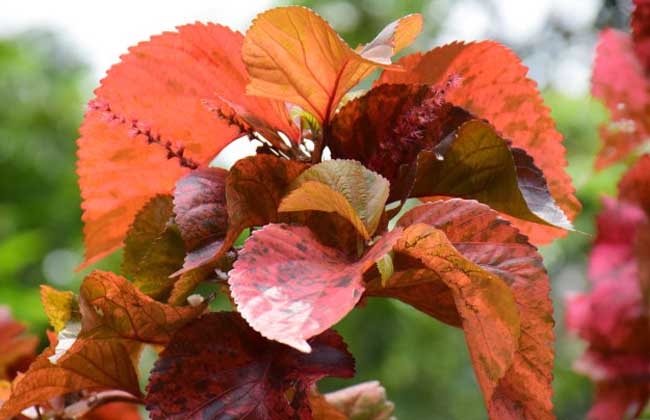
Red mulberry, also known as iron amaranth, blood-seeing sorrow, sea mussel prayer beads, pearl hidden in leaves, etc., is the aboveground part of the plant red mulberry of the Euphorbiaceae family. As an excellent tree species for tropical garden landscaping, it is often cultivated in the south as a hedge and foliage shrub in courtyards and parks, and can be arranged among shrubs to add splashes of color. In the Yangtze River basin it is grown in pots for indoor viewing. Let's take a look at the cultivation techniques of red mulberry below!
Growth Habits of Red Mulberry
Red mulberry is a fairly typical tropical tree species. It prefers high temperatures and high humidity, has low cold resistance, and is not tolerant of frost. When the temperature drops below 10°C, the leaves suffer mild cold damage; with prolonged low temperatures of 6-8°C, the plant is severely damaged. In China, only Hainan, Taiwan, China and the southernmost tip of the mainland allow open-field cultivation; elsewhere it is only suitable for pot cultivation, overwintering in a greenhouse or indoors, with room temperature not lower than 12°C. It likes light and does not tolerate shade, so it should not be grown indoors for long periods. It has relatively high requirements for soil, water and fertilizer conditions, requiring loose, well-drained soil. Its branches are dense and leaves large, with a full crown shape, and it grows poorly in arid, poor soil. For pot cultivation, pond mud or forest soil should be used, with calcium-magnesium phosphate fertilizer mixed with decomposed cake fertilizer as base fertilizer; afterward, depending on leaf growth, a dilute nitrogen fertilizer solution may be sprayed. Stop fertilizing after autumn, and keep the pot soil consistently moist.
Propagation Methods of Red Mulberry
In most regions of China, the heat is insufficient for red mulberry, and it rarely sets seed after flowering, so cuttings are mostly used for propagation. From late March to late April, select healthy 1-year-old branches and cut them into sections about 10 cm long as cuttings. After cutting, soak in water for 1-2 hours, then insert them densely into a moist sand bed. Without shading, keep them moist; in about 20 days they will develop roots and leaves, and in about 1.5 months they can be transplanted to the nursery for growing on. When the seedlings are about 10 cm tall, remove the terminal buds to encourage early development into a bushy crown shape. Cover with plastic film in winter, and the following spring they can be lifted for potting or open-field planting. They can also be potted in autumn or planted into large containers and placed in a warm shed to overwinter.
Cultivation Techniques of Red Mulberry
1. Site selection and land preparation: Red mulberry is not strict about soil, but grows well in slightly alkaline soil and has a certain drought resistance; it grows poorly in fields with poor drainage. Choose a plot with flat terrain, convenient irrigation and drainage, and few weeds, and make level beds. Red mulberry seeds are very small, so land preparation must be fine, achieving level ground and fine soil to facilitate seedling emergence.
2. Apply sufficient base fertilizer: Red mulberry likes fertilizer. Before land preparation, apply 1500 kg of decomposed human and animal manure per mu, then make ridges or beds. The seeding rate varies with sowing time; the earlier the sowing time, the more seed is used. For early spring sowing, the rate is 4-5 kg/mu. Sowing can be done by broadcasting or drilling. After sowing, cover with soil 0.5-1 cm deep.
3. Topdressing and watering: When sown in early spring, seedlings emerge relatively late, taking 7-12 days to emerge. When the seedlings grow to 2 true leaves, the first topdressing can be done at the 3-5 leaf stage, applying 10 kg of urea per mu. A second topdressing is done 12 days later, and a third after the first harvest. After that, apply fertilizer once after each harvest, each time with a dilute liquid fertilizer mainly of nitrogen. If quick-acting nitrogen fertilizer is used, it can be applied together with watering. For spring sowing, water sparingly.
4. Cultivation and pruning: During the seedling growth period of red mulberry, cultivate and weed in time to prevent weeds from affecting the growth of red mulberry seedlings. For red mulberry harvested multiple times, pruning is also needed; that is, after the main branch is harvested, leave 2-3 nodes at the base of the main branch to promote the sprouting of side branches, thereby increasing yield.
5. Timely harvesting: Red mulberry is a leafy vegetable sown once and harvested in batches. The first harvest is mostly combined with thinning. Generally, 40-45 days after sowing, when the seedlings are 10-12 cm tall and have 5-6 leaves, harvest successively along the rows. When harvesting, follow the principle of taking the large and leaving the small, and keeping the remaining seedlings even, to increase later yield, and apply fertilizer after harvest. Red mulberry is mainly eaten for its tender leaves, so harvesting must be timely; otherwise the fiber increases and quality decreases. The yield per mu can reach 1000-1500 kg.
6. Pest and disease control: Red mulberry has strong disease resistance. The main disease is white rust, which can be controlled with triadimefon or mancozeb. The pest is aphids, which can be controlled by spraying with imidacloprid or pirimicarb.