Syngonium cultivation methods and precautions
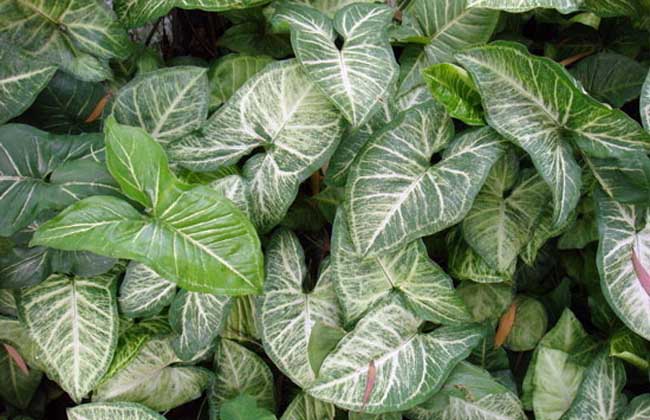
Syngonium, also known as purple-stem taro, cut-leaf taro, silk vine, white butterfly and so on, is a perennial evergreen herbaceous plant in the Araceae family, native to tropical America. Because it is easy to propagate, simple to cultivate, especially shade-tolerant and excellent in decorative effect, it is now widely cultivated around the world as a foliage plant. Let us take a look at the cultivation methods of Syngonium below!
The cultivation value of Syngonium
Syngonium has become one of the more popular indoor potted foliage plants on the international market. In China, the cultivation of Syngonium is very common in the southern provinces. Besides being used as an indoor foliage pot plant, it is used for hanging baskets for ornamental display or with supports for shaping, and is more often used outdoors in semi-shade as ground cover. It is an evergreen trailing herbaceous plant with great development prospects. Large potted pillar-style cultivation can be used for hall display, and in warm regions in semi-shade outdoors, it can be used for trellises and as material for corners, backgrounds, climbing walls and ground cover.
Syngonium propagation methods
1. Cuttings: Syngonium is commonly propagated by cuttings. Vigorous plants often sprout many side branches at the base. When the side branches grow 3 to 5 leaves, the shoot tips above the second node can be cut off, trimmed into cuttings about 10 cm long. If the branches have already grown roots, they can be cut off directly and potted. The cutting bed is best made of fine sand, and the cutting bed temperature should be kept above 25°C to promote rooting. Once new buds grow, they can be potted and planted separately.
2. Tissue culture: Syngonium commonly uses stem tips and lateral buds as explants. After routine disinfection, the stem tips are inoculated on MS medium supplemented with 6-benzylaminopurine 5 mg/L and indoleacetic acid 2 mg/L. After 45 days, the adventitious buds are transferred to 1/2 MS medium supplemented with indoleacetic acid 2 mg/L to induce rooting, and after about 20 to 25 days they become complete small plantlets.
3. Division: Syngonium grows fast, so it should be divided every 2 to 3 years, preferably in April when repotting. The potting soil for potted Syngonium can be a mix of 3 parts pond mud, 1 part compost and 1 part sand.
Syngonium cultivation methods
1. Light: Syngonium has a strong adaptability to light and prefers diffused light, but under too strong sunlight its leaf edges will turn dry and yellow, while too dark light will make the leaves dull. In winter, no shading is needed when giving it light. If kept in a position with insufficient light for a long time, the leaves will grow wildly and the patterns will quickly fade.
2. Watering: Syngonium is a plant that likes moisture and fears drought. In summer, it should be watered sufficiently and the potting soil kept moist, which is beneficial to its stem growth. In winter, watering of Syngonium should be reduced, and its potting soil must not be too wet, otherwise it is easy to cause root rot and leaf withering under low-temperature conditions.
3. Temperature: Syngonium is not cold-tolerant and likes a high-temperature and high-humidity environment. Its general growing temperature is 20 to 30°C, and in winter it must not be lower than 15°C.
4. Fertilizing: Under bright light, Syngonium should be given a dilute fertilizer solution once every two weeks, and a 0.2% solution sprayed once a month. In winter, Syngonium should be fertilized.
5. Soil: Syngonium likes a slightly acidic soil that is high-temperature and high-humidity, loose and fertile, and well-drained. When potting, the soil can be made by mixing leaf mold, peat soil and coarse sand for planting.
6. Pests and diseases: Syngonium is commonly harmed by leaf spot disease and gray mold disease, which can be sprayed with 70% zineb wettable powder at 700 times dilution, and Bordeaux mixture of equal parts can be sprayed routinely for prevention. Pests include whiteflies and thrips that harm stems and leaves, and they can be killed by spraying with 40% omethoate emulsifiable concentrate at 1500 times dilution.
What to do if Syngonium leaves turn yellow?
1. Water-yellow: Caused by overly frequent watering, characterized by no obvious change in old leaves and yellowing of young leaves. In this case, watering should be controlled immediately.
2. Drought-yellow: Caused by lack of water and drought, characterized by old leaves turning yellow first from the bottom up. If the lack of water lasts a little longer, the whole plant's leaves will turn yellow, or even die, so it should be watered in time.
3. Fertilizer-yellow: Caused by overly frequent fertilizing or too high concentration, characterized by young leaves being thick, glossy and uneven. Fertilizing should be controlled, and intertillage and watering should be carried out.
4. Starvation-yellow: Caused by insufficient fertilizer, too low fertilizer concentration, and too long intervals between fertilizing, characterized by yellowing first at the young leaves and tender stems. If fertilizing is not carried out in time after seeing this phenomenon, it will also cause the whole plant's leaves to turn yellow or even die. For flowers lacking fertilizer, never apply a large amount of concentrated fertilizer at one time, so as to avoid burning the roots.