Yucca gloriosa cultivation methods and precautions
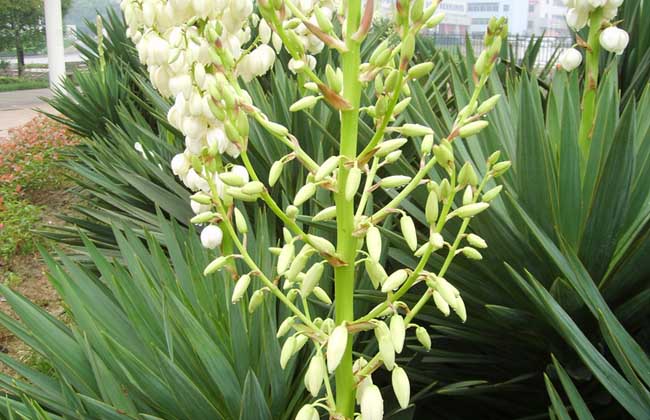
Yucca gloriosa, also known as pineapple flower, thick-leaved yucca, and Spanish dagger, is an evergreen shrub of the genus Yucca in the family Agavaceae. It is native to eastern and southeastern North America, and is cultivated in all areas of China south of northern China. It has strong adaptability and tolerates waterlogging. With large flowers, beautiful tree form, and green leaves, it is often cultivated as an excellent garden ornamental tree. Let us take a look at the cultivation methods of Yucca gloriosa below!
Growth habits of Yucca gloriosa
Yucca gloriosa prefers a warm, humid environment with plenty of sunlight. It is robust, tolerant of poor soil, cold, shade, drought, and relatively tolerant of moisture. It is not demanding regarding soil and has low fertilizer requirements. It prefers well-drained sandy loam, and can also adapt to poor, gravelly piled soil and waste land. It has a wide range of adaptability to pH and can grow in all soils except saline-alkali land. It likes sunlight, resists pollution, has strong sprouting ability and strong adaptability, and is not demanding about the type or amount of fertilizer. When potted, apply a nitrogen-phosphorus-potassium compound fertilizer once or twice each in spring and autumn; do not fertilize in winter and summer.
Propagation methods of Yucca gloriosa
1. Division propagation: In spring from February to March, when the root tiller buds emerge above the ground, they can be divided and replanted. When dividing, it is best for each bud to carry some fleshy roots. First dig a hole and apply fertilizer, then bury the separated tiller buds in it. Do not bury too deep; just slightly cover the top. Alternatively, cut off the part of the stem with the clustered leaves at the end, with a 9-12 cm long section of stem, remove part of the leaves, leaving about 7 leaves, and bury it in a 12-15 cm deep hole, then water after burying.
2. Cutting propagation: Yucca gloriosa cuttings are taken in spring or early summer. Dig up the stem, strip off the leaves, cut into 10 cm lengths. Thick stems can be cut lengthwise into 2-4 pieces, placed flat in a furrow with the longitudinal cut facing down, covered with 5 cm of soil, and kept moist. They sprout 20-30 days after cutting.
3. Seed propagation: Seed propagation of Yucca gloriosa requires artificial pollination. Artificial pollination is best done in May. About 70 days after pollination, the seeds mature. Sow in late September of the same year, and seedlings emerge after one month. The emergence rate is about 40% or more.
Cultivation methods of Yucca gloriosa
1. Planting method: The leaves of Yucca gloriosa are densely grown, widely spreading, and sharp at the tips. When digging them up, first tie them up; bare-root or with native soil are both acceptable. Apply sufficient base fertilizer before planting, water thoroughly after planting, remove the ties, and let the leaves spread out.
2. Daily management: The maintenance and management of Yucca gloriosa is extremely simple. It only requires pruning dead branches and withered leaves, and promptly cutting off the flower stalks after flowering. Pay attention to proper earthing up and fertilizing to promote the emergence of the inflorescence.
3. Pest and disease control: Yucca gloriosa is often affected by brown spot and leaf spot diseases, which can be sprayed with a 1000-fold dilution of 70% thiophanate-methyl wettable powder. Pests include scale insects, whiteflies, and noctuid moths, which can be killed by spraying with a 1000-fold dilution of 40% omethoate emulsifiable concentrate.
Cultivation value of Yucca gloriosa
1. Landscape value: Yucca gloriosa is deep green year-round, with beautiful flowers and leaves, and a peculiar tree form. Several plants form clumps at varying heights. The leaf shape is like a sword. When it blooms, the flower stalk rises tall and upright, the flowers are pure white, and numerous white flowers hang down like bells. The posture is graceful, the flowering period is long-lasting, and the delicate fragrance is pleasant. It is an excellent garden ornamental tree and also a good fresh cut flower material. It is often planted in the center of flower beds, in front of buildings, in lawns, by ponds, on terraced slopes, near buildings, along roadsides, and in hedges.
2. Practical value: The leaf fiber is white, strong, and resistant to waterlogging, known as "white hemp palm," and can be used for cables. The leaves can also extract steroidal hormones. Yucca also has a strong ability to absorb hydrogen fluoride. According to measurements, 1 kg of dry leaves can absorb 266 mg of fluorine. It has strong resistance to and absorption capacity for harmful gases such as SO2, HCl, and HF.
3. Ornamental value: Yucca gloriosa likes sunlight and tolerates shade, and can be placed in an entrance hall with sufficient scattered light for viewing. The leaf color is deep green year-round. Several plants form clumps at varying heights, and the sword-shaped leaves are neatly arranged in a radial pattern. It can be planted in the center of flower beds, beside rocks or terraced slopes, and near modern buildings. Its sharp leaf tips can also be used as a fence, or it can be planted under walls and fences. Yucca gloriosa has strong resistance to harmful gases and can be used as a beautification and greening material in industrial and mining areas.
4. Medicinal value: The flowers of Yucca gloriosa contain medicinal components such as isosarsasapogenin, tigogenin, and gitogenin. It is pungent and slightly bitter in taste, neutral in nature, and has the effects of relieving cough and calming asthma. It is often decocted in water at 3-9 grams for internal use to treat bronchial asthma, cough, and other conditions.