What are the cultivation methods for Musella lasiocarpa?
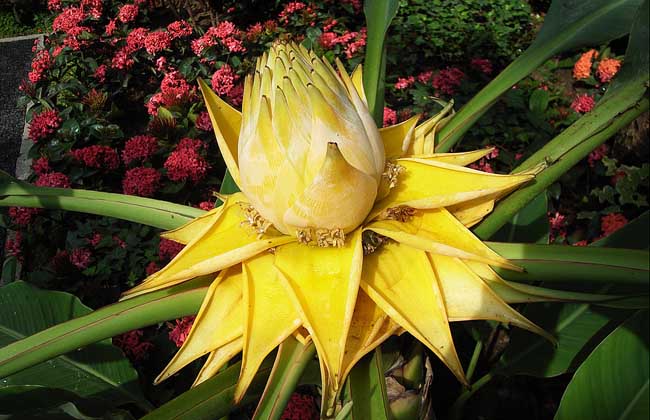
Musella lasiocarpa, also known as the thousand-petal lotus, ground golden lotus, and Budaojingang, is a plant of the genus Musella in the family Musaceae. It originated in Yunnan, China, and is a specialty flower of our country. It has been designated by Buddhist temples as one of the "Five Trees and Six Flowers," and is also a symbol of goodness and the punishment of evil in Dai literature. It has now been introduced and cultivated in the tropical greenhouse of the Beijing Botanical Garden. Let's take a look at the cultivation methods for Musella lasiocarpa!
Growth Habits of Musella lasiocarpa
Musella lasiocarpa originated in Yunnan Province, China, and is also distributed in Sichuan Province. It is a specialty flower of our country and is cultivated especially abundantly in Xishuangbanna. In northern regions, it is only suitable for pot cultivation. It prefers ample sunlight and warmth; at low temperatures below 0°C, the aboveground parts will freeze. It prefers fertile, loose soil. It is easy to transplant, mostly growing on mountain slopes or planted in courtyards, at an altitude of 1500-2500 m.
Cultivation Value of Musella lasiocarpa
1. Landscaping: When Musella lasiocarpa blooms, it looks like a golden lotus surging out of the ground, and the landscape is very magnificent. In courtyards, it is suitable for planting beside windows, wall corners, and rockery stones, or for planting in masses, and it is also suitable for pot cultivation as an ornamental.
2. Medicinal: The flowers of Musella lasiocarpa can be used as medicine and have an astringent and hemostatic effect. They treat leucorrhea, red flooding, and lower intestinal bleeding, and the stem juice is used to relieve alcohol intoxication and monkshood poisoning.
Cultivation Methods for Musella lasiocarpa
1. Propagation: Musella lasiocarpa is mainly propagated by division. In early spring or autumn, small plants grown from root tillers are cut from the mother plant together with their stolons and planted separately. It can also be propagated by sowing seeds.
2. Watering: In the warm regions of southern China, Musella lasiocarpa is often cultivated in the open field. After division and planting in spring and autumn, attention should be paid to watering to keep the soil moist. In the dry season, it should be watered appropriately, and in the rainy season, drainage should be timely.
3. Fertilizing: In early spring and late autumn, apply decomposed organic fertilizer in trenches around the plant of Musella lasiocarpa, and bank fertile soil at the base of the pseudostem. During the vigorous growth period, apply appropriate topdressing to promote growth and flowering.
4. Pruning: After flowering, the aboveground pseudostem of Musella lasiocarpa gradually dies. It should be cut down in time to facilitate new growth the following year.
5. Temperature: In cold regions, Musella lasiocarpa is best cultivated in a greenhouse, and the overwintering temperature should not be lower than 1°C.
6. Pests: When cultivated indoors in the north, if ventilation is poor, it is easily harmed by scale insects, which can be controlled by spraying with a 1000-fold dilution of 40% omethoate emulsifiable concentrate.