What are the cultivation methods and precautions for the fuchsia?
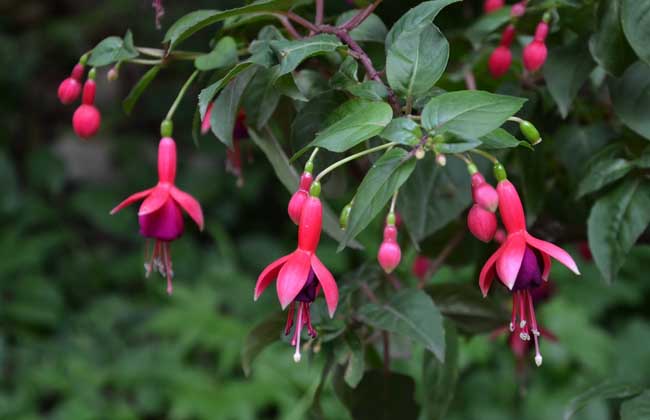
The fuchsia is also known as bell flower, hanging golden bell, and pendant begonia, among other names. It is a perennial herbaceous flowering plant of the genus Fuchsia in the family Onagraceae. There are many varieties, with the main flower colors being red, purple, and white. Although it is delicate and beautiful, it cannot withstand the scorching sun of hot summers, so care must be taken during cultivation. Let's take a look at the cultivation methods and precautions for the fuchsia below!
Growth Habits of the Fuchsia
The fuchsia is a horticultural hybrid artificially bred from Central American material. It prefers a cool, moist climate environment, with an optimal growth temperature of 10-25°C. In winter, it requires ample sunlight, and in summer, it needs a semi-shaded environment. When summer temperatures exceed 38°C, its metabolism slows down and growth stagnates, often resulting in leaf drop and root rot. If effective measures are not taken, the entire plant may die.
Propagation Methods for the Fuchsia
1. Cutting propagation: Softwood cuttings are usually taken from current-year branches in late spring or early autumn, or hardwood cuttings from previous-year branches in early spring. The material used for cuttings, such as nutrient soil, river sand, or peat soil, can also be medium-coarse river sand, but it must be rinsed several times with clean water before use. Sea sand and river sand from saline-alkali areas should not be used, as they are unsuitable for the growth of flowering plants.
2. Layering propagation: Select a robust branch and remove a ring of bark from about 15-30 cm below the tip, with the wound width being about 1 cm and the depth just enough to remove the epidermis. Cut a piece of plastic film 10-20 cm long and 5-8 cm wide, place some moistened garden soil on it, and wrap it around the girdled area like bandaging a wound. Tie the top and bottom ends of the film tightly, leaving the middle bulging. Roots will form in about four to six weeks. After rooting, cut off the branch together with the roots, and it becomes a new plant.
Transplanting Methods for the Fuchsia
1. When potting small seedlings or repotting large plants that have been grown for several years, first place a 2-3 cm thick layer of coarse-grained substrate at the bottom of the pot as a drainage layer. Sprinkle a layer of fully decomposed organic fertilizer on top as a base fertilizer, about 1-2 cm thick. Then cover with a thin layer of substrate, about 1-2 cm thick, and place the plant in, so as to separate the fertilizer from the roots and avoid burning the roots.
2. The substrate for potting can be one of the following: garden soil : cinder = 3:1, or garden soil : medium-coarse river sand : sawdust (mushroom residue) = 4:1:2, or one of paddy soil, pond mud, or leaf mold. After potting, water thoroughly once and place in a shaded environment for one week of care. When transplanting small seedlings, first dig the planting hole, sprinkle a layer of organic fertilizer at the bottom of the hole as a base fertilizer, about 4-6 cm thick, then cover with a layer of soil and place the seedling in, so as to separate the fertilizer from the roots and avoid burning the roots.
Cultivation Methods for the Fuchsia
1. Soil: The fuchsia prefers loose, well-drained sandy loam.
2. Water: Water the fuchsia once every 2-3 days in winter and during the rainy season, once a day in autumn and on sunny days, and control water during the semi-dormant state in summer to prevent leaf drop and root rot.
3. Sunlight: The fuchsia prefers a sunny environment. Insufficient sunlight tends to cause leggy growth, resulting in reduced flowering.
4. Fertilizer: Apply sufficient organic fertilizer before planting the fuchsia, control nitrogen fertilizer during the early growth stage to prevent leggy growth, and increase phosphorus and potassium fertilizer during the flowering period.
5. Temperature: The optimal growth temperature for the fuchsia is 15-25°C. It is sensitive to hot summer temperatures; when the temperature exceeds 30°C, it enters a semi-dormant state. In winter, the temperature must not drop below 5°C.
Precautions for the Fuchsia
1. Fertilizer application: Apply sufficient organic fertilizer before planting the fuchsia, control nitrogen fertilizer during the early growth stage to prevent leggy growth, and increase phosphorus and potassium fertilizer during the flowering period.
2. Reasonable watering: Water the fuchsia once every 2-3 days in winter and during the rainy season, once a day in autumn and on sunny days, and control water during the semi-dormant state in summer to prevent leaf drop and root rot.
3. Reasonable pruning: Prune away all thin, weak branches and withered yellow branches of the fuchsia, and shorten all remaining branches. The length left depends on aesthetics, and the entire plant should be coordinated.
4. Pot soil replacement: Repotting and soil changing for the fuchsia - the fuchsia grows quickly and requires ample nutrients, so the pot soil should be humus-rich sandy loam. Also add 20-30% fully decomposed livestock manure. During the peak growing season, apply liquid fertilizer as a top dressing. In the first 3 years, repot and change the soil every spring to replenish nutrients.
Summer Care for the Fuchsia
1. Avoiding heat and providing shade: In summer, if the temperature exceeds 30°C, avoid intense direct sunlight. During the day, move the potted plant to a cool, ventilated place under the balcony, and move it back to the balcony after sunset (preferably placed under a shade canopy or tree shade). Move the potted plant from the south-facing balcony to the north-facing balcony in advance to avoid sunlight. Place the potted plant in a larger bamboo basket or cardboard box, and fill the surrounding area with soft potting soil to prevent the flower pot from being directly scorched by sunlight.
2. Increasing humidity and lowering temperature: Place half a brick or a whole brick in a container, pour clean water into the container (the water should be higher than the brick surface), and place the potted plant on the brick for long-term cooling. Move the potted plant to a ventilated, light-shaded place downstairs, dig a small pit in the ground, bury the potted plant in the soil, and wait until autumn to place the potted plant indoors. Once the potted plant has been heated by the scorching sun, do not water the leaves or the pot before it has cooled down, to prevent uneven hot and cold temperatures that could cause unexpected damage. During the heat prevention and cooling period, due to reduced light, control watering. Do not water too much or too frequently; just keep the potting soil moist.
3. Preventing rain exposure: Summer is a rainy season. Before it rains, place the potted plant in a rain-sheltered location. If a thunderstorm comes and there is no time to move the pot, promptly pour out the accumulated water in the pot. If the pot is still too wet, sprinkle burnt charcoal fragments on the surface of the potting soil to evaporate some of the excess water. If the water in the potting soil cannot evaporate for a long time and the soil remains too wet, it can also easily lead to leaf drop and root rot, causing the entire plant to die.
Pruning Methods for the Fuchsia
1. Pruning during the flowering period: In the natural environment of northern China, the full bloom period of the fuchsia is from April to July. The last pinching should be stopped in late March of spring. Flowering occurs in mid-to-late April. Because the branch tips continue to bloom and extend, when the flowering branches reach a certain length, the tips should be pinched off, and the new branches that emerge can continue to bloom. During the flowering period, small branches and leaves growing from the center of the plant can be removed at any time to avoid nutrient consumption and facilitate ventilation and light penetration.
2. Pruning after flowering: In July, when the temperature reaches above 30°C, the plant enters a semi-dormant state. The leaves become limp, and at this time heavy pruning should be carried out to reduce nutrient consumption and help it safely pass the summer. All long branches should be shortened, leaving only the main branches, and some old leaves should be removed, placing it in a cool place to pass the summer. If flower buds appear during the summer period, they should also be removed. In September of autumn, new branches will emerge, and the plant shape will be more compact and beautiful.
Disease Control for the Fuchsia
1. Gray mold
[Symptoms] Gray mold occurs during prolonged rainy weather or when too much nitrogen fertilizer is applied or light is insufficient. It mainly harms stems, leaves, and flowers, causing water-soaked spots on the affected parts. If not controlled promptly, they gradually expand into a rotting state covered with gray hairy mycelium, and in severe cases, the plant may die.
[Method] In the early stage of the disease, promptly spray with a 500-fold dilution of 65% zineb or 50% carbendazim or other new fungicides, once every 7-10 days, for 3-4 consecutive sprays. Usually pay attention to ventilation and light to promote good plant growth and improve disease resistance. After the disease occurs, promptly prune and dispose of diseased branches and leaves to reduce the source of infection.
2. Powdery mildew
[Symptoms] Powdery mildew mainly harms stems, leaves, and flower buds. After infection, a layer of white powder appears on the surface. In severe cases, the leaves shrivel and the flowers become smaller.
[Method] Pay attention to ventilation and light, increase the application of phosphorus and potassium fertilizers, and improve plant disease resistance. After the disease occurs, promptly spray with an 800-fold dilution of 70% thiophanate or a 2500-fold dilution of triadimefon or other suitable fungicides, once every 10 days, for 2-3 consecutive sprays.