How to grow Allium giganteum and things to note
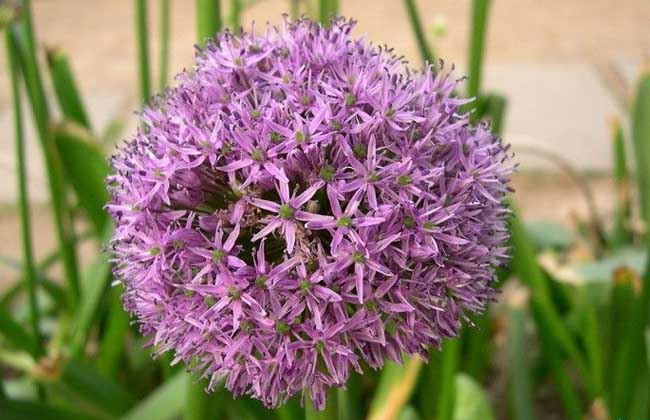
Allium giganteum, also known as Ji'an flower, giant onion, tall onion, huge onion and so on, is a perennial bulbous flower of the genus Allium in the lily family. It originated in Central Asia and the Mediterranean region. In China it is mainly distributed in the northern regions. As a variety for decorating and beautifying flower borders, rock gardens or lawn edges, it has high ornamental value. Let's take a look at how to grow Allium giganteum!
Growth habits of Allium giganteum
Allium giganteum originated in Central Asia and the Mediterranean region, and in China it is mainly concentrated in the northern regions. Its flowering period is spring and summer. It likes a cool environment with plenty of sunlight, and dislikes hot, humid and rainy conditions, continuous cropping and semi-shade. The suitable temperature is 15-25°C. It requires loose, fertile sandy loam and dislikes waterlogging. It is suitable for cultivation in the northern regions of China.
Propagation methods of Allium giganteum
1. Seed propagation: After the seeds of Allium giganteum mature in early July, collect them, dry them in the shade, and store them at a low temperature of 5-7°C. Sow in autumn from September to October, and they will germinate and emerge in March of the following year. In summer the aboveground part also withers, forming small bulbs. Seedling plants need about 5 years of cultivation before they can bloom.
2. Division propagation: Bulb division propagation is carried out in summer and autumn. Peel off the daughter bulbs around the main bulb, and choose sandy loam with a low groundwater level, good drainage, and a loose, fertile texture as the cultivation site. Each mother bulb can be divided into 1-3 small bulbs, among which the larger bulbs can bloom in the second year after planting.
How to grow Allium giganteum
1. Allium giganteum is a flower with an extremely low natural multiplication rate of bulbs, but if the flower stalk is removed as early as possible after it appears, so that nutrients are concentrated on the development of the renewal bulb and daughter bulbs, the number of small bulbs can be appropriately increased. In summer the aboveground part dies. The bulbs can be dug out, separated by size, and placed in a ventilated place to overwinter in summer.
2. Allium giganteum is planted after autumn. Those with bulbs reaching more than 3 cm can bloom after planting, while those smaller than 3 cm need to be grown for one year before they can bloom. The bulb multiplication rate of Allium giganteum is high. Allium giganteum likes a cool environment with plenty of sunlight, requires loose, fertile sandy loam, and dislikes waterlogging. It is suitable for cultivation in the northern regions of China.
3. For open-field cultivation of Allium giganteum, choose sandy loam with a low groundwater level, good drainage, and a loose, fertile texture as the cultivation site. The best time to plant the bulbs is from mid-to-late September to early October, with a plant spacing of 20×30 cm. The planting depth is such that the soil covering the bulb is 2-3 times the height of the fresh bulb.
4. After planting Allium giganteum, slightly press the surface of the hole flat, then water. In winter there is no need to cover for cold protection. In March of the following year, when the leaves emerge from the soil, loosen the soil and water in time. Along with liquid topdressing, water once every 10-15 days. Pay attention to intertillage, loosening the soil, and weeding. In places with dry air, appropriately add a small amount of artificial misting or shading, which can ease the yellowing of the leaves in early summer.
5. After the flowers of Allium giganteum, the stems and leaves wither. Dig up the bulbs early before the rainy season arrives, so as to avoid rotting after rain. Place them in a ventilated and dry place to air-dry, then put them away, spread them out in a ventilated indoor place for storage, and wait until September-October to plant. The planting site should not be continuously cropped. Pay attention to applying decomposed organic fertilizer. Summers are rainy, so drainage must be timely. Allium giganteum is named for its huge inflorescence.