A Detailed Guide to Growing the Succulent Echeveria purpusorum
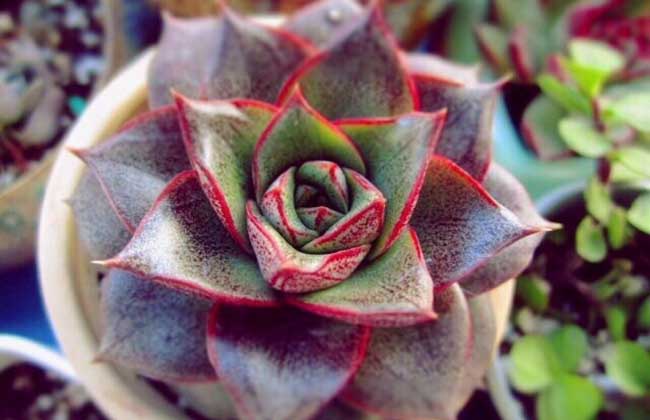
Echeveria purpusorum, also known as the colored stone lotus, is a succulent in the Crassulaceae family, Echeveria genus, with high ornamental value. The Echeveria purpusorum commonly seen in China are all hybrid 'Dionysos'; propagating by leaf cuttings lets you watch a single leaf sprout and grow into a plant. The whole process is very interesting, but the growth rate is too slow, so leaf propagation is not recommended. Let's take a look together at how to grow Echeveria purpusorum!
The Growth Habits of Echeveria purpusorum
The fleshy leaves of Echeveria purpusorum are arranged in a tight rosette. The leaves are broadly ovate to scattered triangular-ovate, with a raised keel-shaped back. Its plant form is unusual, closely resembling a lotus flower. It likes a warm, well-ventilated environment. For cultivation, use fertile, well-drained sandy soil. During the growing season it requires a certain amount of air humidity, but the soil does not need to be overly wet. In winter, water sparingly; it can tolerate low temperatures of 5°C.
Propagation Methods for Echeveria purpusorum
Propagation of Echeveria purpusorum is generally done by beheading to produce offsets for cuttings, or by leaf cuttings. The beheaded plant can be directly stuck into dry gritty soil, and once it has rooted, a small amount of water can be given. Echeveria purpusorum is a very easy-to-grow variety. For the leaf cutting method, take a complete, plump leaf, place it in a cool, shaded spot to let the wound dry, then place it on slightly moist soil. It will slowly grow roots and then sprout. The process takes a while, but you can get many small side shoots; once the side shoots grow larger, remove them and plant them as cuttings.
How to Grow Echeveria purpusorum
1. Soil: Like other Echeveria succulents, Echeveria purpusorum prefers loose, breathable soil. The pot used for planting does not need to be too large either; one equal to or slightly smaller than the size of the plant's crown will do.
2. Light: The most important factor in growing Echeveria purpusorum is sufficient light. If there is not enough light, the leaves will become leggy and the color at the leaf edges will fade. Conversely, if there is plenty of light and a large temperature difference, its appearance will become more attractive. However, with sufficient light you must get the degree right.
3. Watering: During the growing season, Echeveria purpusorum just needs the soil kept slightly on the moist side. Remember not to let water accumulate. In summer, because of dormancy, you need to control water, improve ventilation and lower the temperature. This does not mean giving no water at all; you can water just a little to keep the potting soil slightly moist. In winter, because conditions vary from place to place, some with heating and some without, watering can be done flexibly. When the temperature is below 5°C, water should be cut off.
4. Getting Through Summer: When the summer temperature reaches 30 degrees, appropriate shading should be provided, ventilation strengthened and watering restrained. At the same time, prevent rain and water from flowing into the leaf axils during watering, which can cause the leaves to yellow and rot.
5. Overwintering: When the winter temperature is below 5°C, watering should be controlled. If it drops even lower, the plant should be moved indoors to overwinter, choosing a sunny indoor spot as much as possible.