How to grow Sedum sarmentosum? Master these cultivation methods
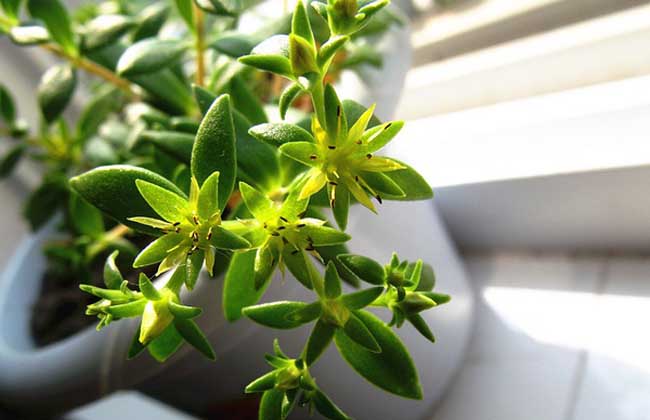
The excellent traits of Sedum sarmentosum as a lawn grass and its tolerance of extensive management make it worth wide promotion and application in urban landscape projects such as roof greening, ground cover, slope protection, flower beds, and hanging baskets. It can also serve as a dedicated lawn grass for roof greening in northern regions, be planted as courtyard ground cover, or be hung indoors for appreciation. Let us take a look below at the cultivation methods for Sedum sarmentosum!
Growth habits of Sedum sarmentosum
Sedum sarmentosum prefers warm, humid, semi-shaded environments. It has strong adaptability, is relatively drought-tolerant and cold-tolerant, and is not particular about soil, growing best in loose sandy loam. It is not strict about light requirements; generally it is suitable for growing under moderate light conditions, and it also tolerates weak light. The optimal growth temperature is 15-25°C, and the overwintering temperature is 5°C.
Propagation methods for Sedum sarmentosum
Sedum sarmentosum can be propagated by seed or by vegetative propagation, namely by stem cuttings, division, or layering. It roots very easily. Division or cuttings are usually used. Division is best done in early spring, while cuttings can be taken at any time. When taking cuttings, cut the creeping stems into small sections of 3 to 5 cm, then insert them into a pre-prepared cutting bed. After inserting, spray and water thoroughly, and keep the soil in the cutting bed moist. At a temperature of 20°C to 25°C, roots will form in 10 to 15 days. When the young roots change from white to yellow-brown, begin transplanting. For ground planting, shade with reed curtains for 3 to 5 days; for potted plants, place them under a cool shed to recover for 3 to 5 days, then move them to a sunny spot for cultivation.
Cultivation methods for Sedum sarmentosum
1. Soil: Sedum sarmentosum is not particular about soil. Garden soil, neutral soil, and sandy loam can all support its growth. It has extremely strong vitality, and its stems can take root as soon as they touch the ground. It dislikes barren soil, where it shows signs of weak growth.
2. Fertilizing: When planting Sedum sarmentosum, an appropriate amount of organic fertilizer must be applied. Crushed cottonseed cake, sesame paste residue, or dried chicken manure are all suitable. During the growth process of Sedum sarmentosum, apply a small amount of compound chemical fertilizer once every half month.
3. Temperature: The suitable growth temperature for Sedum sarmentosum is 15°C to 28°C.
4. Light: Sedum sarmentosum dislikes strong light environments. Under strong light, its leaves show yellowing. It grows well under certain shaded conditions.
5. Watering: Sedum sarmentosum grows quickly and has relatively high water requirements. After fertilizing, immediately water with clear water to prevent the fertilizer from burning the stems, leaves, or roots. The soil must not become waterlogged.
6. Disease prevention: Common diseases of Sedum sarmentosum include gray mold, anthracnose, and powdery mildew. When disease occurs, alternately spray 50% carbendazim wettable powder at 800 times dilution, 80% zineb at 500 times dilution, and 75% chlorothalonil 500 solution.