How to grow the 'First Love' succulent? A detailed guide to cultivation methods
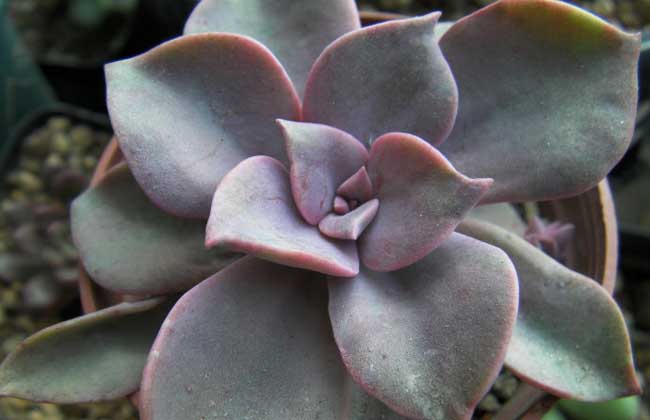
The 'First Love' succulent is one of the classic varieties of Crassulaceae succulents, a small to medium-sized perennial herbaceous or subshrub variety, hybridized from Graptopetalum paraguayense and some Echeveria species. Because it is relatively easy to care for and propagate, and because of the romantic pink tones of its leaves, it is widely favored by succulent enthusiasts. Let's take a look below at how to grow the 'First Love' succulent!
Growth habits of the 'First Love' succulent
The leaves of the 'First Love' succulent are arranged loosely in a rosette, with a waxy white powdery bloom, spoon-shaped leaves that are flat and slightly concave with upturned tips. Its appearance varies greatly under different lighting conditions: when grown outdoors (full sun) it is pink (possibly with a slight orange-yellow tone), while when grown indoors it is blue-green. The flowers are pale yellow with red spots on the inner side. Older plants will sprout lateral buds from the base, becoming clustering plants. It prefers a sunny, warm, dry, and well-ventilated environment, is drought-tolerant, cold-tolerant, and tolerates partial shade. Its main growing seasons are spring and autumn, with no obvious dormant period.
How do you propagate the 'First Love' succulent?
The propagation methods for the 'First Love' succulent generally include division, cuttings, and sowing. Beheading and taking cuttings is the easiest way to survive, and it will grow small lateral buds. If you like multi-headed plants you can keep it as is; if you like single-headed plants you can cut off the head, and a healthier one can survive on its own. The 'First Love' succulent sprouts best, at any time of year; even a rice-grain-sized leaf that drops off can grow into a large seedling. Do not water before the old leaves shrivel; just place them on the soil and avoid direct sunlight.
How do you grow the 'First Love' succulent?
1. Soil mix: For growing the 'First Love' succulent, the soil mix can be coal cinder and river sand mixed with peat and granular soil (kanuma soil, akadama soil, etc.). Spread clean river sand or granules on the soil surface, with breathability as the priority.
2. Sunlight: The 'First Love' succulent needs to receive sufficient sunlight for the leaf color to be vivid, the plant shape to be more compact and attractive, and the leaves to be thick. Too little sunlight causes leggy growth: pale leaf color, loosely arranged leaves, stretched-out spacing between leaves, and thinner leaves. Apart from paying attention to proper shading in summer, it can be in full sun in all other seasons.
3. Watering: The 'First Love' succulent is generally watered only after the soil has dried out. Although the leaves do not easily lose their powdery bloom from contact with water, if water remains in the center of the leaves for too long, it can easily cause rot.
4. Fertilizing: When growing the 'First Love' succulent, a slow-release fertilizer can be applied once each quarter.
5. Repotting: The 'First Love' succulent is a small to medium-sized plant. Depending on its growth state, it must be repotted once every 1 to 2 years. The pot diameter can be 1 to 2 cun larger than the plant diameter, which can promote the plant's growth.
6. Summer: Once the temperature rises above 35 degrees in summer, shade it with a shade net, then gradually cut off water. During the entire summer dormant period, give little or no water. When the temperature drops in mid-September, watering can resume. A 'First Love' that has adapted to a sunroom can still grow normally in summer, with dormancy not very obvious.
7. Winter: In winter, if the temperature can be kept above 0 degrees, you can still give water; below 0 degrees you must cut off water, otherwise it is prone to frost damage. Although winter is cold, you should not go the whole winter without giving any water at all; at appropriate times also give a little water slightly at the base of the plant. Never mist or give a large amount of water. After temperatures rise in spring, you can gradually resume normal watering.