How to plant Catharanthus roseus seeds? Detailed explanation of the sowing method
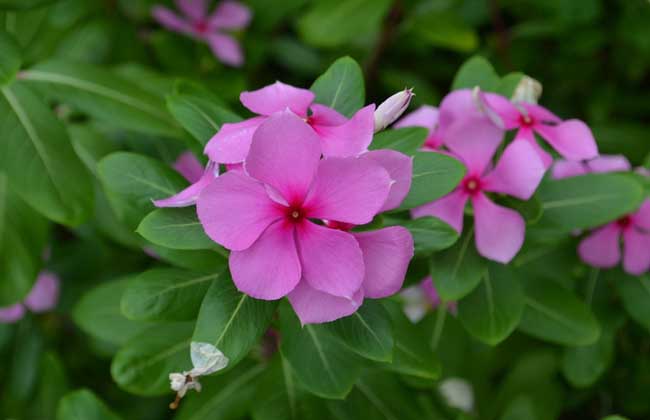
Catharanthus roseus, also known as golden marigold grass, four-season spring, daily renewal, goose-head red, thirty-thousand flowers and so on, is a subshrub plant of the genus Catharanthus in the Apocynaceae family. Multiple varieties have been bred in Taiwan, China, with the trend of breeding toward larger flowers. It is often used for potted plants and planter boxes for ornamental purposes. The whole plant can be used as medicine to relieve pain, reduce inflammation, aid sleep, promote bowel movements and induce diuresis, etc. Now let us take a look at how to plant Catharanthus roseus seeds!
Seed collection time
The fruits of Catharanthus roseus mature at different times because of different flowering times, so seeds must be collected as they ripen. After the fruit matures and its color turns black, the skin easily splits open and the seeds are lost, so seeds must be collected in time. When the fruit skin is seen turning yellow and the black seeds inside can be faintly seen, it is time to harvest.
Sowing time
The suitable temperature for Catharanthus roseus seed germination is 20-25°C. It is usually sown and propagated from March to May, and is mostly grown as an annual. To make it bloom earlier, it can be sown and raised as seedlings in a greenhouse in early spring, given a 20°C environment, and moved to open-field cultivation after the weather warms up.
Seedbed preparation
The seedbed for Catharanthus roseus should be chosen in a place with high, dry terrain, facing south and sunny, and with good drainage. The substrate is best prepared with peat + perlite at a ratio of 3:1. Leaf mold can also be used. Water thoroughly with a 500-600 times dilution of carbendazim solution. After it dries slightly, loosen and level the soil, and make a seedbed 1.2 m wide.
Sowing technique
Broadcast sow Catharanthus roseus at about 1000 seeds per square meter. After sowing, cover with fine, thin sandy soil, do not let the seeds be directly exposed to light, water thoroughly with a fine watering can, and cover with plastic film or straw curtains to keep the soil moist. Seedlings can emerge in 7-10 days. After emergence, remove the plastic film or straw curtains and gradually increase light. The seedlings grow slowly at first, and grow faster after the temperature rises, so thinning should be done in time. To prevent damping-off of Catharanthus roseus, spray-water once a week with an 800 times dilution of chlorothalonil or thiophanate-methyl, for 2-3 consecutive weeks.