What are the cultivation methods for Madagascar periwinkle?
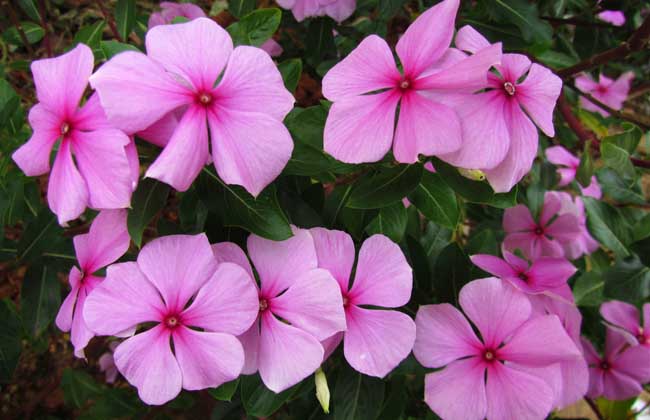
Madagascar periwinkle, also known as riri chun, riri cao, riri xin, sanwan hua, sishi chun, shizhong hua, yanlai hong, etc., is a subshrub plant of the genus Catharanthus in the Apocynaceae family. It has high ornamental value, but the whole plant is toxic and requires careful attention. After accidental ingestion, it can cause symptoms such as decreased white blood cells, decreased platelets, muscle weakness, and paralysis of the limbs. Let us take a look at the cultivation methods and precautions for Madagascar periwinkle!
Growth habits of Madagascar periwinkle
Madagascar periwinkle is native to the Mediterranean coast, India, and tropical America. Its cultivation history in China is not long, mainly cultivated in areas south of the Yangtze River. It is more commonly cultivated in Guangdong, Guangxi, Yunnan and other provinces (autonomous regions), used for potted plants and planting troughs for ornamentation. It likes high temperature and high humidity, tolerates partial shade, and is not resistant to severe cold. The most suitable temperature is 20-33°C. It likes sunlight, avoids wetness and fears waterlogging. It can be cultivated in general soil, but saline-alkali soil is not suitable. Sandy soil or soil rich in humus with good drainage and ventilation is best. Its flowering period and fruiting period are almost year-round.
Cutting propagation of Madagascar periwinkle
Madagascar periwinkle cuttings are mostly taken from April to July. When propagating by cuttings, healthy, pest-free young branches from mature plants should be selected as cuttings. Generally, young branches 10-12 cm long from the top of the plant are selected, and the cutting length is preferably 5-7 cm. The cutting substrate uses a mixed substrate of plain sand, vermiculite, and peat. Wrap a small ball of mud around the base of the cutting, insert it into a cold frame at a room temperature of 20-24°C. Roots form after about 20 days. After the cuttings take root and survive, they can be transplanted into pots. Because seedlings propagated by cuttings grow less vigorously than seed-grown seedlings, they are rarely used in cultivation.
Seed propagation of Madagascar periwinkle
1. Seed collection time: The fruits of Madagascar periwinkle mature at different times because of different flowering times, so seeds should be collected as they mature. After the fruit matures and turns black, the skin easily splits open and the seeds are lost, so seeds need to be collected in time. When the fruit skin turns yellow and the black seeds inside can be faintly seen, it is time to harvest.
2. Sowing time: The suitable temperature for Madagascar periwinkle seed germination is 20-25°C. It is usually sown and propagated from March to May, mostly cultivated as an annual. To make it bloom earlier, it can be sown in a greenhouse in early spring for seedlings at 20°C, and moved to open-field cultivation when the weather warms up in spring.
3. Seedbed preparation: The seedbed for Madagascar periwinkle should be selected in a place with high, well-drained terrain facing south and receiving sunlight, with good drainage. The substrate is best prepared with peat + perlite at a ratio of 3:1. Leaf mold can also be used. Water thoroughly with 500-600 times diluted carbendazim solution. After it dries slightly, loosen and level the soil, and make a seedbed 1.2 m wide.
4. Sowing technique: Broadcast sow Madagascar periwinkle at about 1000 seeds per square meter. After sowing, cover with fine thin sandy soil, do not let the seeds be directly exposed to light, water sufficiently with a fine watering can, and cover with plastic film or straw curtains to keep the soil moist. Seedlings emerge in 7-10 days. After emergence, remove the plastic film or straw curtains and gradually increase light. During the seedling stage, growth is slow; after the temperature rises, growth becomes faster, so thinning should be done in time. To prevent damping-off disease of Madagascar periwinkle, spray with 800 times diluted chlorothalonil or thiophanate-methyl once a week for 2-3 consecutive weeks.
Cultivation methods for Madagascar periwinkle
1. Soil: Madagascar periwinkle prefers fertile and well-drained soil and tolerates poor soil, but must not be alkaline-leaning. In compacted, poorly aerated clayey soil, the plant grows poorly, the leaves turn yellow, and it does not bloom.
2. Sunlight: Madagascar periwinkle is a light-loving plant. During the growing period, it must have sufficient sunlight; the leaves are then dark green and glossy, and the flower colors are vivid. If it grows in shade for a long time, the leaves turn yellow and fall off.
3. Temperature: Madagascar periwinkle likes a warm, slightly dry, and sunny environment. The suitable growth temperature is 18-24°C from March to July, and 13-18°C from September to March of the following year. The winter temperature should not be lower than 10°C.
4. Watering: Madagascar periwinkle avoids wetness and fears waterlogging. Do not water the pot soil too much; excessive moisture affects growth and development. Especially for plants overwintering indoors, watering should be strictly controlled, and it is better to keep them dry, otherwise they are very easily damaged by cold. For open-field cultivation, during heavy summer showers, pay attention to timely drainage to avoid waterlogging causing the whole patch to die.
5. Fertilizing: When fertilizing Madagascar periwinkle, every ten days you can apply compound fertilizer and liquid fertilizer alternately. A layer of base fertilizer should also be spread at the bottom of the pot soil as much as possible to ensure the nutrient content of the pot soil.
6. Pests and diseases: The Madagascar periwinkle plant itself is toxic, so it is relatively resistant to pests and diseases. The main diseases during the seedling stage include damping-off and gray mold, and in addition, fertilizer damage and pesticide damage during the seedling stage should be prevented. If they occur, immediately water thoroughly with clean water, strengthen ventilation, and reduce the damage.
7. Pruning: Madagascar periwinkle is an herbaceous plant and is quite suitable for potted cultivation, but care should be taken not to let the plant grow too tall, which would affect indoor decoration and ornamental value. Therefore, after the plant survives in the pot, it should be pinched back several times to promote more branching and more flowering. After flowering, the spent flowers must be cut off.