What are the cultivation methods for Calathea roseopicta?
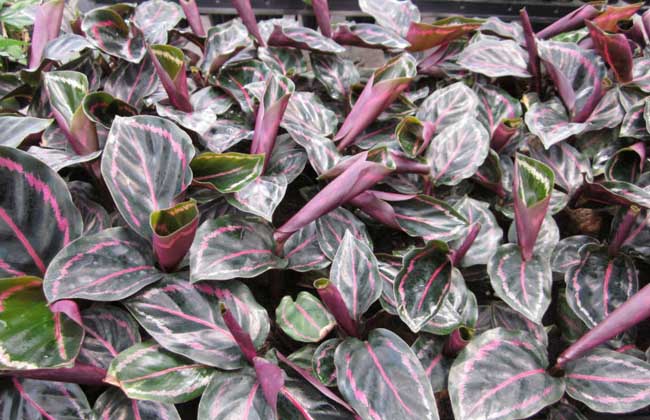
Calathea roseopicta, also known as red rose calathea, red-backed calathea, large peacock calathea, etc., is a perennial evergreen herbaceous foliage plant of the genus Calathea in the family Marantaceae. It is native to Brazil and has been introduced and cultivated in China. Because this plant is shade-tolerant, it is very suitable for indoor decoration and greening in the home, and has high cultivation and ornamental value. Let's take a look at the cultivation methods for Calathea roseopicta!
Growth habits of Calathea roseopicta
Calathea roseopicta prefers a hot and humid environment, and avoids exposure to direct sunlight. It is not heat-tolerant and avoids high temperatures, and is not cold-tolerant. It avoids drought. The suitable growth temperature is 18-25°C. The plant is dwarf and clump-forming, with poor tillering ability. The leaf stalks grow directly on the underground stem, with no main root, so a shallow pot with a wider body should be chosen for pot cultivation. Slightly acidic leaf mold is the most beneficial cultivation substrate for rhizome growth, forming a lush plant.
Propagation methods for Calathea roseopicta
1. Division: Calathea roseopicta is generally propagated by division. Propagation is ideal in spring when the temperature is around 20°C, but as long as the temperature and humidity are suitable, it can also be done year-round. When propagating, use a sharp knife to cut apart the root blocks that bear stems and leaves or leaf buds. For small-scale propagation, the cut root blocks with stems, leaves and leaf buds can be placed directly in clay pots; for large-scale propagation, they should be placed on a seedbed. When the temperature and humidity do not meet the requirements, cover with plastic film, and be sure to make the temperature inside the film reach 20-28°C and the humidity above 80%.
2. Cuttings: For cutting propagation, generally use tender shoot tips. The cuttings are 10-15 cm long. Depending on leaf size, retain one-third or one-half of the leaf. Treat the cuttings with 500 ppm naphthalene acetic acid for 2-3 seconds, or use indoleacetic acid, indolebutyric acid and ABT rooting powder. After treatment, insert the cuttings into the seedbed, preferably with a plant and row spacing of 5×10 cm. Cover with a plastic film arched shed, and manage in the same way as division propagation. Cutting propagation can be carried out at any time when the temperature is not lower than 20°C. The cuttings root in 30-50 days, but the survival rate of cuttings is not as high as that of division propagation, generally around 50%.
Cultivation methods for Calathea roseopicta
1. Soil: Calathea roseopicta prefers well-drained, fertile, loose, slightly acidic leaf mold or culture soil. The potting soil should preferably be made of humus soil, compost plus 1/3 river sand or wood chips, with a pH value of 5.5-7.2.
2. Temperature: The optimal growth temperature for Calathea roseopicta is 20-25°C. In winter, the temperature should not be lower than 15°C. Below 10°C, the above-ground parts gradually die.
3. Light: Calathea roseopicta avoids exposure to direct sunlight. In summer and autumn, shading is required. If the sunlight is too strong, the leaf color tends to look dull and dry; if the light is too weak, the leaves become thin and lusterless, losing their beauty. In winter, sufficient sunlight should be provided.
4. Water: Calathea roseopicta prefers a humid environment. During the high-temperature period in summer and autumn, the potting soil should be kept moist frequently; otherwise, leaf edges will scorch and growth will be poor. In addition to watering once a day, spraying should also be strengthened to keep the relative air humidity at 85-90%.
5. Fertilizer: During the growth period, apply thin fertilizer once a week to Calathea roseopicta, at a concentration equivalent to mixing 3-4 grams of urea per kilogram of water, alternating with 3 grams of urea plus 1 gram of potassium dihydrogen phosphate, or a nitrogen, phosphorus and potassium compound fertilizer of similar concentration. Diluted decomposed cake fertilizer water can also be applied. Avoid applying nitrogen fertilizer alone. Stop fertilizing in winter.
6. Pests and diseases: Calathea roseopicta has few pests and diseases. The main pests are scale insects, whiteflies, etc., which can be killed by spraying with 25% phosmet emulsifiable concentrate at 1000 times dilution or 40% omethoate at 1500 times dilution. Common diseases include leaf spot and rust, which can be prevented and controlled by spraying 2-3 times with 200 times Bordeaux mixture or 50% carbendazim at 1000 times dilution.
7. Overwintering: When the cold winter arrives, in addition to paying attention to heat preservation, watering should be strictly controlled. At this time, overly wet potting soil can easily cause rhizome rot; even if the potting soil is slightly dry, the leaves may wither. When the weather warms up in spring, new leaves will emerge again. When the new leaves begin to sprout, do not water too much either; only as the new leaves increase should the amount of watering be gradually increased.