What is the flower language of cosmos? Let us read its beautiful legend together
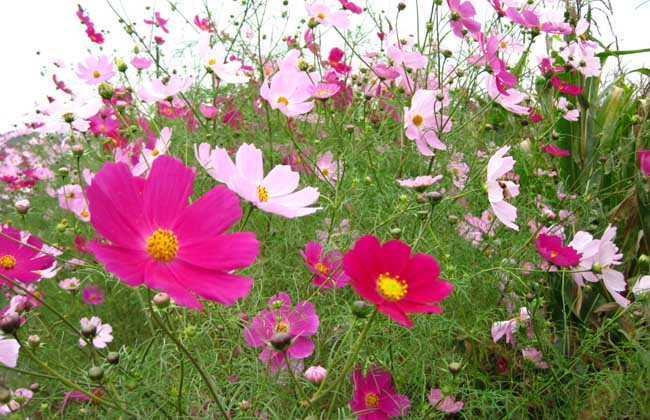
Cosmos is a well-known ornamental plant, also called qiuying, large cosmos, and so on. It is an annual or perennial herbaceous plant of the genus Cosmos in the aster family, native to Mexico in the Americas. It is widely cultivated in China and often grows spontaneously along roadsides, field ridges, and stream banks. In Yunnan and western Sichuan there are large areas of naturalized growth, and its ornamental value is extremely high. Now let us take a look at the flower language and legends of cosmos!
The flower language of cosmos
Cherish the person before your eyes. The flower language of large cosmos is a maiden's true heart, a maiden's pure affection, purity, nobility, freedom, cheerfulness, and eternal happiness. The flower language of white cosmos is purity, the flower language of red large cosmos is passionate love, and the flower language of black large cosmos is that no one can love you like I do, and the end of a romantic love.
The legend of cosmos
The large cosmos princess was the little daughter of the cosmos king. A witch told fortunes and said that she was an eternal loner. This was the strongest curse in the cosmos kingdom, and no one could break this curse. So the large cosmos princess lived alone inside the princess castle.
The large cosmos princess spent a very, very long time alone in the castle. Every day the sun rose and the moon set, and it was always just her alone. Loneliness eroded her heart all the time. Especially at night, because the night was always long and hard to endure, she often sat on the swing in the garden at night and wept alone.
At last, after a very, very long time, a knight from a distant place passed by the princess's castle and saw the large cosmos princess alone. This was a splendid encounter. The knight and the cosmos princess fell in love at first sight, and the two loved each other. The wheel of happiness arrived, and the curse on the large cosmos princess was broken.
Story: Zhang Daren Flower
In 1906, the Guangxu Emperor of the Qing dynasty, Aisin Gioro Zaitian, appointed Zhang Yintang as deputy lieutenant general and sent him to Tibet as the assistant minister for Tibetan affairs to handle Tibetan matters, in order to salvage the dangerous situation in which government orders were not carried out.
After Zhang Yintang entered Tibet in November 1906, he strictly investigated and handled the corrupt official and military systems, vigorously carried out rectification, and personally drafted and submitted the "Nineteen Articles on Governing Tibet" in a telegram to the Qing court. Zhang Yintang's ideas and actions won the appreciation of the court, the local government of Tibet, and both monastic and lay people, and people affectionately called him "Zhang Daren."
Zhang Yintang valued ethnic unity and was even more fond of flowers to the point of obsession. When he entered Tibet, he brought a packet of "cosmos" seeds and gave them separately to the powerful figures and monks of the time, sowing them in monasteries and the courtyards of monastic and lay officials. This flower had extremely strong vitality. Once it set foot on this high and vast land, it quickly spread throughout Tibet. The simple Tibetan people did not know the original name of this flower and only knew that it had been given by Zhang Daren, so they all called the flower he brought "Zhang Daren."