How to grow Glottiphyllum? Detailed guide to cultivation methods and precautions
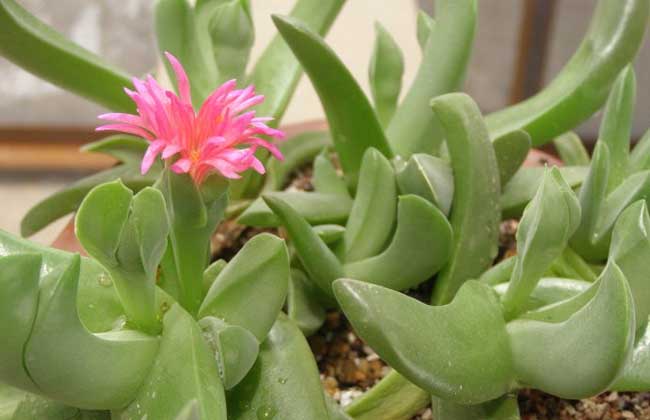
Glottiphyllum is also known as ox-tongue leaf, Buddha's palm, ox-tongue flower, tongue-leaf flower, tongue-leaf daisy, and so on. It is a perennial succulent plant of the genus Glottiphyllum in the family Aizoaceae, native to South Africa where winters are warm, and it is widely cultivated around the world. It is suitable for pot cultivation, placed on desks, windowsills, and tables; small and exquisite, very elegant. Let's take a look at the cultivation methods for Glottiphyllum below!
Cultivation value of Glottiphyllum
The leaves of Glottiphyllum are thick and juicy, emerald green and translucent, shaped like jade, elegant and unique. It blooms in the first month of winter, with golden yellow flowers, dazzling and eye-catching, especiallylovable. Glottiphyllum is suitable for pot cultivation, placed on desks, windowsills, and tables; small and exquisite, very elegant. It can be used to decorate windowsills and beautify balconies. When the stems elongate and the leaf clusters hang below the rim of the pot, if not discarded, they should be hung up for display, thereby compensating for the bare surface of the pot.
Propagation methods for Glottiphyllum
1. Sowing: The sowing period for Glottiphyllum is from late April to mid-May. Sow in pots indoors according to the method for small seeds. At a room temperature of 20-24°C, germination begins after 10 days, and seedlings emerge quickly and uniformly. When the seedlings of ox-tongue palm grow to more than 3 cm, transplant them into small flower pots. During the seedling stage, appropriate shade should be provided, and the potting soil should be kept slightly moist; do not water heavily.
2. Cuttings: For Glottiphyllum plants over 2 years old, the leaves at the base of the stem begin to fall off. At this time, dormant buds at the leaf scars sprout and produce side branches. Cut the side branches from the base, remove a few leaves at the base to expose the stem of the ox-tongue palm, and insert into moist plain sandy soil. After the sandy soil dries, drip a little water, place in a warm room with appropriate shade, and roots will form after 20 days.
Cultivation methods for Glottiphyllum
1. Temperature: Glottiphyllum prefers warmth, and the most suitable temperature for growth is 18-22°C. It is not cold-tolerant, and the overwintering temperature should be maintained above 5°C. It also fears hot and high-temperature climates; above 30°C is unfavorable for plant growth and it enters a semi-dormant state. Measures such as shading, spraying water on the plant and surrounding environment, and enhancing ventilation should be taken to lower the temperature and create a cooler microclimate.
2. Light: Glottiphyllum prefers a semi-shaded environment and avoids intense sunlight exposure. From May to September, shading should be provided, blocking about 50% of sunlight, or the plant should be placed in a location with sufficient scattered light. At other times, full sunlight should be given, especially in spring when it must receive sufficient sunlight. When light is sufficient, the plant is emerald green all over, the leaves are glossy and shiny, and the flowers are numerous and vibrant. When light is insufficient, not only do the leaves become weak, but flower bud differentiation is also difficult and the number of flowers decreases; even if it blooms, the flower color becomes dull and lusterless, affecting its ornamental value.
3. Watering: The thick succulent leaves of Glottiphyllum have well-developed water-storage tissue, so it is very drought-tolerant. Even if the leaves wilt due to drought, it does not matter; as long as some water is given, the softened leaves will perk up again. However, it is not tolerant of waterlogging; overly moist potting soil will cause the plant to grow leggy and reduce flowering, and excessive waterlogging can lead to root rot. During the spring and autumn growing periods, watering should follow "alternating dry and wet, leaning toward dry"; be sure to wait until the potting soil is dry before watering.
4. Fertilizing: Glottiphyllum does not like heavy fertilizer. Spring is the peak period for plant growth and flowering, so a fertilizer combining nitrogen, phosphorus, and potassium should be applied once every half month to promote growth and flowering. In summer, the plant enters a semi-dormant state, and fertilizing should stop. In autumn, the plant enters a period of vigorous growth again, but nitrogen fertilizer should stop being applied, and potassium fertilizer should be increased to prevent excessive autumn growth from affecting the plant's cold resistance. Fertilizing should also stop in winter.
5. Repotting: Glottiphyllum should be repotted once every 2 years or so, usually after flowering in spring. It prefers loose, highly permeable sandy loam soil. The substrate can be made from materials such as leaf mold, garden soil, and coarse sand. When mixing is difficult, more drainage layers should be placed at the bottom of the pot to facilitate drainage. Usually, after the plant has been grown for 3 years, it tends to deteriorate, requiring cuttings or division to ensure the leaves remain emerald green and the flowering is abundant.
6. Disease prevention: The main diseases of Glottiphyllum are leaf spot and rust, which can be controlled by spraying Bordeaux mixture (1:1:100) once every half month. For pest damage, there are scale insects, which can be killed by spraying with 40% omethoate emulsifiable concentrate at 1500 times dilution.