When chopping firewood, don't miss a red orchid if you see one; a single plant can be worth several hundred yuan
Promote Chinese orchid culture, spread orchid knowledge
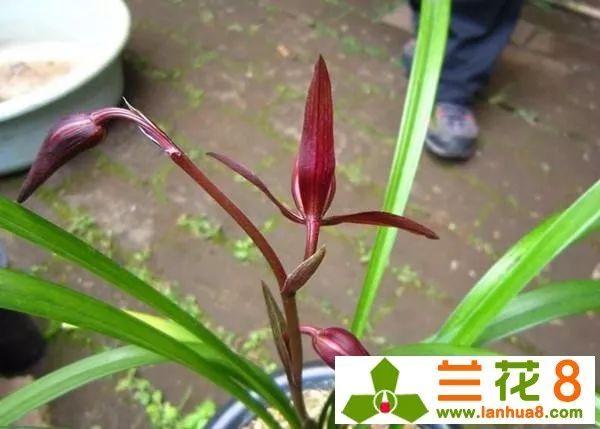
In the mountains of our countryside there are many good things - wild vegetables, wild fruits, Chinese herbal medicines, to say nothing of those. Back when I went into the mountains to chop firewood, I came across a red orchid, and at the time I didn't pay it any mind. After all, there are quite a lot of wild orchids around here, and red ones are often seen too, so I didn't feel it was anything special and left it alone, just took a photo. Later I sent the photo of this red orchid to a friend who knows about orchids, and he told me that a red orchid like this can sell for several hundred yuan per plant.
Hardy orchid (Cymbidium kanran) red flower
According to my friend who knows about orchids, orchids are divided into many kinds. The most common in the mountains is the spring orchid (Cymbidium goeringii); there are more of them in mountain forest areas such as Zhejiang, Sichuan, Guizhou, Hunan, Hubei, Yunnan and Jiangxi. The red flower I found belongs to the hardy orchid (Cymbidium kanran), which is less common in the wild and has rather strict requirements for its growing environment - it only grows in high-altitude, warm and humid deep mountains. Ordinary hardy orchids are blue-green; the one I found is red, and moreover a brilliant color, so it is a rather rare colored flower, and naturally its price rises accordingly, much more expensive than an ordinary hardy orchid.
What is the difference between the hardy orchid and the spring orchid?
The spring orchid's leaves are smaller and the plant is shorter, while the hardy orchid is clearly taller and larger than the spring orchid, especially the broad-leaved hardy orchid, whose leaves are very wide, so it can be told apart at a glance. The flowers are different too: the spring orchid's flowering period is in spring after the New Year, and one flower scape and flower stem bears only one flower, at most two, whereas the hardy orchid flowers in winter, and a single flower stem can bear several to more than ten flowers. Besides the difference in number, the shape of the petals is also clearly different, and easy to identify.
Spring orchid (Cymbidium goeringii)
Hardy orchid (Cymbidium kanran)
What kind of hardy orchid is valuable?
Only hardy orchids that have mutated are valuable - that is, hardy orchids with "art" (yi). These are mainly divided into leaf art and flower art. Leaf art means a mutation appears on the orchid's leaves, for example obvious white or yellow stripes on the leaves, which is called striped art (gaoyi); hardy orchids with striped art are very valuable. Flower art means a mutation appears on the flowers, the most common being an altered flower color, so there are quite a lot of colored-flower hardy orchids and they are relatively easy to come across. Among them, pure white, pure black and pure yellow hardy orchid colored flowers are the most valuable; red flowers, purple flowers and multi-colored flowers rank lower, but those with high purity and brilliant color are also quite good. In addition, hardy orchids also include suxin (plain-heart), petal-type, butterfly flowers, strange flowers and so on, all of which are relatively high-value art orchids.
Hardy orchid leaf art, striped art
Hardy orchid butterfly flower
Friendly reminder:
Although many orchids are relatively valuable, few people come across them; most are just ordinary orchids with no value, which nobody in the city will buy, so even if you dig them up you can't sell them. Occasionally someone finds a sky-high-priced orchid worth thousands or tens of thousands, but that is also good luck, not much more likely than winning the lottery, so I don't recommend everyone blindly digging up orchids in the mountains. If while working in the mountains you happen to come across a valuable orchid, don't miss it either - dig it up and grow it yourself at home, and if you meet a buyer who knows his stuff, you can sell it too.
Orchid Bar, your good teacher on the road to growing orchids